64307 7. Is Jesus Relevant Today?

According to surveys, most people today are living without real meaning and purpose. They attempt to fill this need for meaning with money, pleasure or popularity.

Even those who achieve success find life hollow. Although Madonna achieved superstar status, she confessed, “There were many years when I thought fame, fortune, and public approval would bring me happiness. But one day you wake up and realize they don’t.”1

So, what is the answer to our need for meaning and purpose? If it isn’t in fame, fortune or success, what is it?

Two thousand years ago Jesus Christ said we were created for a relationship with God, and he claimed to be the only one who can give our lives true meaning and eternal life (John 14:6; John 10:10). But are Jesus’ words relevant today? To find out, let’s look at what he said about life’s most important questions:

  • “Who am I?”
  • “Why am I here?”
  • “Where am I going after I die?”

So, what did he say about God, about us, and about where we go after this life ends?

What Did Jesus Say About God?

God Is Relational

Most so-called “gods” of other religions are impersonal. The God of whom Jesus spoke is not like the impersonal Force in Star Wars. Neither is he some great unsympathetic bogeyman in the sky, delighting in making our lives miserable.

On the contrary, Jesus taught that God is relational like us, but even more so. He thinks. He hears. He communicates in language we can understand. Jesus told us and showed us what God is like. According to Jesus, God knows each of us intimately and personally, and thinks about us continually. Let’s look at other things Jesus told us about God.

God Is Loving

Jesus told us that God loves us unconditionally. He taught that God’s love is radically different from ours in that it is not based upon attraction or performance. It is totally sacrificial and unselfish. That means God loves everyone the same regardless of race, sex, social status, financial success, or intelligence. Jesus demonstrated God’s love wherever he went, healing the sick and reaching out to the hurting and poor.

 Jesus compared God’s love with the love of a perfect father. A good father wants the best for his children, sacrifices for them, and provides for them. But in their best interests, he also disciplines them.

Jesus illustrates God’s heart of love with a story about a rebellious son who rejected his father’s advice about life and what is important. Arrogant and self-willed, the son wanted to quit working and “live it up.” Rather than waiting until his father was ready to give him his inheritance, he began insisting that his father give it to him early.

In Jesus’ story, the father granted his son’s request. But things went very badly for the son. After wasting all his money on sinful living and self-indulgence, the rebellious son became desperate and was so hungry he began working on a pig farm and even eating the pig’s food. Finally, unsure whether his father would accept him back, he took a chance, packed his bag and headed home. He was willing to accept the scorn and even rejection of his father.

While many earthly fathers would be angry and scold their son, Jesus tells us that God’s love isn’t like that. In Jesus’ story, not only did the father welcome him home, but he even ran out to meet him. The repentant son said to him, “Father, I have sinned against heaven and against you. I am no longer worthy to be called your son” (Luke 15:21).

Then, in an amazing act of love and mercy, the father embraced his son and gave him the best family robe to wear and placed a ring on his finger to confirm his love and acceptance. Afterwards he celebrated his son’s return home with a family feast, honoring his son’s return home.

It is noteworthy that even though the father greatly loved his son, he didn’t chase after him. He let the son he loved feel pain and suffer the consequences of his rebellious choice. In a similar way, the Scriptures teach that God’s love will never compromise what is best for us. It will allow us to suffer the consequences of our own wrong choices and rebellion. However, like the father in Jesus’ story, God will always welcome us back if we are willing to return in humility.

God’s unconditional love is best expressed in John 3:16:

“For God so loved the world that He gave His only Son, that whosoever believes in Him will not perish, but have everlasting life.”

Jesus also taught that God will never compromise his character. Character is who we are down deep. It is our essence from which all our thoughts and actions stem. So, what is God’s character like—down deep?

God Is Holy

Throughout the Scriptures (nearly 600 times), God is spoken of as “holy.” Holy means that God’s character is morally pure and perfect in every way. Unblemished. This means that God never entertains a thought that is impure or inconsistent with his moral excellence.

God’s holiness means that evil cannot exist in his presence. Since evil is the opposite of his nature, He hates it. It’s like pollution to him.

But if God is holy and abhors evil, why didn’t he make our character like his? Why are there child molesters, murderers, rapists, and perverts? And why do we struggle so with our own moral choices? That brings us to the next part of our quest for meaning. What did Jesus say about us?

What Did Jesus Say About Us?

Made For a Relationship with God

If you were to read through the New Testament you would discover that Jesus continually speaks of our immense value to God, telling us that God created us to be his special children.

God’s Word tells us that before the universe was created, God planned to create us and adopt us into his family. (Ephesians 1:1-7) Not only did he plan to adopt his children, but he has an incredible inheritance for them. Like the father’s heart in Jesus’ story about the prodigal son, God wants to lavish on us an inheritance of blessing and royal privilege. In his eyes, we are beloved.

Freedom To Choose

God could have made us like robots, programmed to love and obey him by a set of algorithms. But real love needs to be a free choice. To make freely exchanged love possible, God created human beings with a unique capacity: free will. Freedom to choose allows us to love and obey God, but it also allows us to reject God’s love and rebel against him.

Rebellion Against God’s Moral Laws

Former skeptic C.S. Lewis reasoned that although we are internally programmed with a desire to know God, we rebel against it from the moment we are born.2 Lewis also began to examine his own motives, which led him to the discovery that he instinctively knew right from wrong.

We all experience this sense of right and wrong when we read of Hitler killing six million Jews, or a hero sacrificing his or her life for someone. We instinctively know it is wrong to lie and cheat. Lewis wondered where this sense of right and wrong came from. This recognition that we are programmed with an inner moral law led the former atheist to the conclusion there must be a moral “Lawgiver.”

Indeed, according to both Jesus and the Scriptures, God has given us a moral law to obey. And not only have we turned our backs on a relationship with him, we also have broken these moral laws that God established. Most of us know some of The Ten Commandments: “Don’t lie, steal, murder, commit adultery,” etc. Jesus summarized them by saying we should love God with all our heart and our neighbor as ourselves. Sin, therefore, is not only the wrong that we do in breaking the law, but also our failure to do what is right.

The result is that our sins have broken God’s intended relationship with us. The result of this rebellion against God has led to a world plagued by greed, hatred, war, rape and rampant crime.

Our Sins Have Separated Us from God’s Love

Although God loves us beyond comprehension, our rebellion (sin) has created a wall of separation between him and us (see Isaiah 59:2). In the Scriptures, “separation” means spiritual death. And spiritual death means being completely separated from the light and life of God.

“But wait a minute,” you might say. “Didn’t God know all of that before he made us? Why didn’t he see that his plan was doomed for failure?”

Of course, an all-knowing God would realize that we would rebel and sin. In fact, it is our failure that makes his plan so marvelous and mind-blowing. This brings us to the reason that God came to Earth in human form. And even more incredible—the remarkable reason for Jesus’ death on the cross.

What Did Jesus Say About Himself?

God’s Perfect Solution

During his three years of public ministry, Jesus taught us how to live in accordance with God’s will. He also performed many miracles, even raising the dead. But he stated that his primary mission was to save us from our sins. He told his followers, “The son of man came to seek and save the lost” (Luke 19:10).

Jesus claimed to be the promised Messiah who would take our iniquity upon himself. The prophet Isaiah had written about the Messiah 700 years earlier, giving us several clues regarding his identity. But the clue most difficult to grasp is that the Messiah would be both man and God! Isaiah wrote,

For unto us a child is born, unto us a son is given. And his name shall be called…Mighty God, Everlasting Father, Prince of Peace (Isaiah 9:6).

The ancient prophets had foretold that the Messiah would become God’s perfect sin offering, satisfying his justice. This perfect man would qualify to die for us (Isaiah 53:6). According to the New Testament authors, the only reason Jesus was qualified to die for the rest of us is because, as God, he lived a morally perfect life and wasn’t subject to sin’s judgment.

It’s difficult to understand how Jesus’ death paid for our sins. Perhaps a judicial analogy might clarify how Jesus solves the dilemma of reconciling God’s perfect love and justice.

Imagine entering a courtroom, guilty of murder. As you approach the bench, you realize that the judge is your father. Knowing that he loves you, you immediately begin to plead, “Dad, just let me go!”

To which he responds, “I love you, son, but I’m a judge. I can’t simply let you go.”

Being both your father and your judge, he is torn. After he tearfully considers both roles, he bangs the gavel down and declares you guilty. Justice cannot be compromised, at least not by a judge. But because he loves you, he steps down from the bench, takes off the robe, and offers to pay the penalty for you. And in fact, he takes your place in the electric chair.

This is the picture painted by the New Testament. God stepped down into human history, in the person of Jesus Christ, died on the cross instead of us, for us. Jesus is not a third-party whipping boy, taking our sins, but rather he is God himself. Put more bluntly, God had two choices: to judge sin in us or to assume the punishment himself. In Christ, he chose the latter.

In other words, God’s perfect justice is completely satisfied by the death of his Son, Jesus Christ. All our sins—no matter how bad they are or have been—are completely paid for by the blood of Christ. As the apostle Paul explains to the Romans, “For the wages of sin is death, but the gracious gift of God is eternal life in Christ Jesus our Lord” (Romans 6:23).

Many wonder, why is Jesus alone able to save us from our sins? Aren’t there others qualified to save us? Although there have been many people and prophets who have lived comparatively good lives. The New Testament tells us, “Jesus is the only One who can save people. No one else in the world is qualified to save us” (John 14:6; Acts 4:12 NCV).

A Gift Undeserved

The biblical term to describe God’s free forgiveness through Christ’s sacrificial death is grace. Whereas mercy saves us from what we deserve, the grace of God also gives us what we don’t deserve. Let’s review for a minute how Christ has done for us what we could not do for ourselves:

  • God loves us and created us for a relationship with himself.3
  • We have the freedom to accept or reject that relationship.4
  • Our sin and rebellion against God have created a wall of separation between us and him.5
  • God has paid our debt in full by Jesus’ death in our place, making eternal life with him possible.6

We now have the picture of God’s plan of the ages coming together, and the reason we were created. But there still is one missing ingredient. According to Jesus and the authors of the New Testament, each of us must respond to Jesus’ offer of forgiveness for our sins. It’s a free gift—he won’t force us to take it.

You Choose the Ending

We continually make choices—what to wear, what to eat, our career, marriage partner, etc. It is the same when it comes to a relationship with God. We can choose to accept Jesus, ignore him or reject him.

Our choices are often influenced by others. But in some instances, we are given the wrong advice. On September 11, 2001, 600 innocent people put their trust in the wrong advice and innocently suffered the consequences. The true story goes like this:

One man who was on the 92nd floor of the south tower of the World Trade Center had just heard a jet crashing into the north tower. Stunned by the explosion, he called the police for instructions on what to do. “We need to know if we need to get out of here, because we know there’s an explosion,” he said urgently on the phone.

The voice on the other end advised him not to evacuate. “I would wait ’til further notice.”

“All right, he replied.” He told others around him, “Don’t evacuate.” He then hung up.

Shortly after 9:00 A.M., another jet crashed into the 80th floor of the south tower. Nearly all 600 people in the top floors of the south tower perished. The failure to evacuate the building was one of the day’s great tragedies.7

Those 600 people perished because they relied on the wrong information, even though it was given by a person who was trying to help. The tragedy would not have occurred had the 600 victims been given the right information.

Our conscious choice about Jesus is infinitely more important than the one that faced the ill-informed 9/11 victims. Eternity is at stake. We can choose one of three different responses. We can ignore Jesus. We can reject Jesus. Or we can accept Jesus’ offer of forgiveness.

The reason many people go through life ignoring God is that they are too busy pushing their own agenda. Chuck Colson was like that. At age 39, Colson occupied the office next to the president of the United States. He was the “tough guy” of the Nixon White House, called “the hatchet man,” who could make the hard decisions. Yet, the Watergate scandal ruined his reputation and his world became unglued. Later he writes:

I had been concerned with myself. I had achieved, I had succeeded, and I had given God none of the credit, never once thanking Him for any of His gifts to me. I had never thought of anything being ‘immeasurably superior’ to myself, or if I had in fleeting moments thought about the infinite power of God, I had not related Him to my life.8

Many can identify with Colson. It’s easy to get caught in the fast pace of life and have little or no time for God. Yet ignoring God’s gracious offer of forgiveness has the same dire consequences as outright rejection. Whether we ignore Jesus or outright reject him, our sin debt would remain unpaid.

The main reason most people reject Christ is because they don’t want him interfering with their moral choices. The desire for moral freedom kept C. S. Lewis from God for most of his college years. After his quest for truth led him to God, Lewis explains how acceptance of Christ involves more than just intellectual agreement with the facts. He writes:

Fallen man is not simply an imperfect creature who needs improvement: he is a rebel who must lay down his arms. Laying down your arms, surrendering, saying you are sorry, realizing that you have been on the wrong track and getting ready to start life over again…is what Christians call repentance.9

Repentance means a dramatic turn-around in thinking. Colson recalls when he repented of his sin and received Jesus as his personal savior and Lord:

I knew the time had come for me. …Was I to accept without reservations Jesus Christ as Lord of my life? It was like a gate before me. There was no way to walk around it. I would step through, or I would remain outside. A ‘maybe’ or ‘I need more time’ was kidding myself.

After an inner struggle, this former aide to the president of the United States finally realized that Jesus Christ was deserving of his full allegiance. He writes:

And so early Friday morning, while I sat alone staring at the sea I love, words I had not been certain I could understand or say fell naturally from my lips: ‘Lord Jesus, I believe You. I accept You. Please come into my life. I commit it to You.’10

Colson discovered that his questions, “Who am I?” “Why am I here?” and “Where am I going?” are all answered in a personal relationship with Jesus Christ. The apostle Paul writes, “It is in Christ that we find out who we are and what we are living for” (Ephesians 1:11, The Message).

Because Jesus’ death satisfied God’s wrath against us, we no longer are under the penalty of sin. Paul states this clearly to the Colossians when he writes,

You were his enemies, separated from him by your evil thoughts and actions, yet now he has brought you back as his friends. He has done this through his death on the cross in his own human body. As a result, he has brought you into the very presence of God, and you are holy and blameless as you stand before him without a single fault (Colossians 1:21b-22a NLT).

Are you at the point in your life where you would like to accept God’s free offer? The choice is yours.

Forgiveness of sin, purpose in life, and eternal life are all yours for the asking. You can invite Christ into your life right now through prayer. Prayer is talking with God. God knows your heart and is not as concerned with your words as he is with the attitude of your heart. The following is a suggested prayer:

“Dear God, I want to know you personally and live eternally with you. Thank you, Lord Jesus, for dying on the cross for my sins. I open the door of my life and receive you as my Savior and Lord. Take control of my life and change me, making me the kind of person you want me to be.”

Does this prayer express the desire of your heart? If so, simply pray the above suggested prayer in your own native language.

If you sincerely invited Jesus Christ to be your Savior and Lord, he entered your life, becoming your guide, your counselor, your comforter, and your best friend. Furthermore, his indwelling Holy Spirit gives you strength to overcome trials and temptation, freeing you to experience a new life full of meaning, purpose, and power.


Endnotes

64307.1 Endnotes

Why Jesus?

End Notes

1 http://www.azlyrics.com/lyrics/kanyewest/jesuswalks.html

2 Jack Nicholson, interviewed by Mike Sager, Esquire, “The Meaning of Life,” (January, 2004), 70, 71.

3 O: The Oprah Magazine, “Oprah talks to Madonna,” (January, 2004), 120.

4 Quoted in Josh McDowell, The Resurrection Factor (San Bernardino, CA: Here’s Life Publ., 1981), 1.

5 Quoted in William R. Bright, Jesus and the Intellectual (San Bernardino, CA: Here’s Life Publ., 1968), 33.

6 Quoted in Rick Warren, The Purpose Driven Life (Grand Rapids, MI: Zondervan, 2002), 17.

7 Quoted in Michka Assayas, Bono in Conversation (New York: Riverhead Books, 2005), 203.

8 Søren Kierkegarrd, Philosophical Fragments, trans. Howard V. Hong and Edna H. Hong (Princeton, NJ: Princeton University Press, 1985), 26-28.

9 C. S. Lewis, Mere Christianity (San Francisco: Harper, 2001), 160.

10 Ray C. Stedman, God’s Loving Word (Grand Rapids, MI: Discovery House, 1993), 50.

11 Quoted in Assayas, 204.

12 R. C. Sproul, Reason to Believe (Grand Rapids, MI: Lamplighter, 1982), 44.

13 C. S. Lewis, The Best of C. S. Lewis (Washington, DC: Canon, 1974), 343.

14 Lewis, 357.

15 Randy Alcorn, Heaven (Wheaton, IL: Tyndale, 2004).

16 John 3:16; Ephesians 1:3-11

17 Genesis 3:6,7; Romans 5:12; John 3:19

18 Romans 3:23; Isaiah 59:2

19 Romans 5:15-21; Romans 6:23; Titus 3:5-7

20 Quoted in Assayas, 204.

21 Ravi Zacharias, Jesus among Other Gods (Nashville: Word, 2000), 158.

22 Martha T. Moore and Dennis Cauchon, “Delay Meant Death on 9/11,” USA Today, Sept. 3, 2002, 1A.

23 Charles W. Colson, Born Again (Old Tappan, NJ: Chosen, 1976), 114.

24 Ravi Zacharias, A Shattered Visage: The Real Face of Atheism (Grand Rapids, MI: Baker, 2004), 155.

25 Lewis, Mere Christianity, 56.

26 Colson, 129.

27 Ibid., 130.

64300 Y-Jesus (book)

Download the eBook

Acknowledgments

Table of Contents

1. Was Jesus a Real Person?

2. Was There a Jesus Conspiracy?

3. Is Jesus God?

4. Are the Gospel Accounts of Jesus True?

5. Is Jesus the Jewish Messiah?

6. Did Jesus Rise from the Dead?

7. Is Jesus Relevant Today?

8. What Is Jesus’ Plan for Us?

Appendix

A. Did Jesus claim to be God?

B. Did the Apostles Believe Jesus is God?

C. Why Aren’t Gnostic Gospels in the New Testament?

D. Is Jesus Coming Back?

64300.1 Magazine Acknowledgements

Published by JesusOnline Ministries

Chief Editor: Larry Chapman

Project Coordinator: Helmut Teichert

Writers: Larry Chapman, Rick James, Erick Stanford

Scripture quotations marked NIV are taken from the Holy Bible, New International Version®, NIV®. Copyright © 1973, 1978, 1984, 2011 by Biblica, Inc. All rights reserved worldwide.

Scripture quotations marked NLT are taken from the Holy Bible, New Living Translation, copyright © 1996, 2004, 2007 by Tyndale House Foundation, Tyndale House Publishers, Inc., Carol Stream, Illinois 60188. All rights reserved.

Scripture quotations marked Phillips are taken from The New Testament in Modern English by J.B. Phillips copyright © 1960, 1972 J. B. Phillips. Administered by The Archbishops’ Council of the Church of England. Used by Permission.

Scripture quotations marked NCV are taken from the New Century Version®. Copyright © 2005 by Thomas Nelson. Used by permission. All rights reserved.

“Scripture quotations marked ESV are from The ESV® Bible (The Holy Bible, English Standard Version®), © 2001 by Crossway, a publishing ministry of Good News Publishers. Used by permission. All rights reserved.”

Copyright © 2025 by JesusOnline Ministries
JesusOnlineMinistries.org

Publisher grants permission to reproduce this material without written approval, but only for non-profit use. No part of this material may be altered or used out of context without publisher’s written permission.

Acknowledgments

I am indebted to Dr. Bill Bright, who passed away before this project was finished. Dr. Bright enthusiastically endorsed and contributed to the development of the material presented in this endeavor.

Special thanks are also due to Rick James and Eric Stanford, who have both spent countless hours clarifying some of the concepts presented.

Several others have contributed greatly to the writing of these articles, including Dr. Henry Brandt, Dave Chapman, Dr. Bert Harned, and New Testament scholar, Dr. Ron Heine. The valuable input from Brian Ricci, Jamin Latvala, and the Campus Crusade staff at the University of Washington were especially helpful and constructive. Special thanks also are due Helmut Teichert of Bright Media, who has been the overall director of the project. Finally, I would like to thank my wife, Marianne, for inspiring me to undertake this effort.

Larry Chapman

64400.1 Magazine Acknowledgements

Chief Editor: Larry Chapman
Project Coordinator: Helmut Teichert
Editorial Director: Rick James
Design: Hydrangraphik ® Studio (www.hydragraphik.com)
Sun Mountain Productions
Article Editors: Rick James, Eric Stanford
Copy Editor: Eric Stanford
Writers: Larry Chapman, Rick James, Erick Stanford

Y-ZINE
P.O. Box 6017
Great Falls, MT 59403

Copyright 2006 by Bright Media Foundation and B & L Publications.
All rights reserved.
ISBN 0-9717422-3-5

Acknowledgments

I am indebted to Dr. Bill Bright, who passed away before this project was finished. Dr. Bright enthusiastically endorsed and contributed to the development of the material presented in this endeavor.

Special thanks are also due to Rick James and Eric Stanford, who have both spent countless hours clarifying some of the concepts presented.

Several others have contributed greatly to the writing of these articles, including Dr. Henry Brandt, Dave Chapman, Dr. Bert Harned, and New Testament scholar, Dr. Ron Heine. The valuable input from Brian Ricci, Jamin Latvala, and the Campus Crusade staff at the University of Washington were especially helpful and constructive. Special thanks also are due Helmut Teichert of Bright Media, who has been the overall director of the project. Finally, I would like to thank my wife, Marianne, for inspiring me to undertake this effort.

Larry Chapman

64401 1. Back to the Beginning

Did the Universe Have a Beginning?

Scientific discoveries revive the ancient belief in a beginning to the universe. If we could rewind the history of the universe, what would we discover about its origin and development? Did it really have a beginning, or was it always there?

The influential ancient philosopher Aristotle stated, “It is impossible that movement should ever come into being or cease to be, for it must always have existed. Nor can time come into being or cease to be.”

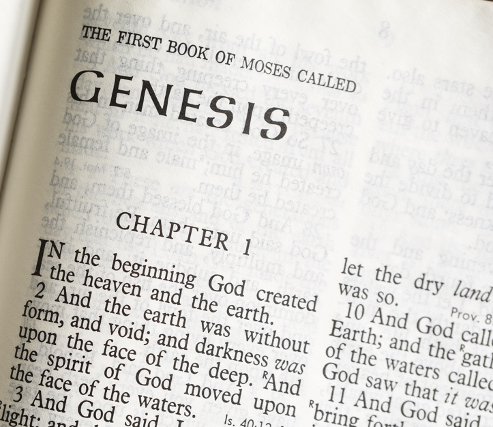
Meanwhile, the biblical book of Genesis famously starts off, “In the beginning God created the heaven and the earth.”

Which is it? Is the universe eternal—has it always been here? Or did it have a start at some point in time—did it have a birthday, so to speak? These are the two schools of thought that have enrolled followers since early times. (Actually, there was also a third school that postulated that the universe existed on the back of a giant sea turtle, but they’re mostly gone now.)

The seesaw of opinion has tipped one way or the other over time. But lately the weight of evidence has all been coming down on the side of the birthday universe.

In the old days when the Christian church dominated Western society, the creation of the universe was taken for granted. But slowly the scientific viewpoint pushed aside creation as well as the Creator. Now many scientists are thinking that the idea of a creation may not have been so far off from the truth as they thought. It’s looking like the universe had a beginning after all.

Remarkably, one of the first scientists to swing the pendulum of opinion back to the birthday-universe position was so entrenched in eternal-universe thinking that at first he refused to believe his own conclusions.

A GREAT BRAIN’S BIGGEST BLUNDER

When Albert Einstein developed his revolutionary theory of general relativity in 1916, his mathematical calculations pointed to an extraordinary conclusion—the universe was expanding. And since if you rewind the tape on any expansion, you get back to a point where it started, that meant the universe must have had a beginning too.1

Einstein, however, was like most scientists of his day in that he believed in an eternal universe. Unwilling to accept a beginning to the universe, Einstein fudged the numbers in order to nullify the conclusion that the universe was expanding.

University of California astrophysicist George Smoot explains that Einstein’s main problem with an expanding universe was its implication of a beginning. A beginning pointed to a beginner beyond scientific investigation.2 However, once experimental data proved that the universe really was expanding, Einstein admitted his error, calling it “the biggest blunder of my life.” 3

There’s a point worth considering here: if it could happen to Einstein, it could happen to anyone. Rarely is anyone completely objective when it comes to the issue of a Creator. While it is true that religious belief and philosophy became an obstacle for scientific inquiry in the days of Galileo, trends have changed. In the modern era, it has at times been a prejudice against the possibility of a cosmic designer that has kept many scientists from honest and open inquiry.

Thankfully, the truth generally comes out in the end and scientists begin to see the light. For Einstein and others, it was something called red shift that started the parade of evidence for a universe with a beginning.

REDSHIFTING THE BIG BANG THEORY INTO HIGH GEAR

In the late 1920s, the American astronomer Edwin Hubble noticed something unusual as he gazed into the heavens. It wasn’t a new planet or little green men waving at him from Mars; it was something both more tedious and at the same time more thrilling.

Hubble had been spending countless nights at the Mount Wilson Observatory, studying the stars and galaxies and especially the spectrum of color in the light they sent our way. He discovered that the light from most other galaxies was shifted to the red end of the spectrum, which indicated they were moving away from us.

Furthermore, the farther a galaxy was away from us, the more red-shifted its light was and, thus, the faster it was moving away from us. The only explanation for all of this was that space itself was expanding, causing all galaxies to move away from each other. In an expanding universe, from any point in space (including our own), it would appear that most stars and galaxies were racing away. And the farther away they were, the faster they would be racing.

There it was in the redshift: proof that Einstein had been right in the first place (before he fudged his formula) and that the universe really was expanding. Proof, in other words, that the universe was not eternal but had a beginning.4

And yet not everyone accepted the proof at first, including a scientist named Sir Fred Hoyle (former Plumian professor of astronomy at Cambridge University and founder of the Institute of Astronomy at Cambridge). Ironically, it was Hoyle who originally described the event as a “big bang,” meaning to mock the idea. The name stuck. (According to physics professor Brian Greene, the term “big bang” is actually misleading since there was nothing to explode and no space in which an explosion could take place.)5 But unlike Hoyle, many other scientists began coming over to the side of the newly named theory.

The world’s leading astrophysicist, Stephen Hawking, who has held the esteemed position of Lucasian Professor of Mathematics at Cambridge, calls Hubble’s discovery of an expanding universe “one of the great intellectual revolutions of the twentieth century.”6 The discovery that the universe had a beginning has led to a new science called cosmology, which attempts to understand what happened at the origin of the universe, how it works, and what will happen in its future.

The new science led cosmologists to take another look at a seemingly mundane insight from the 19th century, the second law of thermodynamics.

A SECOND LAW OF FIRST IMPORTANCE

In addition to Hubble’s discovery, the second law of thermodynamics also predicts a beginning to the universe. You say you don’t know the second law of thermodynamics? Think again.

Let’s say you come into a room containing me and a bunch of your other pals, and you find a steaming cup of Starbucks coffee on the table. Being the thoughtful individual that you are, you ask, “Does this belong to anyone?”

To which I reply, “It’s been there for the last month.”

Well, you’d know immediately I was wrong or lying (probably lying). Why? Because the coffee wouldn’t still be hot if it had been there for a month; it would be room temperature.

That’s the second law of thermodynamics in action. This law states that everything continually moves from a state of order to disorder and that heat and energy dissipate over time. This is a law that has been verified by proof after scientific proof and has never been shown to be wrong.

Now let’s apply this law to the universe, just as cosmologists have. If the universe were eternal, it would have gone cold and lifeless long ago. The stars would have burned out. Planets would have broken up into clouds of dust. And even the black holes would have ceased vacuuming the universe of unsightly stars and planets.

When you see flaming suns and scorching meteors, in other words, you’re looking at a steaming cup of coffee that over infinite time would have long since gone room temperature. Since the universe is still full of pockets of heat and energy, it cannot be eternal. Who would have thought heat would be such a helpful clue? And that is just the half of it.

THE SIGNIFICANCE OF TV INTERFERENCE

There is still another way that the measurement of heat help to prove that the universe is expanding. In the spring of 1964, two researchers at Bell Labs observed a persistent hiss while testing their microwave radiation detector. Regardless of which direction they pointed the antenna, the static was the same. (This is the same static as TV interference. The same static that was supposed to be gone when I paid $150 to have my satellite dish installed.) Those men, Arno Penzias and Robert Wilson, had discovered what scientists say is the echo from the birth of the universe.7

But how could scientists know for sure that the hiss they were hearing was actually an echo from the beginning of the universe? Mathematicians calculated that heat generated at the moment the universe began would have been enormous beyond comprehension. This heat would have gradually dissipated over the life of the cosmos, leaving only a tiny residual of about 3 degrees Kelvin (-270 degrees C).

Additionally, in order for galaxies to have formed by the explosion needed to have slight variations in the form of waves or ripples.

According to George Smoot, these ripples would result in very slight fluctuations in the predicted temperature and would reveal an identifiable pattern.8 Thus, if the temperatures matched up, the birth of the universe would be scientifically verified. Merely discovering the temperature to be 3 degrees Kelvin would not prove that the universe actually had a beginning, the fluctuations also needed to match.9

But how could we verify fluctuations so subtle?

THE GREATEST DISCOVERY OF ALL TIME?

In 1992, a team of astrophysicists led by Smoot launched the COBE satellite in order to verify the temperatures in space. The satellite would be able to take precise measurements and determine whether fluctuations in temperature existed.

The results stunned the scientific world. Not only was the three-degree temperature confirmed, but more importantly, the profiles of the fluctuations were discovered to be a match with what had been expected.10 Hawking called the discovery “the scientific discovery of the century, if not all time.” Smoot himself excitedly stated to newspaper reporters, “What we have found is evidence for the birth of the universe.” 11 He also said, “If you’re religious, it’s like looking at God.” 12

Astounded by the news, Ted Koppel began his ABC Nightline television program with an astronomer quoting the first two verses of the Bible. The other special guest, a physicist, immediately added his quote of the third Bible verse: “In the beginning God created the heavens and the earth. … And God said, ‘Let there be light,’ and there was light” (Genesis 1:1, 3).13

Evidence like that provided by the COBE satellite raises some intriguing questions, to say the least.

THE QUESTIONS THAT FOLLOW THE EVIDENCE

Einstein’s theorems based on his theory of relativity predict that the universe could not have begun without an outside force or Beginner.14 Since Einstein’s theory of relativity ranks as the most exhaustively tested and best proven principle in physics, his conclusion is deemed correct.15

Tests from an array of radio telescopes at the South Pole have confirmed the Big Bang to a still higher degree of accuracy than ever before.16 Background radiation measurements exceed 99.9% of what had been predicted.17 There are now more than 30 independent confirmations that the universe had a one-time origin.18

New telescopes such as the infrared Spitzer Space Telescope, launched in 2003, have opened up even bigger windows to our universe. They have prompted astronomer Giovanni Fazio, from the Harvard-Smithsonian Center for Astrophysics, to remark, “We are now able for the first time to lift the cosmic veil that has blocked our view.” 19

As a result of the accumulating evidence, the scientific community has long since begun asking questions about origins, such as the following:

  • What was there before the Big Bang?
  • Why did the Big Bang result in a universe enabling life to exist?
  • How could everything originate from nothing?

Smoot ponders what was there before the beginning: “Go back further still, beyond the moment of creation—what then? What was there before the big bang? What was there before time began?” 20 The same astrophysicist notes that “until the late 1910’s … those who didn’t take Genesis literally had no reason to believe there had been a beginning.” 21 The Genesis account of creation and the Big Bang theory both speak of everything coming from nothing. Suddenly the Bible and science agree (a discovery somewhat embarrassing to materialists). Smoot admits, “There is no doubt that a parallel exists between the Big Bang as an event and the Christian notion of creation from nothing.” 22

The evidence had begun to add up, and some scientists weren’t liking the sum.

TRYING TO AVOID THE BAD DREAM

A beginning to the universe was like a bad dream come true for materialists who wanted to believe everything had always existed. It brought scientists face to face with the logical conclusions that primary cause must exist. That argument is a simple logical syllogism:

  1. Everything that has a beginning had a cause.
  2. The universe had a beginning.
  3. Therefore, the universe had a cause.

But admitting a cause leads to the next logical question: who or what is the cause?

Think about it for a minute. Since time, space, matter, and motion are all a part of the created universe, then before the beginning it was timeless, spaceless, and motionless.

What can happen spontaneously from this state of affairs? There’s nothing moving, there’s nothing colliding, there’s … well, nothing. Not even the potential for anything to happen.

The fact everything came from nothing has forced scientists to acknowledge that something outside of space and time, something very powerful and with apparent volition, must have acted to bring about the beginning. That is, there must have been an intelligent Designer of the universe. Some might go ahead and use the name God for this Creator.

Well, in certain academic circles, this line of reasoning simply won’t do. Thus it is that many materialists have looked for a way to prove that the universe didn’t have a beginning. Smoot remarks, “Cosmologists have long struggled to avoid this bad dream by seeking explanations of the universe that avoid the necessity of a beginning.” 23

Sir Fred Hoyle (he who mockingly coined the term “big bang”) was one scientist who strongly opposed the concept of a beginning for the universe. In 1948 Hermann Bondi and Thomas Gold joined Hoyle in postulating that matter was in a continual state of creation. They called their idea the steady state theory, which was an attempt to show that the universe is eternal after all, even though the evidence had long been trending against such a view. However, the COBE discovery of background radiation was the fatal blow to the steady state theory.24

Next came the oscillating universe theory. According to this concept, the universe explodes, contracts, and explodes again, eternally yo-yoing. This would be another way to permit a belief in the eternal existence of the universe. But the physics for this theory didn’t work.

More recently, some scientists, including Hawking, have begun considering the so-called multiverse theory. This theory accepts that our universe is finite, but it suggests that ours is just one of many universes. The whole multi-universe may be eternal, according to this theory, even though our particular universe is not. This theory is covered in more depth in another article in this magazine, but the key point to understand about it right now is that it has no evidence whatsoever to support it.

These theories fit neatly with the philosophy of materialism, whereas a beginning of the universe would raise the obvious question, who was there to start it? Professor Dennis Sciama, Hawking’s supervisor while he was at Cambridge, admits his reasons for supporting the steady state theory: “I was a supporter of the steady state theory, not in the sense that I believed that it had to be true, but in that I found it so attractive I wanted it to be true.” 25

An origin of the universe meant materialists were suddenly faced with the questions that threatened their worldview.

A ONE TIME BEGINNING

Hoyle and other scientists fervently pursued alternative explanations to a one-time origin of the universe. Eventually, however, the evidence showed clearly that the universe had a beginning, and the Big Bang theory was proclaimed victorious. Ironically, it was evidence from Hoyle’s own research that helped confirm that the universe had a one-time beginning.

Today most cosmologists and physicists accept the Big Bang theory as the scientific explanation of how our universe began. In fact, scientists believe they can trace the history of the universe all the way back to 10-43 of a second. Prior to that point in the history of our universe, all of our current theories break down and science can see no further back. The very beginning of the universe remains a mystery.

Imagine rewinding the universe back to its beginning, a time when there were no stars. No light, matter, or energy. Not even space or time. Suddenly an enormous explosion erupted from this nothingness at a temperature exceeding a million trillion trillion degrees.26 Time begins along with matter, energy, and space.

When a bomb ejects shrapnel into the air, both the bomb material and the space it blows into have already been there. However, in the beginning of the universe, neither space nor matter existed until the explosion. The space surface of the universe and the newly created matter came into existence.

According to the Big Bang theory, this explosion launched the entire universe, from the most distant galaxy to the most colorful nebula, to quasars flashing like beacons, to our own comforting sun and nearby planets, to you and me with our questions about where we came from and what it all means. Since man alone thinks about the meaning and purpose of life, the beginning—and the cause of that beginning—must be fascinating to each one of us.

The verdict is in on the question of whether the universe is eternal or had a beginning. The idea that everything in the cosmos originated out of nothing seems mythical, yet it is now mainstream science.

64401.1 Endnotes

Back to the Beginning

ENDNOTES

1. Brian Greene, The Elegant Universe (New York: Vintage, 2000), 81-82.

2. George Smoot and Keay Davidson, Wrinkles in Time (New York: Avon, 1993), 36.

3. Greene, 81-82.

4. Stephen Hawking, A Brief History of Time (New York: Bantam, 1990), 38-51.

5. Greene, 83.

6. Hawking, 39.

7. Smoot, 80-83.

8. Ibid., 187.

9. Ibid., 240.

10. Ibid., 241.

11. Associated Press, “U.S. Scientists Find a ‘Holy Grail’: Ripples at the Edge of the Universe,” International Herald Tribune (London), April 24, 1992, 1.

12. Thomas H. Maugh II, “Relics of ‘Big Bang’ Seen for First Time,” Los Angeles Times, April 1992, A1, A30.

13. Nightline with Ted Koppel, ABC, April 25, 1992.

14. Hugh Ross, The Creator and the Cosmos, 3rd ed. (Colorado Springs, CO: NavPress, 2001), 224.

15. Roger Penrose, Shadows of the Mind (New York: Oxford University Press, 1994), 230.

16. E. M. Leitch et al., “Measurement of Polarization with the Degree Angular Scale Interferometer,” Nature 420 (2002): 772-87; J. M. Kovac et al., “Detection of Polarization in the Cosmic Microwave Background Using DASI,” Nature 420 (2002): 772-87; Matias Zalarriaga, “Background Comes to the Fore,” Nature 420 (2002): 747-48.

17. Gregg Easterbrook, “Before the Big Bang,” U.S. News & World Report special edition, 2003, 16.

18. Hugh Ross, “Big Bang Passes Test,” Connections, Qtr 2, 2003.

19. Paul Recer, “Newest Space Telescope: The Spitzer,” Seattle Post Intelligencer, December 19, 2003, A17.

20. Smoot, 291.

21. Ibid., 30.

22. Ibid., 17.

23. Ibid., 291

24. Ibid. 86.

25. Stephen Hawking, ed., Stephen Hawking’s A Brief History of Time: A Reader’s Companion (New York: Bantam, 1992), 63.

26. Bradford A. Smith, “New Eyes on the Universe,” National Geographic, January 1994, 33.

64402 2. What Are the Odds?

 Why is Only Earth Suitable for Life?

In his movie Signs, M. Night Shyamalan presents us with a priest (played by Mel Gibson) who has lost his faith. Through the death of his wife, the priest has come to the conclusion that life is random. He has decided that he will no long pretend to see God in the picture.

As Shyamalan zooms in his lens, he shows us that life is without focus: there is no recognizable pattern. But typical of Shyamalan, he turns the lens one more screw to the right, and at this magnification a pattern emerges. Gibson’s character is able to see the hand of a great designer lurking behind all that had seemed random. His wife’s dying words, his daughter’s obsession with water, his son’s asthma —everything served a larger purpose.

At the end Mel Gibson returns to the priesthood and makes a blockbuster called The Passion of the Christ. Well, not exactly, but his character comes full circle—from faith to skepticism and back to faith. Meanwhile, Shyamalan takes his audience on the same circuitous journey, exploring issues of design and higher purpose in the world.

In many ways the evidence for intelligent design of the universe has come full circle. When early humans looked at the heavens, they could not escape the concept of a creator. In fact, until the 1500s, most people believed in the ancient astronomer Ptolemy’s teaching, that Earth was the center of the universe.

But, in the 16th century, Copernicus showed that Earth revolved around the Sun. Suddenly our planet seemed less special. Some astronomers looked out at the universe through telescopes and deduced a creator was unnecessary. Their argument for a materialist worldview was energized by the belief in an ordinary Earth.

Although the founders of modern astronomy strongly believed that the universe was the work of a cosmic genius, these later followers saw the cosmos as totally autonomous and independent of a designer. Copernicus, a strong believer in God, couldn’t have disagreed more with such an assumption, and would have taken exception to it.

In the 19th century, this belief in an ordinary Earth became popularized as the “Copernican Principle.” This principle has become the bedrock for a materialistic view of the world. However, in the latter part of the 20th century evidence began pouring in about the remarkable fitness of Earth for life.

Scientists have learned that only an exceptionally fine-tuned planet like Earth has  the necessary ingredients to harbor life. Additionally, our solar system and galaxy, as well as our entire universe, appear designed to support intelligent life.

The odds that such fine-tuning could have occurred by chance is not just unlikely–scientists say it is virtually impossible.

THEY DON’T CALL THESE NUMBERS ASTRONOMICAL FOR NOTHING

An article in U.S. News & World Report remarks, “So far no theory is even close to explaining why physical laws exist, much less why they take the form they do. Standard big bang theory, for example, essentially explains the propitious universe in this way: ‘Well, we got lucky.’ ” 1

On Christmas Day in 2002, Jack Whitaker, of Scott Depot, West Virginia, got lucky, becoming the largest single-ticket lottery jackpot winner until that time in North America. His prize? A Powerball jackpot of $314.9 million. Over a hundred million other tickets didn’t match. What are the odds of that? (And what are the odds that within two years he would be robbed twice, face charges for attacking a bar manager, be sued for making trouble at a nightclub and a racetrack, and be arrested twice for drunk driving? Not nearly as unlikely as his Powerball winning ticket, but still true.)

If someone won even two such lotteries consecutively, we would all assume the results were rigged. And yet, when it comes to life existing in our universe, the odds are far more remote than winning a hundred Powerball lotteries consecutively.

Physicist Paul Davies comments, “The conclusion must be that we live in a world of astronomical unlikelihood.” 2

Donald Page of Princeton’s Institute for Advanced Study has calculated that the odds against our universe randomly taking a form suitable for life is one out of 10124, a number beyond imagination.3

To try and visualize the difficulty, imagine all the grains of sand on all the beaches on Earth. Then encrypt one grain with a special code known only to you, and randomly bury that grain on a beach somewhere on Earth. (Maybe enjoy a vacation in Maui while you’re at it).

The chance a blindfolded person would ever discover that one grain of sand on their first pick is one out of 1020 (one chance in 100 billion billion.)

Now offer a reward to anyone who can find it on one pick, even though they don’t know which beach to scour, or how deep it is buried. But what if they did? Would anyone believe they discovered it by accident? Yet, scientists tell us that the likelihood of a Big Bang explosion resulting in a universe able to support life like ours is many times more improbable.

As we consider the odds for the fine-tuning of our universe, galaxy, solar system, and planet, let’s keep in mind just how extreme these odds really are. Not just one, but all of them require unbelievably precise fine-tuning. Can such precision be a result of anything other than design? Let’s take a look at why many scientists are asking this question.

A FINELY TUNED UNIVERSE

Dr. Robin Collins states in The Case for a Creator, “Over the past thirty years or so, scientists have discovered that just about everything about the basic structure of the universe is balanced on a razor’s edge.” 4 Over 35 different characteristics of the universe and its physical laws must be precisely fine-tuned for physical life to be possible.5 Following are six of those characteristics:

  1. A large enough expansion rate. The birth of the universe had to begin with enough force, or life couldn’t exist. Stephen Hawking states, “If the rate of expansion one second after the big bang had been smaller by even one part in a hundred thousand million million, the universe would have recollapsed before it ever reached its present size.” 6
  2. A controlled expansion rate. Although the expansion rate had to be great enough for the universe to avoid a big crunch, if its outward force had been even a fraction greater, that would have been too much for gravity to form stars and planets. Life could never have been possible.7
  3. Force of gravity. If the gravitational force were altered by 0.0000000000000000000000000000000000001 percent, neither Earth nor our Sun would exist—and you would not be here reading this.8
  4. The balance of matter and antimatter. In the formation of the universe, the balance between matter and antimatter, and the excess of matter over antimatter, needed to be accurate to one part in ten billion for the universe to arise.
  5. The mass density of the universe. For physical life to exist, the mass density of the universe must be fine-tuned to better than one part in a trillion trillion trillion trillion trillion (1060).9 Thus, the mass contained in all dark and visible matter, including stars, is essential for the existence of our universe.
  6. Space-energy density. The space-energy density of the universe requires much greater precision than the mass density. For physical life to be possible, it must be fine-tuned to one part in 10120.10

According to the Big Bang theory, all of this minute fine-tuning was programmed into the initial conditions of the first microsecond of the explosion that began our universe. At that instant the rate and ratios of expansion, mass, density, antimatter, matter, etc., were set in place, eventually leading to a habitable planet called Earth.

In addition to the 35 different characteristics of our universe that must be just right for life to exist, our galaxy, solar system, and planet also needed to be exceptionally fine-tuned or we would not be here.11

A FINELY TUNED GALAXY

Galaxies are formations of from millions to perhaps a trillion stars. Our own galaxy is called the Milky Way. It’s unknown how many galaxies the universe contains, but it may be around a trillion. Surprisingly, given the great number of these star groups, most galaxies are incompatible with life.

In order for life to exist in a galaxy, it needs to meet several criteria.12 The following are just three of the fine-tuned characteristics a galaxy needs to support life:

  • Shape of the galaxy. The Milky Way is spiral-shaped. Of the three types of galaxies—elliptical, irregular, and spiral— the spiral type is most capable of hosting human life.
  • Not too large a galaxy. Our Milky Way is enormous, measuring 100,000 light-years from end to end. However, if it were just a bit larger, too much radiation and too many gravitational disturbances would prohibit life like ours.
  • Not too small a galaxy. On the other hand, a stable Earth orbit that is necessary for life could not exist if our galaxy were slightly smaller. And a smaller galaxy would result in inadequate heavy elements, such as iron and carbon, essential to life.

Our Milky Way galaxy meets these and many other conditions essential for life. Most of the others do not.

When we focus in even closer, on our own star and its planets, the odds for life being possible become even more extreme.

A FINELY TUNED SOLAR SYSTEM

Copernicus’s theory that Earth revolved around the Sun, seemed to relegate our planet to an ordinary status in the universe. However, if Earth was the center of our solar system, as Ptolemy and 16th century Catholic Church leaders had taught, we wouldn’t be here. None of them, including Copernicus, knew that in order for human life to be possible, Earth needs to revolve around a Sun that has just the right size, location, and conditions as ours does.

But that is not all. We need other planets such as Jupiter and Mars to act as defense shields, protecting us from a potential catastrophic bombardment of comets and meteors. We also need a moon of just the right size and position to impact our tides and seasons. Let’s take a look at just a few of the many conditions in our solar system that are just right for life.

The Sun’s distance from the center of the galaxy. Our Sun is positioned thousands of light-years from the center of the Milky Way, near one of its spiral arms.13 This is the safest part of the galaxy, away from its highly radioactive center.

The Sun’s mass not too large. If the mass of the Sun were a small percentage greater, it would burn too quickly and erratically to support life.

The Sun’s mass not too small. On the other hand, if it were smaller, its greater flaring would disrupt Earth’s rotation rate.

The Sun’s metal content. Only two percent of all stars have enough metal content to form planets. Too much metal in a star will allow too many planets to form, creating chaos. Our Sun has just the right amount of metal for planets to form safely.

Effect of the Moon. The Moon stabilizes the Earth’s tilt and is responsible for our seasons. If it weren’t there, our tilt could swing widely over a large range, making our winters a hundred degrees colder and our summers a hundred degrees warmer.

When astronomers consider our remarkable solar system, they acknowledge that if it was slightly different, advanced biological life would be impossible. But it is not enough to have the right universe, galaxy, and solar system for human life to be possible. The conditions of our home planet must also be fine-tuned to a razor’s edge.

THE MATH MIRACLE

Implicit in all of the scientific discoveries of fine-tuning in the universe is the foundational importance of mathematics to exploring the nature of the universe. Because mathematics is the lens by which we study the universe, we can miss the genius behind the lens itself!

Physicist Eugene Wigner, in a widely quoted paper entitled “The Unreasonable Effectiveness of Mathematics in the Physical Sciences,” notes that scientists often take for granted that the math they use to study and quantify the miracles of the universe is miraculous itself. Wigner states, “The enormous usefulness of mathematics is something bordering on the mysterious. …There is no rational explanation for it. …There is no rational explanation for it. …The miracle of the appropriateness of the language of mathematics for the formulation of the laws of physics is a wonderful gift which we neither understand nor deserve.” 14

Such is the nature of mathematics that no one would claim to have invented an equation but only to have discovered or uncovered something that was always true. As the great scientist Johannes Kepler staed, “The great scientist Johnannes Kepler stated, “The chief aim of all investigations of the external world should be to discover the rational order and harmony which has been imposed on it by God and which He revealed to us in the language of mathematics.”

Even as we calculate the extreme precision by which the universe was designed, we are alerted to yet another contour of design in the universe the mathematical laws.

A FINELY TUNED PLANET

You may believe that aliens have sent life to Earth from a far distant galaxy (the premise of that memorable drama from 2004, AVP: Alien vs. Predator). You may believe that the government is hiding something outer spatial in Nevada’s mysterious Area 51. Or you may simply believe that there is undoubtedly intelligent life on other planets. In any case, we have all been raised on the assumption that, given enough time, intelligent life will spring up anywhere in the cosmos (with perhaps a few more eyeballs or reptilian features). Yet new evidence from cosmology is really saying the opposite.

The reality is that we live on an extremely rare planet perfectly positioned in an extremely rare solar system, ideally located in an extremely rare galaxy, within a highly improbable universe. Let’s look at our rare Earth.

Water. Earth has an abundance of water, which is essential for life. Mars once had water and therefore might have harbored life. But water is only one of many requirements for life.

Oxygen. Earth is the only planet in our solar system in which we can breathe. Attempting to breathe on other planets, such as Mars or Venus, would be instantly fatal, Mars having virtually no atmosphere and Venus having mostly carbon dioxide and almost no oxygen.

Earth’s distance from the Sun. If the Earth were merely one percent closer to the Sun, the oceans would vaporize, preventing the existence of life. On the other hand, if our planet were just two percent farther from the Sun, the oceans would freeze and the rain that enables life would be nonexistent.

Plate tectonic activity on Earth. Scientists have determined that if the plate tectonic activity were greater, human life could not be sustained and greenhouse-gas reduction would overcompensate for increasing solar luminosity. Yet, if the activity was smaller, life-essential nutrients would not be recycled adequately and greenhouse-gas reduction would not compensate for increasing solar luminosity.

Ozone level in the atmosphere. Life on Earth survives because the ozone level is within the safe range for habitation. However, if the ozone level were either much less or much greater, plant growth would be inadequate for human life to exist.

For life to exist, these, as well as many other conditions needs to be just right.15

ONE BLOOMING ROCK

University of Washington professors Peter Ward and Donald Brownlee conclude in their book, Rare Earth, that the conditions favorable for life must be so rare in the universe that “not only intelligent life, but even the simplest of animal life is exceedingly rare in our galaxy and in the universe.”16 This has led their readers to the conclusion expressed by the reviewer from the New York Times: “Maybe we are alone in the universe, after all.”17

If Ward and Brownlee are right, what does that mean to us?

Michael Denton, senior research fellow in human molecular genetics at the University of Otago in New Zealand, tells us why this remarkable fine-tuning has reopened the discussion on the importance of man in our lonely universe.18

No other theory or concept imagined by man can equal in boldness and audacity this great claim … that all the starry heavens, and every species of life, that every characteristic of reality exists for mankind. … And today, four centuries after the scientific revolution, the doctrine is again re-emerging. In the last decades of the twentieth century, its credibility is being enhanced by discoveries in several branches of fundamental science.

It seems ludicrous to claim that life exists on only one tiny speck in a universe of ten billion trillion stars. Yet, incredibly, Earth appears to sit alone in a hostile universe devoid of life, a reality portrayed recently in National Geographic:

If life sprang up through natural processes on the Earth, then the same thing could presumably happen on other worlds. And yet when we look at outer space, we do not see an environment teeming with life.

We see planets and moons where no life as we know it could possibly survive. In fact, we see all sorts of wildly different planets and moons—hot places, murky places, ice worlds, gas worlds—and it seems that there are far more ways to be a dead world than a live one.19

The incredibly precise numerical values required for life confront scientists with obvious implications. Stephen Hawking observes, “The remarkable fact is that the values of these numbers seem to have been very finely adjusted to make possible the development of life.”20

64402.1 Endnotes

What Are the Odds?

1. Gregg Easterbrook, “Before the Big Bang,” U.S. News & World Report, special edition, 2003, 16.

2. Paul Davies, Other Worlds (London: Penguin, 1990), 169.

3. Dietrick E. Thompsen, “The Quantum Universe: A Zero-Point Fluctuation?” Science News, August 3, 1985, 73.

4. Quoted in Lee Strobel, The Case for a Creator (Grand Rapids, MI: Zondervan, 2004), 131.

5. Hugh Ross, The Creator and the Cosmos, 3rd ed. (Colorado Springs, CO: NavPress, 2001), 224.

6. Stephen Hawking, A Brief History of Time (New York: Bantam, 1990), 121–122.

7. John D. Barrow and George Silk, The Left Hand of Creation: The Origin and Evolution of the Expanding Universe (New York: Basic, 1983), 206.

8. Lawrence M. Krauss, “The End of the Age Problem and the Case for a Cosmological Constant Revisited,” Astrophysical Journal 501 (1998): 461–466.

9. Ross, 53.

10. Ibid., 187.

11. Ibid., 187–193.

12. Guillermo Gonzalez and Jay W. Richards, The Privileged Planet (Washington, DC: Regnery, 2004), 132–138.

13. Ibid., 132–138.

14. Eugene Wigner, “The Unreasonable Effectiveness of Mathematics in the Physical Sciences,” Communications on Pure and Applied Mathematics 13 (1960), 1-14.

15. Ross. 175-199.

16. Peter D. Ward and Donald Brownlee, Rare Earth (New York: Copernicus, 2000).

17. William J. Broad, “Maybe We Are Alone in the Universe After All,” New York Times, (February 8, 2000), 1-4.

18. Michael J. Denton, Nature’s Destiny: How the Laws of Biology Reveal Purpose in the Universe (New York: The Free Press, 1998), 3-4.

19. Joel Achenbach, “Life Beyond Earth,” National Geographic (January, 2000, Special Millennium Issue), 45.

20. Hawking, 124.