DARWIN’S PREDICTION
Darwin’s theory of macroevolution states that each species, including human beings, is a link of an evolutionary chain which began billions of years ago with the earliest protocell. His theory states that over several billion years, lower forms of life would gradually evolve into higher species, leaving an abundance of transitional fossils for paleontologists to examine. His theory of human evolution progresses through six key evolutionary stages:
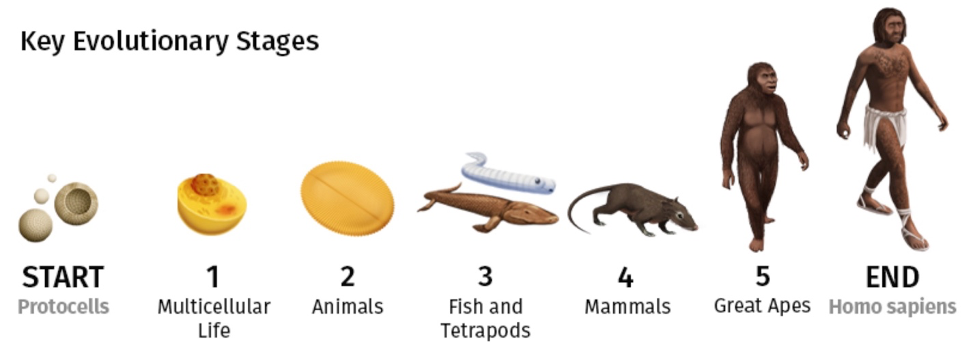
Darwin assumed that paleontologists would discover an abundance of transitional fossils verifying his theory of macroevolution.
The transitional fossils Darwin predicted aren’t those with microevolutionary changes of one type of bird evolving into another (like the finches he observed on Galapagos Islands), or one type of horse evolving into another horse, etc. Those are examples of minor changes within a particular species.
The transitional fossils Darwin predicted in his theory of macroevolution would show the incremental stages of development as one species gradually evolved into another totally different species, a process that he believed would take millions of years. So, if a fish gradually evolved into a mammal, countless intermediate fossils should be discovered showing many different stages between the fish and the mammal.
DARWIN’S DILEMMA
Darwin predicted that during the gradual evolutionary process, millions of transitional species would leave a trail of fossil evidence, showing how one species changed incrementally into another.
Darwin believed the discovery of transitional fossils would take us from the world of theory to the world of forensics. Fossils are hard evidence, not theoretical probabilities.
There were plenty of fossils for Darwin to evaluate, but he couldn’t understand why his theory’s predicted transitional fossils were absent from the fossil record. He wrote,
Why, if species have descended from other species by fine gradations, do we not everywhere see innumerable transitional forms? Geology assuredly does not reveal any such finely graduated organic chain; and this, perhaps, is the most obvious and serious objection which can be urged against the theory.1
But Darwin blamed the lack of transitional fossils on what he called, “an imperfect geological record.” However, he was still troubled, hoping the fossils would be found.
For nearly two centuries since Darwin began formulating his theory, paleontologists have been busy digging, classifying, and looking for his predicted fossils in a worldwide hunt. Billions of fossils representing about 250,000 species have been meticulously scrutinized.
Let’s see what this lengthy passage of time has revealed about Darwin’s predicted fossils.
FATAL BLOW TO DARWIN
We begin with the early Cambrian period. Paleontologists are at a loss to explain how life appeared so rapidly during the Cambrian period. Darwin himself had no explanation for how life could develop so quickly. Neither do paleontologists today.
Prior to the Cambrian period, only fossils of simple life forms have been excavated. Then, suddenly, the fossil record is teeming with more complex life forms than even exist today. It is so extraordinary that paleontologists call it the “Cambrian Explosion.”
Seemingly in an instant of geological time, complex life forms with fully developed eyes appeared during the Cambrian period. Because these complex life forms appeared suddenly in the geological record, paleontologists call it “biology’s big bang.”
What paleontologists find in the Cambrian explosion is not simply the appearance of a few new animals, but an abundance of fifty completely different body types without prior transitions or predecessors. In other words, brand new life forms appeared without an evolutionary trail.
Darwin staked his entire theory on the premise that a new species could never suddenly appear, since that would contradict his theory of natural selection. He said,
If numerous species, belonging to the same … families, have really started into life at once, that fact would be fatal to the theory of evolution through natural selection.2
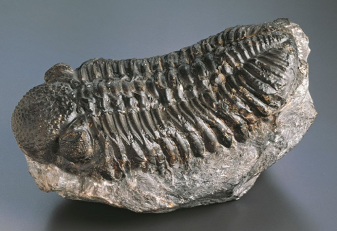
Darwin theorized that complex organs like the eye could only develop gradually over enormous periods of time, traceable to a common ancestor.
Yet five totally different phyla with no hint of a common ancestor all suddenly popped into existence during the Cambrian period, each with fully developed eyes.
As we learned in the last chapter, the eye is an irreducibly complex organ that has no functional value unless all its many parts synchronize to provide sight.3
T. S. Kemp, curator of the zoological collections at the Oxford University Museum of Natural History, is one of the world’s foremost experts on Cambrian fossils. When discussing the sudden appearances of new species, Kemp discloses,
With few exceptions, radically new kinds of organisms appear for the first time in the fossil record already fully evolved. … It is not at all what might have been expected.4
Stephen Jay Gould, a staunch advocate of materialistic evolution, reiterates how the Cambrian explosion is a puzzle to Darwinists, writing,
We do not know why the Cambrian explosion could establish all major anatomical designs so quickly. … The Cambrian explosion was the most remarkable and puzzling event in the history of life.5
The sudden appearance of new life forms in the Cambrian explosion contradicts Darwin’s theory and has been a source of great frustration to materialists.
But the Cambrian explosion of suddenly appearing life forms is not the only contradiction of Darwinian macroevolution.
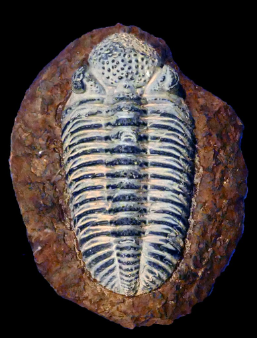
American Paleontologist, Niles Eldredge, shockingly admits the failure of the entire fossil record to provide evidence for macroevolution, stating,
No one has found any such in-between creatures and there is a growing conviction among many scientists that these transitional forms never existed.6 No wonder paleontologists shied away from evolution for so long. It never seems to happen.7
Eldredge also explains the failure of paleontologists to recognize the failure of the fossil record to back up Darwin’s theory of gradualism.
Paleontologists clung to the myth of gradual adaptive transformation even in the face of plain evidence to the contrary.8
Leading atheist Richard Dawkins also clung to the myth of gradualism, admitting,
Without gradualness we are back to a miracle.9
DARWIN’S MISSING FOSSILS
According to paleontologists, the fossil record shows that most species do not change but rather remain virtually the same for millions of years. They call this phenomenon: stasis.
Although some fossils have been identified as possibly transitional (i.e., Archaeopteryx and Tiktaalik roseae), Gould says that evolutionists simply avoid talking about the embarrassing lack of fossil evidence. He confesses the silence regarding the lack of transitional fossils,
It’s not evolution so you don’t talk about it.10
As a committed evolutionary leader, Gould admits to the failure of the fossil record as being the “trade secret of paleontology.”
The extreme rarity of transitional forms in the fossil record persists as the trade secret of paleontology. The evolutionary trees that adorn our textbooks have data only at the tips and notes of their branches; the rest is inference, however reasonable, not the evidence of fossils.11
Paleontologist Whitey Hagadorn, who has comprehensively studied fossils of early marine life notes the absence of transitional fossils.
Paleontologists have the best eyes in the world. If we can’t find the fossils, sometimes you have to think that they just weren’t there.12
Kemp, Gould, Eldredge and Hagadorn are all noted paleontologists who honestly admit that the fossil evidence Darwin predicted of interim species does not exist.
Because the transitional fossils Darwin predicted haven’t been unearthed, both Gould and Eldredge developed the theory that life didn’t evolve gradually over long periods of time, but rather that new species evolved in short spurts. They call their theory “Punctuated Equilibria,” a radical departure from Darwin’s theory of gradualism.
WHERE IS THE HUMAN FOSSIL TRAIL?
When it comes to the origin of human beings, Darwin’s theory clearly states that we are not unique but rather are the end product of billions of years of evolution from tiny protocells. Gould, who admitted the failure of the fossil record to support Darwinism, stated that our existence as a species was the result of “a glorious accident.” When asked in an interview what the accident was, Gould replied,
The accident is the 60 trillion contingent events that eventually led to the emergence of Homo sapiens.13
60 trillion lucky breaks? Hmm.
Is there any real evidence that humans evolved? Darwin believed the fossil trail would show the progressive evolution of our species from ancient primates and hominids. So, have paleoanthropologists discovered an evolutionary link between hominids and us?
We’ve all seen museum exhibits or artists’ renderings like this drawing depicting slightly erect ape-like creatures that presumably became us.
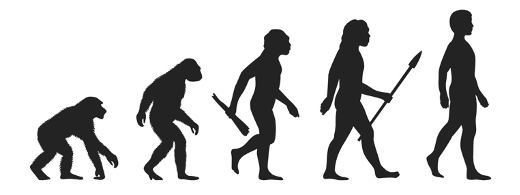
Such exhibits and drawings imply that there is solid fossil evidence to back up the claim that pre-human fossils have been discovered. But have they actually discovered such pre-human fossils?
Paleoanthropologists have uncovered pieces of bones and skull fragments from fossils they consider human ancestors. Ardipithecus ramidus, the oldest of these, is dated at over 4 million years old. Homo habilis and Homo erectus are depicted as more recent members of our family tree. But what evidence supports their belief that these hominid fossils are truly our ancestors?
It all looks and sounds so convincing. However, what sounds like a solid argument for human ancestry unravels when experts analyze the fossils. Henry Gee, the chief science writer for Nature admits,
The intervals of time that separate fossils are so huge that we cannot say anything definite about their possible connection through ancestry and descent.14
The problem is that there is almost no fossil evidence to examine. Paleoanthropologists are attempting to fill in an enormous puzzle with only a few fragments of bones and teeth that according to Gee, could be “fitted into a small box.”15
Although Gould remained an evolutionist, he agreed with the difficulty of connecting an evolutionary trail between hominids and Homo sapiens, stating,
Most hominid fossils, even though they serve as a basis for endless speculation and elaborate storytelling, are fragments of jaws and scraps of skulls.16
Gee and Gould are not the only experts pointing out the absence of transitional fossils between hominids and us. Harvard evolutionary biologist Richard Lewontin also admitted,
When we consider the remote past, before the origin of the actual species Homo sapiens, we are faced with a fragmentary and disconnected fossil record.17
HUMANS APPEARED SUDDENLY
Although small fragments of hominid bones have been discovered, there is a huge jump from such creatures to our own species. Naturalist Ian Tattersall (curator at the American Museum of Natural History) refers to the suddenness with which humans appear in the fossil record.
Something extraordinary, if totally fortuitous, happened with the birth of our species….Homo sapiens is as distinctive an entity as exists on the face of the Earth, and should be dignified as such instead of being adulterated with every reasonably large-brained hominid fossil that happened to come along.18
Darwinists are unable to explain why our species appeared so suddenly. Professor Emeritus of Biology at the University of Sussex, John Maynard Smith, writes,
Something very puzzling happened…. The fossil evidence is patchy, but it seems that hominids suddenly developed brains that, in terms of size, were much like ours.19
The fossil record shows that hominids had small, ape-like brains and no capacity for language. Then, suddenly, man appears with several unique features, including an enlarged brain capacity. Tattersall, Smith and other naturalists are puzzled as to why there are no clear-cut links between hominids without language capacity and Homo sapiens who have both the hardware and the software for language, something unique to our species.
The sudden brain size and language capacity of Homo sapiens in the fossil record presents a huge problem for Darwinists who argue against a designer. In his book, Mapping Human History, evolutionist Steve Olson spells out the problem.
Of course, language could not have come from nowhere. To speak, early humans needed particular vocal and neural mechanisms. But here a notorious problem arises. Any adaptations produced by evolution are useful only in the present, not in some vaguely defined future.20
For human speech to work, the brain structure, the tongue, the larynx, the vocal cords, and many other parts all need to be fully developed in synchrony as if it had been designed. Once again, Darwinism is confronted with its unsolved puzzle of irreducible complexity.
Evolutionary biologist Ernst Mayr, explains the dramatic difference between hominids and us,
Humans have the ability to conceptualize, resulting in the development of art, literature, mathematics, and science. Hominids and all other animals lack this unique human quality, and are only able to communicate by giving and receiving signals.21
The lack of a transitional link from primates to man led Mayr to conclude,
Man is indeed as unique, as different from all other animals, as had been traditionally claimed by theologians and philosophers.22
During an interview with the French science monthly La Recherché, mathematician Marcel Schutzenberger was asked, “The appearance of human beings—is that a miracle?” The brilliant mathematician replied by stating that Darwinism has been unable to explain the uniqueness and sudden appearance of man. He concludes his remarks with,
Naturally. And here it does seem that there are voices among contemporary biologists—I mean voices other than mine—who might cast doubt on the Darwinian paradigm. The reality is that we are confronted with total conceptual bankruptcy.23
Lewontin also poured cold water on claims that a missing link between humans and apes has been discovered. He admitted,
Despite the exciting and optimistic claims that have been made by some paleontologists, no fossil hominid species can be established as our direct ancestor.24
DARWIN’S FATALLY FLAWED MYTH
Darwin said, “the most obvious and serious objection” to his theory was the lack of intermediate fossils showing how one species gradually evolved into another species. He also said,
If numerous species, belonging to the same … families, have really started into life at once, that fact would be fatal to the theory of evolution through natural selection.
The Cambrian explosion, as well as the entire fossil record of the past century and a half have confirmed Darwin’s worst fears, that his theory of macroevolution is fatally flawed. Biochemist Michael Denton pronounces his verdict on Darwin’s theory of macroevolution.
One might have expected that a theory of such cardinal importance, a theory that literally changed the world, would have been something more than metaphysics, something more than a myth. Ultimately the Darwinian theory of evolution is not more nor less than the great cosmogenic myth of the twentieth century.25
But the main failure of Darwinism is not just the failure of the fossil record to support macroevolution. It’s Darwin’s premise that life is simply the result of time plus chance without an intelligent primary cause. To most people that just doesn’t make sense, even to open-minded materialists and atheists.
Former atheist Lee Strobel writes of his reasons for rejecting Darwinism.26
I realized that if I were to embrace Darwinism and its underlying premise of naturalism, I would have to believe that:
- Nothing produces everything
- Non-life produces life
- Randomness produces fine-tuning
- Chaos produces information
- Unconsciousness produces consciousness
- Non-reason produces reason
Strobel continues,
Based on this, I was forced to conclude that Darwinism would require a blind leap of faith that I was not willing to make.
The Darwinian belief that life all came about by chance over eons of time has failed to meet Darwin’s own standard of proof. But, if life can’t be explained apart from intelligent design, what did the designer reveal about himself and our purpose here on Earth?
In the final chapter we will see if there is an answer to these all-important questions.