
In the previous chapters we’ve seen how many scientists are now speaking of a “superintellect” who created the universe from nothing, fine-tuned it for life, and designed the incredibly complex “software” coding of DNA.
The only other option to an intelligent designer is that somehow it all just happened by what Stephen Jay Gould called, “60 trillion contingent events.” He and other materialists are willing to believe we are the results of such impossible odds rather than accept the overwhelming evidence for intelligent design.
So, we must choose between a mathematically impossible stroke of luck that we are here on planet Earth, or the obvious inference of an intelligent designer who planned it all.
Once former atheist Lee Strobel realized the failure of Darwinism to account for our existence, he began a quest to discover the truth about an intelligent designer. He writes,
As I reviewed the avalanche of information from my investigation, I found the evidence for an intelligent designer to be credible, cogent, and compelling.1
Agnostic physicist Fred Hoyle, who originally scoffed at creation, became so persuaded by the case for a superintellect that he admitted,
A common sense interpretation of the facts suggests that a superintellect has monkeyed with physics, as well as chemistry and biology, and that there are no blind forces worth speaking about in nature.2
Albert Einstein, who is considered by many to be the greatest intellect in the history of humanity referred to the intelligence behind creation as,
…an intelligence of such superiority that, compared with it, all the systematic thinking and acting of human beings is an utterly insignificant reflection.3
Even atheist Stephen Hawking admitted there are “religious implications” about why our universe is so perfect for life that science can’t answer.4 He admitted,
Up to now, most scientists have been too occupied with the development of new theories that describe what the universe is to ask the question why.5
Since materialists like Hawking are unable to answer the question of why everything is so perfectly fine-tuned for life, he merely passes the baton to philosophers and theologians. Yet, Hawking himself never acknowledged the existence of an intelligent designer.
However, many other scientists and philosophers have been outspoken about the evidence for a creator. When it comes to the intelligence behind the sophisticated coding of DNA, British philosopher Antony Flew renounced his fifty years of staunch atheism to accept the reality of an intelligent designer.
HAS IT ALL BEEN DESIGNED FOR US?
So, why is everything in the universe so perfectly fine-tuned for human life to exist? Mathematician Roger Penrose –who, with Hawking, derived proof for the beginning of time–offers his insight:
There is a certain sense in which I would say the universe has a purpose. It’s not there just somehow by chance.6
English theoretical physicist Paul Davies explains how intelligent design throughout the universe clearly points to a purpose for our existence.
The laws which enable the universe to come into being spontaneously seem themselves to be the product of exceedingly ingenious design. If physics is the product of design, the universe must have a purpose, and the evidence of modern physics suggests strongly to me that the purpose included us.7
Biochemist Michael Denton, senior research fellow in human molecular genetics at the University of Otago in New Zealand says that the evidence the universe exists for mankind is more compelling today than at any time in the history of modern science. He writes,
No other theory or concept imagined by man can equal in boldness and audacity this great claim … that all the starry heavens, and every species of life, that every characteristic of reality exists for mankind.8
These scientists have concluded that the universe has been designed for us, the only creatures with the intelligence to gaze at the stars and wonder who put them there. However, scientists like Hoyle, Einstein, Hawking, Davies, and Jastrow have not been able to answer the question of why we are here, passing the baton to philosophers and theologians.
Astronomer Robert Jastrow, who helped establish the scientific goals for the exploration of the moon during the Apollo lunar landings, explains why science has passed the baton of explaining our meaning and purpose to philosophers and theologians:
For the scientist who has lived by his faith in the power of reason, the story ends like a bad dream. He has scaled the mountains of ignorance; he is about to conquer the highest peak; as he pulls himself over the final rock, he is greeted by a band of theologians who have been sitting there for centuries.9
A PERSONAL CREATOR?
Many scientists like Arthur L. Schawlow, former Professor of Physics at Stanford University, winner of the Nobel Prize in physics, believe that our new understanding of the universe provides compelling evidence for a personal God who cares about our needs. He explained,
It seems to me that when confronted with the marvels of life and the universe, one must ask why and not just how. The only possible answers are religious…. I find a need for God in the universe and in my own life.10
So, have we been created for a higher purpose than just to live for a certain number of years, make a living, have children, get old, and then die? Is that all there is to life?
Is there really a personal God who not only created us, but has also spoken to us about himself and our purpose on Earth?
Many think that God is simply an impersonal force like quantum energy, that has no feelings and is unable to relate to our human needs.
However, philosopher Francis Schaeffer deduces that it would be impossible for an impersonal being to create our complex universe as well as personal beings like us. He writes,
No one has ever demonstrated how…an impersonal being can produce the needed complexity of the universe, let alone the personality of man.11
Dr. William Lane Craig lays out the argument for a personal Creator with the following logical deduction:12
- Everything that begins to exist has a cause.
- The universe began to exist.
- Therefore, the universe has a cause.
Craig deduces that since intelligence, volition, and power are all implied in the act of creating, the Creator must be personal. A mere force wouldn’t have had the creative ability to plan it all.
If we think about a painting such as the Mona Lisa, we see the same things. Leonardo Da Vinci needed intelligence, volition, and power to paint the image he wanted to portray. These attributes point to Da Vinci being a person, and not a mere force. Likewise, both the creation and fine-tuning of the universe point to a personal creator.
HAS THE CREATOR SPOKEN?
Even many non-Christian scientists have acknowledged that the Creator has revealed his intelligence, power, and intentionality throughout the universe. But, has he spoken to us about why he created us and what our purpose is here on Earth?
A creator who intentionally designed us with consciousness, personality, and the ability to communicate would be able to communicate with us if he so desired. And of all creatures on Earth, humans are the only ones who can communicate propositional ideas –and we do it through written and spoken language. The philosopher Francis Schaeffer reasons,
Why should he not communicate in verbalized form when he has made man a verbalized being?13
Schaeffer then goes on to explain why God’s communication through history and science should be consistent with his written revelation. In The God Who is There, Schaeffer explains that God has communicated to us through science and the Bible.
God has set the revelation of the Bible in history; God has also set man in the universe, which the Scriptures themselves say speaks of this God. What sense then would it make for God to give his revelation in a book that was wrong concerning the universe? God has spoken, in a linguistic propositional form, truth concerning himself and truth concerning man, history and the universe.14
Schaeffer summarizes how God’s truth is revealed in both science and the Bible.
God has communicated to man, not only about the cosmos and history but also about himself.15
SCIENCE AND THE BIBLE
Although science had originally been compatible with belief in God and the Bible, it drifted into materialism after the Enlightenment. By the time Hubble discovered that the universe had a one-time beginning, most scientists believed it had always existed. If the universe had always existed, materialists presumed there would be no need for a creator. They scoffed at the Bible as a book of unscientific myths.
However, Hubble’s discovery stunned materialists who suddenly had to ask how everything could come from nothing. Many scientists admitted that the Bible had been right all along.
Agnostic George Smoot, who won the Nobel Prize for verifying the one-time creation of the universe, stated that “an obvious parallel exists between the big bang and the Christian teaching of creation from nothing.”16
So, what are the parallels Smoot refers to?
WHAT DOES THE BIBLE SAY ABOUT THE CREATOR?
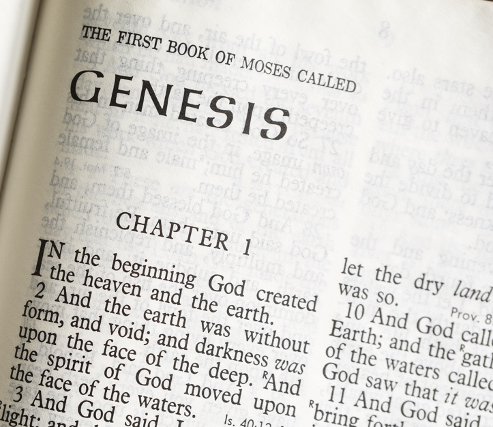
In Genesis, the first book of the Bible, it says, “In the beginning God created the heavens and the Earth.” (Genesis 1:1) The Bible reveals the following things about God and creation:
- God exists outside of time
- God created everything from nothing
- Everything was created for man’s existence
The New Testament book of John tells us that it was through Jesus Christ that everything was created, including life itself. (John 1:1-14).
But what was the evidence that convinced John and the other writers of the New Testament that Jesus was God in human skin?
Jesus’ righteous life, his miracles, and his profound teaching captured the hearts of his followers. But it wasn’t until after Jesus’ resurrection from the dead they fully believed that he was the fulfillment of hundreds of Old Testament prophecies revealing that God himself would come to Earth to become the Savior for our sins, making it possible for us to have eternal life with him (Isaiah 9:6; chapter 53).
Jesus’ followers wrote that he was the one who put the stars in space, established the laws of the universe, and created everything including DNA and us. It was a mind-blowing thought to them that God himself was in their presence.
WHO IS THE REAL JESUS?
The apostle Paul, who originally opposed Jesus, later wrote of him as the Creator of everything—including life itself,
“Now Christ is the visible expression of the invisible God. He existed before creation began, for it was through him that everything was made…. In fact, every single thing was created through, and for him…Life from nothing began through him, and life from the dead began through him, and he is, therefore, justly called the Lord of all.” (Portions of Colossians 1:15-17, J. B. Phillips.)

The New Testament book of Hebrews reveals that Jesus is the radiance of God who created the universe.
It also tells us that God speaks to us today through Jesus Christ.
“In the past God spoke to our ancestors through the prophets at many times and in various ways, but in these last days he has spoken to us by his Son, whom he appointed heir of all things, and through whom also he made the universe. The Son is the radiance of God’s glory and the exact representation of his being, sustaining all things by his powerful word.” (Hebrews 1:1-3, NIV)
If Jesus was the Creator, we would expect his life to have impacted our world more than any other person in history. The historian H.G. Wells, who was not a believer, affirms Jesus’ unique impact on history:
I am an historian, I am not a believer, but I must confess as a historian that this penniless preacher from Nazareth is irrevocably the very center of history. Jesus Christ is easily the most dominant figure in all history.17
So, is Jesus Christ the one who answers the basic questions about life:
- How did we get here?
- What is our purpose here?
- Where do we go after we die?
And what does Jesus tell us about God? Is he merely an impersonal force, or is he a good God who loves us and cares about us personally?
Jesus claimed to not just answer these questions, but to offer forgiveness, acceptance, hope, and a personal relationship with himself as our Creator.
But how do we know his promises are true?
The eBook, Who Is the Real Jesus, answers these important questions.
We encourage you to download the eBook and investigate evidence for Jesus’ reality, his claims, his identity, his resurrection, and his amazing promise of eternal life.