Table of Contents
2. Was There a Jesus Conspiracy?
4. Are the Gospel Accounts of Jesus True?
5. Is Jesus the Jewish Messiah?
6. Did Jesus Rise from the Dead?
8. What Is Jesus’ Plan for Us?
Appendix
B. Did the Apostles Believe Jesus is God?
Published by Y-Jesus.com
Scripture quotations marked NIV are taken from the Holy Bible, New International Version®, NIV®. Copyright © 1973, 1978, 1984, 2011 by Biblica, Inc. All rights reserved worldwide.
Scripture quotations marked NLT are taken from the Holy Bible, New Living Translation, copyright © 1996, 2004, 2007 by Tyndale House Foundation, Tyndale House Publishers, Inc., Carol Stream, Illinois 60188. All rights reserved.
Scripture quotations marked Phillips are taken from The New Testament in Modern English by J.B. Phillips copyright © 1960, 1972 J. B. Phillips. Administered by The Archbishops’ Council of the Church of England. Used by Permission.
Scripture quotations marked NCV are taken from the New Century Version®. Copyright © 2005 by Thomas Nelson. Used by permission. All rights reserved.
“Scripture quotations marked ESV are from The ESV® Bible (The Holy Bible, English Standard Version®), © 2001 by Crossway, a publishing ministry of Good News Publishers. Used by permission. All rights reserved.”
Copyright © 2025 by JesusOnline Ministries
Publisher grants permission to reproduce this material without written
approval, but only for non-profit use. No part of this material may be altered or used out of context without publisher’s written permission.
I am indebted to Dr. Bill Bright, who passed away before this project was finished. Dr. Bright enthusiastically endorsed and contributed to the development of the material presented in this endeavor.
Special thanks are also due to Rick James and Eric Stanford, who have both spent countless hours clarifying some of the concepts presented.
Several others have contributed greatly to the writing of these articles, including Dr. Henry Brandt, Dave Chapman, Dr. Bert Harned, and New Testament scholar, Dr. Ron Heine. The valuable input from Brian Ricci, Jamin Latvala, and the Campus Crusade staff at the University of Washington were especially helpful and constructive. Special thanks also are due Helmut Teichert of Bright Media, who has been the overall director of the project. Finally, I would like to thank my wife, Marianne, for inspiring me to undertake this effort.
Larry Chapman
Published by Y-Origins
Scripture quotations marked NIV are taken from the Holy Bible, New International Version®, NIV®. Copyright © 1973, 1978, 1984, 2011 by Biblica, Inc. All rights reserved worldwide.
Scripture quotations marked Phillips are taken from The New Testament in Modern English by J.B Phillips copyright © 1960, 1972 J. B. Phillips. Administered by The Archbishops’ Council of the Church of England. Used by Permission.
Copyright © 2026 by JesusOnline Ministries
I am indebted to Dr. Bill Bright, who passed away before this project was finished. Dr. Bright enthusiastically endorsed and contributed to the development of the material presented in this endeavor.
Special thanks are also due to Rick James and Eric Stanford, who have both spent countless hours clarifying some of the concepts presented.
Several others have contributed greatly to the writing of these articles, including Dr. Henry Brandt, Dave Chapman, Dr. Bert Harned, and New Testament scholar, Dr. Ron Heine. The valuable input from Brian Ricci, Jamin Latvala, and the Campus Crusade staff at the University of Washington were especially helpful and constructive. Special thanks also are due Helmut Teichert of Bright Media, who has been the overall director of the project. Finally, I would like to thank my wife, Marianne, for inspiring me to undertake this effort.
Larry Chapman
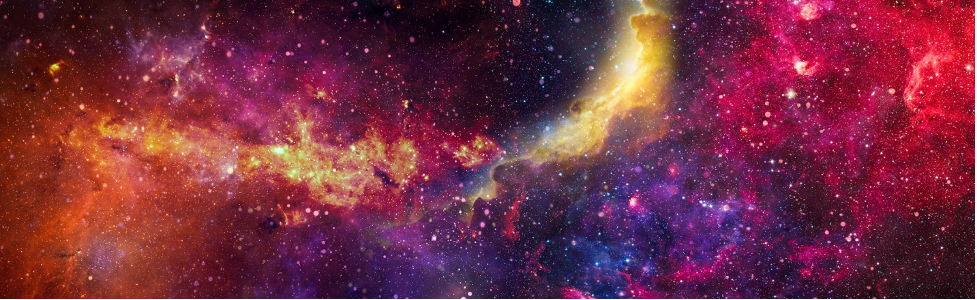
Since the dawn of civilization man has gazed in awe at the stars, wondering what they are and how they got there. Although our unaided eyes can only see about 6,000 stars on a clear night, the Hubble and James Webb telescopes reveal there are as many as 2 trillion galaxies, each with hundreds of billions of stars. Our sun is like one grain of sand amidst all the world’s beaches.
Prior to the 20th century, astronomers believed our own Milky Way galaxy was the entire universe, and that only about 100 million stars existed. The prevalent scientific opinion at that time was that the universe had always existed.
But in the early 20th century, George Lemaitre, a Belgian priest, who was also a professor of physics, showed mathematically from Einstein’s theory of relativity that the universe was expanding. This was a revolutionary thought that most scientists rejected, until 1929 when American astronomer Edwin Hubble discovered evidence that Lemaitre was correct.
Hubble had been spending countless nights at the Mount Wilson Observatory, studying the stars and galaxies and the spectrum of color in the light they sent our way. He discovered the further away a galaxy was from us, the more intense its red shift on the color spectrum. The implication was revolutionary to astronomy because it proved the universe was expanding. That meant it must have had a beginning in the distant past.1
And yet not everyone accepted the proof at first, including the great Albert Einstein.
When Einstein developed his revolutionary theory of general relativity in 1916, his mathematical calculations proved the universe was expanding. And rewinding the tape on the expansion of the universe, you get back to a point where it didn’t exist, confirming it must have had a beginning.2
But Einstein was unwilling to accept a beginning to the universe, fudging the numbers of his own theory to avoid the conclusion that the universe was expanding. So, why would this great scientist fudge his own equations that showed an expanding universe?
University of California astrophysicist George Smoot explains that Einstein’s main problem with an expanding universe was its inference of a beginning. And a beginning pointed to a Beginner beyond scientific investigation.3 However, to Einstein’s credit, once experimental data proved him wrong, he admitted his error, calling it “the biggest blunder of my life.”4
British astronomer Sir Fred Hoyle also opposed the evidence for a beginning to the universe, sarcastically calling it a “big bang.” Hoyle’s name for the creation event stuck. Physics professor Brian Greene explains that the term “big bang” is actually misleading since there was nothing to explode and no space for an explosion to take place.5
For example, when a bomb ejects shrapnel into the air, both the bomb material and the space it blows into have already been there. However, in the beginning of the universe, neither space nor matter existed until the moment of creation.
Hoyle, along with his colleagues Bondi and Gold had proposed the steady-state theory as an alternative to the “big bang.” Their theory predicted the universe is eternal and continually creates new matter to balance its expansion. The steady-state theory was the main scientific rival to Hubble’s evidence that the universe had a one-time beginning.
Professor Dennis Sciama, Steven Hawking’s supervisor while he was at Cambridge, admits his reasons for supporting the steady state theory rather than a one-time beginning:
I was a supporter of the steady state theory, not in the sense that I believed that it had to be true, but in that I found it so attractive I wanted it to be true.”6
Few scientists are willing to be as candid as Dennis Sciama’s admission about why they opposed a beginning to the universe. Einstein, Sciama, Hoyle and other great scientists had originally allowed their materialistic biases to blind them to the new evidence.
Despite his initial opposition, Hoyle finally became convinced by the overwhelming evidence that the universe—including time, space, matter and energy—did have a one-time beginning from nothing.
Stephen Hawking, called Hubble’s discovery of an expanding universe “one of the great intellectual revolutions of the twentieth century.”7 The discovery that the universe had a beginning has led to a new science called cosmology, which attempts to understand what happened at the origin of the universe, how it works, and what will happen in its future.
The discovery of a one-time beginning led cosmologists to take another look at a seemingly mundane insight from the 19th century, the second law of thermodynamics. That law states that everything in the universe is constantly moving from a state of order to disorder. A simple illustration is how a hot cup of coffee will gradually become cold as its heat dissipates. The same is true of stars and planets throughout the universe.
In addition to Hubble’s discovery, the second law of thermodynamics also predicts a beginning to the universe. If the universe were eternal, it would have gone cold and lifeless long ago. The stars would have burned out. Planets would have broken up into clouds of dust. And even the black holes would have ceased vacuuming the universe of unsightly stars and planets.
There is still another way that the measurement of heat helps to prove that the universe is expanding. In the spring of 1964, two researchers at Bell Labs observed a persistent hiss while testing their microwave radiation detector. Regardless of which direction they aimed the antenna, the static was the same. Those men, Arno Penzias and Robert Wilson, had discovered what scientists say is the echo from the birth of the universe.8
According to mathematicians, if the universe began in an intense “explosion,” the heat would have been 100 million trillion trillion degrees Kelvin. However, due to its expansion, that enormous heat would have cooled to slightly under three-degrees Kelvin today.
In 1992, a team of astrophysicists led by George Smoot launched the COBE satellite to verify the temperatures in space. The satellite would be able to take precise measurements and determine whether predicted fluctuations in temperature existed.
The results stunned the scientific world. Not only was the temperature of empty space (2.7 degrees Kelvin) confirmed, but more importantly, the profiles of the fluctuations were discovered to be a match with what had been expected.9 Hawking called the discovery “the scientific discovery of the century, if not all time.” Smoot himself excitedly stated to newspaper reporters,
What we have found is evidence for the birth of the universe.10 If you’re religious, it’s like looking at God.11
Astounded by the news, TV journalist Ted Koppel began his ABC Nightline program with an astronomer quoting the first two verses of the Bible. The other special guest, a physicist, immediately added his quote of the third Bible verse:
In the beginning God created the heavens and the earth. … And God said, ‘Let there be light,’ and there was light. (Genesis 1:1, 3).12
And the evidence kept mounting. Tests from an array of radio telescopes at the South Pole have confirmed the universe had a beginning to a still higher degree of accuracy than ever before. Background radiation measurements exceed 99.9% of what had been predicted.13
There are now more than 30 independent confirmations that the universe had a one-time origin.14 That’s as much forensic proof as most DNA matches.
Today most cosmologists and physicists accept the big bang theory as the scientific explanation of how our universe began. In fact, scientists believe they can trace the history of the universe all the way back to 10-43 of a second. Prior to that point (singularity) in the history of the universe, all theories break down, and science can see no further back.
Some scientists aren’t willing to accept the fact that everything was created from nothing and have attempted to propose alternative ideas as to how the universe came to exist. But these hypothetical proposals are highly speculative without any evidence to support them.
The evidence for a one-time beginning of space, matter, energy, and time itself is like a bad dream for materialists. Smoot remarks,
Cosmologists have long struggled to avoid this bad dream by seeking explanations of the universe that avoid the necessity of a beginning.15
What scientists do know from the evidence is that the universe, and everything in it had a beginning. What materialists struggle with is how it got started and was there a Beginner.
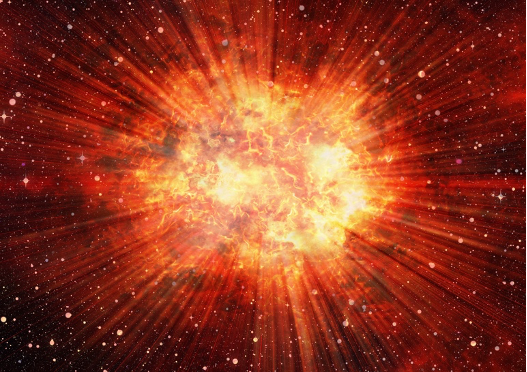
Suddenly, a cataclysmic explosion erupted at a temperature exceeding a million trillion trillion degrees.16
At that point, time, matter, energy, and space all began.
Scientists began asking: “Who or what started it?” Einstein’s theory of relativity predicts that the universe needed an outside force or Beginner.17 Since Einstein’s theory of relativity ranks as the most exhaustively tested and best proven principle in physics, his conclusion is deemed correct by scientists.18
The Genesis account of creation clearly states that God spoke everything into existence from nothing. For centuries scientists scoffed at the Genesis account as mythical. But with the new evidence, Nobel Prize-winning physicist George Smoot admits,
Until the late 1910’s … those who didn’t take Genesis literally had no reason to believe there had been a beginning.19
He also pointed out how the new discovery of a beginning agreed with the Bible.
There is no doubt that a parallel exists between the Big Bang as an event and the Christian notion of creation from nothing.20
But what stunned scientists even more than a beginning to the universe is how finely tuned it is for life. In the next chapter, we will look at the rare conditions that make life possible on planet Earth.

Scientists are rethinking the origin of the universe and its physical laws which make life possible. As cosmologists study our universe, they are in awe of the precise fine-tuning which makes life possible. What they have discovered is that life couldn’t exist unless dozens of physical laws and characteristics in our universe met precise conditions. Cosmologists call this remarkable accommodation for life, fine-tuning.
If the explosion that began our universe was just like an enormous nuclear explosion, it could never have resulted in the life we have today on Earth. What was so different about the creation event that started our universe?
Dr. Robin Collins states in The Case for a Creator,
Over the past thirty years or so, scientists have discovered that just about everything about the basic structure of the universe is balanced on a razor’s edge.1
Collins is referring to the fact that over 35 different characteristics of the universe and its physical laws needed to be precisely fine-tuned for physical life to be possible.2 Following are just six of those 35 characteristics:
At the very moment of creation, the rate and ratios of expansion, mass, density, antimatter, matter, etc., were set in place, eventually leading to a habitable planet called Earth.
In addition to the 35 different characteristics of our universe that must be just right for life to exist, our galaxy, solar system, and planet also needed to be exceptionally fine-tuned, or we would not be here.8
It’s estimated that there are approximately 2 trillion galaxies in the universe, including our own Milky Way galaxy, which contains 100-400 billion stars like our own Sun.
Movies like Star Wars and Star Trek give the impression that life exists in many galaxies throughout the universe.
Surprisingly, given the great number of these star groups, most galaxies are incompatible with life. Let’s look at why.
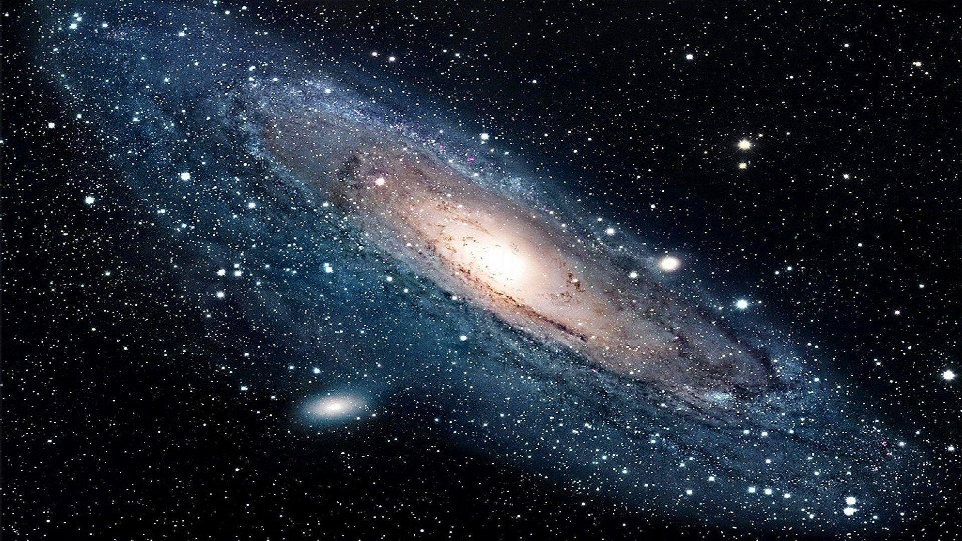
To accommodate life, a galaxy needs to meet several criteria.
Following are just three of the finely tuned characteristics a galaxy needs to support life:
Our Milky Way galaxy meets these and many other conditions essential for life. Most of the other galaxies in the universe can’t accommodate life.
Not only does the universe and characteristics of our galaxy need to be precisely fine-tuned for life to exist, but so does our solar system.
For our existence to be possible, Earth needs to revolve around a sun that is precisely the right size, has the perfect location and life-accommodating conditions as ours does.9
Earth also needs other planets such as Jupiter and Mars to act as defense shields, protecting us from a potential catastrophic bombardment of comets and meteors. Our moon also shields us and is just the right size and location to help impact our tides and seasons. Let’s look at just a few of the many conditions in our solar system that are just right for life.
When astronomers consider our remarkable solar system, they acknowledge that if it was slightly different, advanced biological life would be impossible.
But it is not enough to have the right universe, galaxy, and solar system for human life to be possible. The conditions of our home planet must also be fine-tuned to a razor’s edge.
In the past century, movies and TV shows have popularized the idea that extraterrestrials from other planets exist in our universe. Many have come to believe that thousands of other planets like Earth are abundant in our galaxy and others scattered throughout the universe.
This desire to find intelligent life elsewhere in the universe has led to an all-out effort by scientists to search for radio signs of intelligence throughout the galaxy. In 1961, astrobiologist Frank Drake calculated the probability that other intelligent life could exist in the Milky Way. If so, we would presumably discover their radio signals.
Since 1984, over 100 researchers from SETI (Search for Extraterrestrial Intelligence) have explored the galaxy with an array of telescopes searching for planets that could harbor life.
Since then, only a few potential planets have been located, but no radio signals or other evidence of life have been discovered. The silence from space is discouraging for those who want to find life elsewhere in the universe.
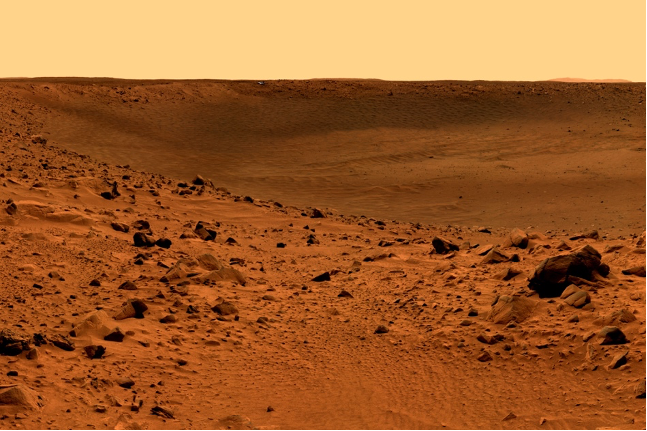
In our own solar system, NASA’s images of Mars, Venus, Mercury, Jupiter, and other planets in our solar system show no evidence of life. Just lots of rocks and barren volcanic material. A look at the surface of Mars reminds us of what barrenness looks like. Although it appears Mars had water in the past, no evidence of microbial life has yet been discovered.
Life on Earth exists because we live on a planet perfect for life, in a rare solar system, located in an extremely rare galaxy, within a finely tuned universe.
The reality is that there are no other planets astronomers have discovered that are like planet Earth. They are all just gas giants or a surface of rocks similar to this image of Mars.
Here are just a few reasons that make life on Earth possible.
These and other conditions make Earth unique, not only in our solar system, but throughout the universe. Regardless of what science fiction books and movies like Star Trek and Star Wars depict, life on Earth is unique and extremely improbable.

So, what are scientists saying about life on Earth being so improbable?
University of Washington professors Peter Ward and Donald Brownlee conclude in their book, Rare Earth, that life must be so rare in the universe that “not only intelligent life, but even the simplest of animal life is exceedingly rare in our galaxy and in the universe.”12
The big question the book raises is, “Are we alone?”
The New York Times reviewer of Rare Earth concludes:
“Maybe we are alone in the universe, after all.”13
Incredibly, Earth appears to sit alone in a hostile universe devoid of life, a reality described in a National Geographic article:
If life sprang up through natural processes on the Earth, then the same thing could presumably happen on other worlds. And yet when we look at outer space, we do not see an environment teeming with life. We see planets and moons where no life as we know it could possibly survive. In fact, we see all sorts of wildly different planets and moons—hot places, murky places, ice worlds, gas worlds—and it seems that there are far more ways to be a dead world than a live one.14
The incredibly precise numerical values required for life confront scientists with obvious implications. Stephen Hawking observed,
The remarkable fact is that the values of these numbers seem to have been very finely adjusted to make possible the development of life.15
Although it’s possible intelligent life will be discovered elsewhere in the universe, the odds against it are so overwhelming that scientists have concluded that any intelligent life in our vast universe defies all probability. In other words, we shouldn’t even be here.
Once scientists were convinced that the universe had a one-time beginning, they began asking how a random explosion in the distant past could result in the complexity of life we see today. Where did these laws come from? Is there a scientific theory that can explain everything from a materialistic perspective?
An article in U.S. News & World Report summarizes the lack of a scientific answer to the question of why physical laws are so perfectly designed.
So far, no theory is even close to explaining why physical laws exist, much less why they take the form they do. Standard big bang theory, for example, essentially explains the propitious universe in this way:
“Well, we got lucky.”16
So, did we just get lucky to live in a universe, galaxy, solar system and planet that is perfectly fine-tuned for life, or is a superintelligent Creator behind all the precise laws and characteristics that led to life on Earth?
We will examine that intriguing question in the next chapter.
After Edwin Hubble’s discovery that the universe had a one-time beginning, cosmologists soon realized that the universe and its laws have been perfectly fine-tuned for human life.
The fine-tuning of the universe resulting in intelligent life has scientists scratching their heads about why Earth is the only planet in our galaxy where life has been discovered. Although the Drake equation predicts there could be other intelligent life in our galaxy, so far, all efforts to discover it have been unrewarded.
For life to be possible, over a hundred parameters must be balanced on a razor’s edge. If just one of them was off by just a slight degree, you wouldn’t be reading this. Scientists began investigating the odds of a random big bang producing life as we know it.
Donald Page of Princeton’s Institute for Advanced Study has calculated that the probability of life existing in our universe is just one out of 10124, a number beyond imagination.1
Astronomer Hugh Ross calculates that the probability for life to exist on Earth is less than 1 chance in 10282.2 To put that number in perspective, it would be easier to pick just one atom out the entire universe than for life on Earth to exist. (There are 1080 atoms in the observable universe.)
Another way to try and visualize the difficulty of life originating from a random explosion is to imagine burying one specially marked grain on a beach somewhere on Earth, and having a blindfolded person randomly discover it on his or her first pick.
The chance of a person discovering that one grain of sand on their first pick is one out of 1020 (one chance in 100 billion billion.) It would be astronomically easier to pick that one grain of sand from the beaches of the world than the probability of life existing on Earth.
So, what are the odds of an unplanned big bang producing human beings? Roger Penrose, Nobel Prize winning mathematician, has calculated the probability of human life resulting from natural processes alone at 10-1023. That’s a probability so small that it’s mathematically impossible to have occurred randomly.3
To help us grasp the improbability, imagine (if it were possible) winning over a trillion trillion trillion trillion trillion trillion trillion trillion trillion trillion trillion trillion trillion trillion Power Ball lotteries successively after purchasing only one ticket for each lottery.
Absolutely impossible—unless the outcome for each lottery had been fixed by someone in control. And that is what many scientists are thinking—that the fine-tuning of our physical laws and their constraints must have been “fixed”—or programmed—by a Superintelligence.
The improbability of life prompted Physicist Paul Davies to conclude the obvious, “The conclusion must be that we live in a world of astronomical unlikelihood.”4
So, are we just lucky to be here, or is there something or Someone who programmed everything to make life possible? That’s the big question scientists are grappling with.
Let’s look at how they answer that question.
Science cannot answer the question of how the universe began because all laws of science break down before 10-43 of a second prior to the initial explosion (singularity). That means that science cannot empirically look back on what led to its birth. They can only speculate.
The origin and fine-tuning of the universe for life have divided the scientific community into those who believe there must be a Superintelligence behind everything and those who believe in a purposeless, materialistic existence. Since science itself assumes a natural, materialistic explanation for everything, some scientists are unwilling to accept a supernatural force that is behind it all. Essentially there are two opposing views regarding the origin of the universe and its fine-tuning for life: materialism and intelligent design.
In the last few hundred years, a paradigm shift has taken place in science when it comes to the question of God and creation.
The former paradigm assumed God existed. Modern science began with a desire to know how God created the universe. Great scientific minds who believed in God were Isaac Newton (laws of motion and gravity), Galileo Galilei (astronomy), Johannes Kepler (planetary motion), Robert Boyle (chemistry), and Francis Bacon (scientific method).
However, since the 18th century, science has evolved into having a materialistic worldview. That later paradigm attempted to exclude God from scientific conclusions.
It is primarily due to the arguments of 18th century English philosopher David Hume that science has dismissed any argument for intelligent design of the universe and the laws that brought it about. Hume, a materialist, claimed the universe emerged by undirected natural causes alone, without any supernatural intelligence.
So, even if overwhelming evidence logically points to intelligent design, materialists will reject it as an explanation, calling it “unscientific.” That is because their world view rules out any evidence or inference of God or the supernatural.
However, the evidence for a one-time beginning of the universe and its fine-tuning for life has many objective scientists rethinking our origins. The improbability of human life from a big bang prompted Stephen Hawking, the British theoretical physicist to ask,
What is it that breathes fire into the equations and makes a universe for them to describe? The usual approach of science of constructing a mathematical model cannot answer the questions of why there should be a universe for the model to describe.5
Hawking goes on to say that the answer to that question lies beyond scientific research and needs to be addressed by philosophers. Later, when asked about the incredible fine-tuning required for life, Hawking related to a reporter,
The odds against a universe like ours emerging out of something like a big bang, are enormous. … I think clearly there are religious implications whenever you start to discuss the origins of the universe.6
Materialists like Hawking attempted to find non-religious explanations for the improbability of life and our existence. He speculated that our universe could be just one of many other universes, thereby increasing the probability that life would exist in at least one of them.
Hawking’s Cambridge colleague Sir Martin Rees has also considered the idea that our universe might be one of many others. He writes of his reason for agreeing with Hawking,
If one does not believe in providential design, but still thinks the fine-tuning needs some explanation, there is another perspective—a highly speculative one.… It is the one I prefer, however, even though in our present state of knowledge any such preference can be no more than a hunch.…There may be many “universes” of which ours is just one.7
Like Hawking, Rees is a materialist who admits favoring the multi-universe idea because it provides an alternative to providential design.
But is the search for other universes driven by science, speculation, or materialistic bias? Charles Seife, a mathematician and journalist for Science magazine, explains what he believes to be the real motivation behind the multi-universe theory:
Scientists tend to be uncomfortable with coincidences, and the many worlds interpretation gives a way out.8
Even Hawking and Rees, admitted multiple universes can never be empirically verified. In The Elegant Universe, Brian Greene calls the multi-universe idea “a huge if.”9
Physicist Paul Davies explains why materialists are so fervent in their attempts to validate the multi-universe theory. In Other Worlds, he writes,
Whether it is God, or man, who tosses the dice, turns out to depend on whether multiple universes really exist or not. If instead, the other universes are ghost worlds, we must regard our existence as a miracle of such improbability that it is scarcely credible.10
In his book, God and the New Physics, Davies explains why many scientists reject the multi-universe idea as too speculative. Since Hawking’s hypothesis is based on imaginary time rather than scientific evidence, Davies asserts that belief in multiple universes “must rest on faith rather than observation.”11
However, isn’t that the exact criticism materialists use against intelligent design? Yet, intelligent design is based on scientific discovery, whereas belief in multiple universes has no scientific evidence whatsoever to support it.
That’s the reason investigative reporter for the Atlantic Monthly, Gregg Easterbrook, concludes his research on the multi-universe idea by stating,
The multi-verse idea rests on assumptions that would be laughed out of town if they came from a religious text.12
There are only two options for why everything in our universe is so precisely fine-tuned for life:
In Alpha & Omega, Charles Seife summarizes how some view the fine-tuning:
It seems like a tremendous coincidence that the universe is suitable for life.”13
Cosmologists Bernard Carr and Sir Martin Rees state in the journal Nature,
Nature does exhibit remarkable coincidences and these do warrant some explanation.”14
In another article in Nature, Carr leaves the identity of the “tailor” to theologians.
One would have to conclude either that the features of the universe are only coincidences or that the universe was indeed tailor-made for life. I will leave it to the theologians to ascertain the identity of the tailor.15
Although Hawking continually tried to theorize how life could have originated naturally without Superintelligence, he admitted,
It would be very difficult to explain why the universe should have begun in just this way, except as the act of a God who intended to create beings like us.16
Albert Einstein, who also didn’t believe in a personal God, concluded that the universe must have been designed by a Superintelligence.
After he finally accepted the evidence for a beginning of the universe, as well as its incredible fine-tuning, Einstein referred to its Creator as—
… an intelligence of such superiority that, compared with it, all the systematic thinking and acting of human beings is an utterly insignificant reflection.17
In response to the evidence, Carr, Rees, Hawking, and Einstein all allude to an intelligent designer, but their materialistic bias prevented them from accepting it as reality.
However, Cosmologist Edward Harrison speaks for more objective scientists who respond to the evidence for fine-tuning by clearly stating the obvious:
Here is the cosmological proof of the existence of God. The fine-tuning of the universe provides prima facie evidence of deistic design…. Many scientists, when they admit their views, incline toward the design argument.18
Although many scientists remain materialists, the evidence for fine-tuning has had its impact on those willing to look beyond the boundaries of science for an answer to why we exist. There is an increasing number who believe it confirms the biblical account of creation which teaches that human life is the focus of a supernatural plan.
Arno Penazis, Nobel Prize winner in physics, was convinced that is true. He concludes,
Astronomy leads us to a unique event, a universe which was created out of nothing, one with the very delicate balance needed to provide exactly the conditions required to permit life, and one which has an underlying (one might say, ‘supernatural’ plan).19
The big question confronting science is: how did life itself begin on Earth? Materialists believe life must have begun when organic chemicals accidentally combined to form amino acids which then became proteins.
However, Biochemists have discovered that the secret to life is the sophisticated coding (software) in an incredibly complex molecule called deoxyribonucleic acid, better known as DNA.
In the next chapter we will examine DNA, the highly complex molecule with its specialized “software” that makes life possible. After examining the sophisticated coding of DNA, we will hear what scientists say about whether DNA could have originated by chance alone.
Prior to the 19th century, no one had any idea how life originated on Earth other than an act of God. Materialists, who did not believe in God, just assumed a natural explanation would eventually emerge.
Charles Darwin’s theory of evolution published in 1859, only dealt with the development of life through natural selection, not with the origin of the first living cell.He assumed that life occurred spontaneously when organic molecules somehow combined in a slimy pond.
Nevertheless, biologists believed Darwin’s theory ruled out the need for a designer in the origin of life as well as its development into various species. In The God Hypothesis, Cambridge educated philosopher of science, Dr. Stephen Meyer, reveals that physicists have been more willing to acknowledge a “superintellect” than have biologists. He writes,
Whereas many physicists have recently considered design by a ‘superintellect’ as an explanation for the origin of the finely tuned features that make life possible in the universe, biologists have long resisted the design hypothesis. Ever since Darwin, they have assumed that they could…explain ‘design without a designer.’1
Encouraged by Darwin’s “guess” as to how life began, chemists began laboratory experiments hoping to create life. In the 1950’s, Harold Urey, a professor at the University of Chicago challenged his students to create life in a test tube. One of his students who tried, Stanley Miller, was jubilant when after enormous efforts he produced a few amino acids—the building blocks of proteins.
It all appeared so promising, but what Miller did not understand then was that without an extremely sophisticated molecule called DNA, those amino acids would never be able to form proteins—the stuff of life. The initial euphoria of his experiment faded once further discoveries from biochemistry revealed life’s incredible complexity.
Professor J.P. Moreland compares such laboratory results with the complexity required to generate life:
If life can be likened to an encyclopedia in complexity and information, the best we have done is to synthesize a compound which carries the complexity and information of the word ME. The jump from ME to an encyclopedia is so far and speculative that the relevance of progress so far is questionable.2
In the many decades following Miller’s discovery, biologists are not any closer to creating life in a test tube.
Cambridge Professor of Evolutionary Paleobiology, Simon Conway Morris, remarks on chemists’ many failed efforts to replicate life in a test tube. He explains,
Something is clearly missing: life cannot be created in the laboratory, nor is there any clear prospect of it happening.3
Having failed in their attempts to create life in a laboratory, biologists kept searching for answers to the question of how life began. Finally, in the 1950s there was a stunning breakthrough in their research.
On February 28th, 1953, two biologists, James Watson and Francis Crick, announced that they had discovered “the secret of life.” What they had discovered was the structure of DNA, which could store information in the form of a four-character digital code.4
As evolutionists, Watson and Crick originally reminded biologists that the intelligent coding of DNA was “not designed but rather evolved.”5 However, as the complex coding of DNA became understood, biologists came to realize that natural selection could never have created the intelligence behind its sophisticated coding.
Let us look closer at DNA, and why, in Meyer’s words, “the materialist understanding of life has begun to unravel.”6
DNA (deoxyribonucleic acid) is an extremely complex molecule that instructs amino acids to form specific proteins that are the building blocks of life and its diversity. Every living thing on Earth has its own unique DNA.
Each DNA molecule contains the complete genetic blueprint for every cell in every living thing. In a sense it is like a recipe where common ingredients make different dishes. DNA is essentially a chemical software program that instructs cells to make life in all its diversity whether it be flowers, trees, whales, lions, chickens, dogs, chimps, or people.
The genius of DNA lies not only in its complex coded instructions for life but also in its incredibly well-designed architecture, which allows it to contain billions of detailed instructions within a microscopic molecule. Incredibly, just one gram of DNA could theoretically store 215 million gigabytes of data, nearly a million times the storage capacity of an average home computer.
Our genetic blueprint is present in each of our thousand million million cells. Imagine an enormous building with thousands upon thousands of rooms, where each room houses a complete set of blueprints for the entire structure. However, instead of thousands of cells, our bodies contain trillions of cells, each with a complete package of DNA instructions.7
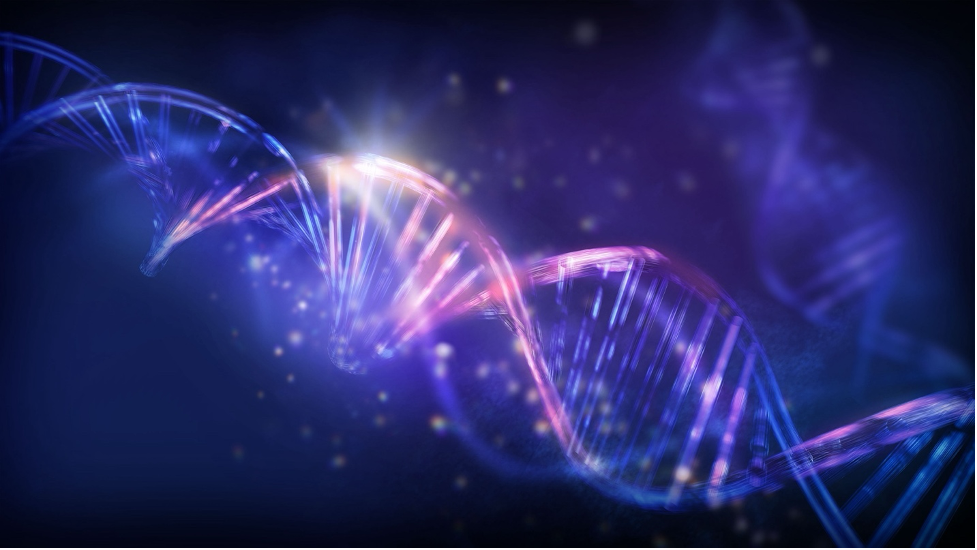
When DNA directs the cell to make proteins, it first gives instructions to make amino acids. Then twenty different amino acids must precisely link up into a chain, folding into an exacting, irregular three-dimensional protein. Amino acids are like letters in an alphabet; their arrangement spells out each specific protein.
The process of amino acids constructing proteins is incredibly precise and complex. MIT-trained scientist Dr. Gerald Schroeder explains,
An adult human body is made of approximately seventy-five trillion cells. Every second of every minute of every day, your body is organizing on the order of 150 thousand thousand thousand thousand thousand thousand amino acids into carefully constructed chains of proteins.8
Each strand of DNA in our bodies consists of three billion base pairs of genetic information. These base pairs form a chain, which constitutes the entire human genetic code. Today the entire human genome has been mapped, showing the uniqueness of our species. Even though humans are closest to chimpanzees in DNA sequencing, there are still a staggering 40 million differences.9
DNA works much like a coded language. Microsoft founder Bill Gates discloses,
DNA is like a computer program, but far, far more advanced than any software we’ve ever created.10
So how did a molecule with such complex coded instructions originate? What natural process triggered a smattering of organic chemicals to come together and form the incredibly sophisticated double helix? Gerald Schroeder remarks,
And here’s that enigma. … It shows its head in a dozen different ways, the problem of how the entire process originally got started.11
Such complexity is so improbable that scholars like Morris, Schroeder, Meyer, and a host of biochemists believe DNA coding exhibits creative intelligence beyond random chemical bonds. However, evolutionists are still searching for a natural origin of DNA’s origin.
Having acknowledged the impossibility of DNA to originate naturally, some scientists wondered if DNA emerged from RNA. However, biologists who have analyzed RNA now believe it too “could not have emerged straight from the prehistoric muck.”12
The origin of DNA remains an unsolved mystery, causing some evolutionists to reconsider their materialistic world view. In Probability 1, mathematician and evolutionist Amir Aczel summarizes the DNA dilemma for materialists:
Having surveyed the discovery of the structure of DNA … and having seen how DNA stores and manipulates tremendous amounts of information (3 billion separate bits for a human being) and uses the information to control life, we are left with one big question: What created DNA?13
An increasing number of scientists in other fields are also admitting that DNA’s complexity is not explainable by mere chance any more than that of the fine-tuning of our universe is for life. Theoretical physicist Paul Davies affirms in The 5th Miracle,
The peculiarity of biological complexity makes genes seem almost like impossible objects. …I have come to the conclusion that no familiar law of nature could produce such a structure from incoherent chemicals with the inevitability that some scientists assert.14
Biochemistry professor Michael Behe explains how DNA and its function in the cell has puzzled scientists seeking a natural explanation.
In the face of the enormous complexity that modern biochemistry has uncovered in the cell, the scientific community is paralyzed.15
Although he was an agnostic, Astronomer, Fred Hoyle, shocked materialists by admitting,
Were a refined theory available for estimating the information content of DNA it would, in our opinion, be immediately apparent from its overwhelming content that life could never have arisen on a miniscule planet like on Earth. It would be seen that, to match the information content of even the simplest cell, nothing less than the resources of the entire Universe are needed.”16
In light of the evidence of design, what are evolutionists concluding about DNA’s origin?
Atheist Richard Dawkins, who is an outspoken adversary of intelligent design has written, “biology is the study of complicated things that give the appearance of having been designed for a purpose.”17
Yet other leading scientists are willing to objectively look at the evidence. Evolutionist Amir Aczel questions his own materialistic belief by considering DNA as too complex to have arisen from natural processes. In an objective mode he asks,
Are we witnessing here something so wondrous, so fantastically complex, that it could not be chemistry or random interactions of elements, but something far beyond our understanding?18
The most knowledgeable biologist on the intricate coding of DNA is its co-discoverer, Francis Crick, a staunch evolutionist. The Nobel Prize–winning biologist admits,
An honest man, armed with all the knowledge available to us now, could only state that in some sense, the origin of life appears at the moment to almost be a miracle, so many are the conditions which would have had to have been satisfied to get it going.19
As a materialist, Crick began looking to outer space for the origin of life (panspermia).
Aczel reasons that the complexity of DNA could not have arisen naturally on Earth, asking,
Was it perhaps the power, thinking, and will of a supreme being that created this self-replicating basis of all life?20
Like Crick, Aczel concludes that DNA must have arrived from outer space (panspermia). However, not a shred of evidence backs that up. Because of their bias against intelligent design, materialists simply can’t accept intelligent design as how life originated—regardless of the evidence.
However, DNA’s intelligent coding led to many atheists admitting the compelling case for intelligent design. British philosopher Antony Flew, a leading atheist for fifty years, became so overwhelmed by the intelligent coding of DNA that he admitted,
What I think the DNA material has done is show that intelligence must have been involved in getting these extraordinarily diverse elements together. The enormous complexity by which the results were achieved look to me like the work of intelligence.21
Flew accepts Darwinian evolution as how life eventually developed but doubts it can account for life’s origins. He concluded that intelligent design is the best option to explain biological complexity. Flew made front page news when he renounced his fifty years of atheism, remarking,
The argument to Intelligent Design is enormously stronger than it was when I first met it…It now seems to me that the finding of more than fifty years of DNA research have provided materials for a new and enormously powerful argument to design.22
Flew was convinced by the overwhelming complexity of DNA’s coding in the sequencing of amino acids to form proteins. Meyer compares the sequencing of the amino acids in DNA to a language, noting,
Amino acids alone do not make proteins, any more than letters alone make words, sentences or poetry.23
Meyer then explains that the odds of such sophisticated coding developing without an intelligent designer are beyond all probability. He writes,
The probability of producing even a single functional protein of modest length (150 amino acids) by chance alone in a prebiotic environment stands at no better than …1 chance in 10164, an inconceivably small probability.24
To grasp such an astronomical number, consider that the odds against winning a Power ball lottery with a single ticket are about 1 in 108. Or trying to pick a solitary atom from all the atoms in the universe would be 1 in 1080. Meyer compares the intelligence required for codes and languages with that of DNA.
Our experience with information-intensive systems (especially codes and languages) indicates that such systems always come from an intelligent source.25
Honest atheists like Flew are persuaded that DNA could not have originated by chance. Materialists who struggle to explain the origin and fine-tuning of our universe for life are now even more perplexed by that tiny molecule, DNA. Perhaps they should consider the words of Einstein, who referred to the intelligence behind creation as, “infinitely superior” to human understanding.
Prior to the discovery of DNA, Charles Darwin theorized that life evolved from the tiniest protocell into every other form of life, including ours. He claimed that the evidence would eventually support or refute his claims.
In the past hundred years biochemists have discovered startling new evidence about the cell’s complexity that challenges Darwin’s materialistic assumptions.
In the next chapter we will look at what Darwin predicted about “organs of extreme perfection” like the eye and discover whether his theory of macroevolution has been verified or refuted by the evidence.
When Charles Darwin published Origin of Species in 1859, materialists rejoiced. Darwin was their hero because he created a new paradigm where God was squeezed out of science. No longer was the biblical view of creation considered scientifically credible.
No scientific theory has impacted civilization more than Darwin’s theory that all of life began and developed naturally without a Creator.
Darwin’s theory of macroevolution, that all life evolved over time from the first primordial creature into every species that has ever existed, changed the landscape of biological science as well as our culture.
Although Darwin never intended his theory to be a foundation for evil, both Hitler and Stalin justified their atheism and racial oppression on his theory that only the fittest survive. If we are simply the result of random mutations, what meaning would human life have? His view that certain races were inferior to others promoted racism and led to slavery of blacks.
Darwin’s theory that life could be explained apart from God was a source of moral freedom for materialists. Atheist, Richard Dawkins, stated his personal satisfaction with Darwin’s theory because the reason for our existence could be explained without God. He wrote,
Darwin’s theory of evolution…is satisfying because it shows us…how unordered atoms could group themselves into ever more complex patterns until they ended up manufacturing people. Darwin provides a solution, the only feasible one so far suggested, to the deep problem of our existence.1
Many people think of Darwin’s theory of evolution as just one theory. However, Darwin actually proposed two theories: Microevolution and Macroevolution. His theory of microevolution was based on indisputable evidence, but macroevolution was hypothetical, without scientific evidence to support its claims. Let’s look at the significant difference between his two theories.
Microevolution: While visiting the Galapagos Islands in 1831, Darwin observed finches had evolved with different beaks to help adapt to their unique food source. Creatures that adapt to their environment survive better than those that don’t, passing on favorable mutations to their offspring. Selective breeding of animals uses the same principle. Darwin was correct about microevolution. Just as his finches adapted to their unique environment, so do all species adapt, whether by natural selection or by selective breeding.
Macroevolution: The big leap Darwin took from minor changes within a species was his assumption that over billions of years favorable mutations due to natural selection changed one species into another species, the tiniest microbe through several stages eventually becoming a human being. His big assumption was that every species has evolved from lower forms of life.
Darwin did have concerns whether evidence would support his theory of macroevolution. There were two primary claims his theory made that he said would either prove or disprove macroevolution:
Complex Organs: Darwin realized that complex organs appear designed, but stated,
If it could be demonstrated that any complex organ existed which could not possibly have been formed by numerous, successive, slight modifications, my theory would absolutely break down.2
Transitional Fossils: Darwin predicted “truly enormous” numbers of intermediate varieties in the fossil record. However, he was greatly concerned that his predicted transitional fossils weren’t being found. In the next chapter, “Where are Darwin’s Fossils,” we examine the fossil evidence to see if his prediction holds true.
In his Origin of Species, Darwin dedicated a chapter to“Organs of Extreme Perfection and Complication,” where he tried to explain how complex organs like the eye could evolve, even though sight wouldn’t be possible until all its parts were fully functional.
Darwin assumed the eye began as a light-sensitive cell in a primordial creature, giving it a survival advantage which evolved into a fully functional eye over millions of years. He based his belief partially on the fact that various forms of eyes exist in different species.
But Darwin admitted having no idea how that first primordial creature developed a light-sensitive cell, dismissing its origin as unimportant. In Origin of Species he wrote,
How a nerve comes to be sensitive to light hardly concerns us more than how life itself originated.3
In 1859 when Darwin published his theory, biologists were unaware of how intricately complex organs like the eye function at the molecular level. He only dealt with the eye as a complete organ, not as a highly integrated organ with millions of working parts.
Darwin’s theory that complex organs like the eye gradually evolved over millions of years has been invalidated by the new evidence revealed by the electron microscope. The new discoveries of how the eye works at a molecular level have stunned evolutionists.
Next to the brain, the eye is the most complex organ in the human body, with over two million working parts at the molecular level. Sight is only possible if all its parts work together in synchrony. Yet, if each part needed to evolve before being functional, how could a partial eye provide a survival advantage during the millions of years it took to develop?
Was Darwin’s speculation on how the eye evolved just wishful thinking? He realized that if his theory couldn’t explain how complex organs like the eye evolved, his entire theory of macroevolution would “absolutely break down.” Several years after he had written his world-changing theory Darwin admitted his fear in an 1860 letter to botanist Asa Gray,
The eye to this day gives me a cold shudder.4
And it is no wonder that he was concerned. Darwin’s big problem was answering the question of how a non-seeing eye kept gradually evolving toward its ultimate function of sight without any foreknowledge of what that function was. Darwin still maintained his speculative idea that the eye evolved in successive steps over millions of years by chance.
The Human Eye and its Primary Functioning Parts
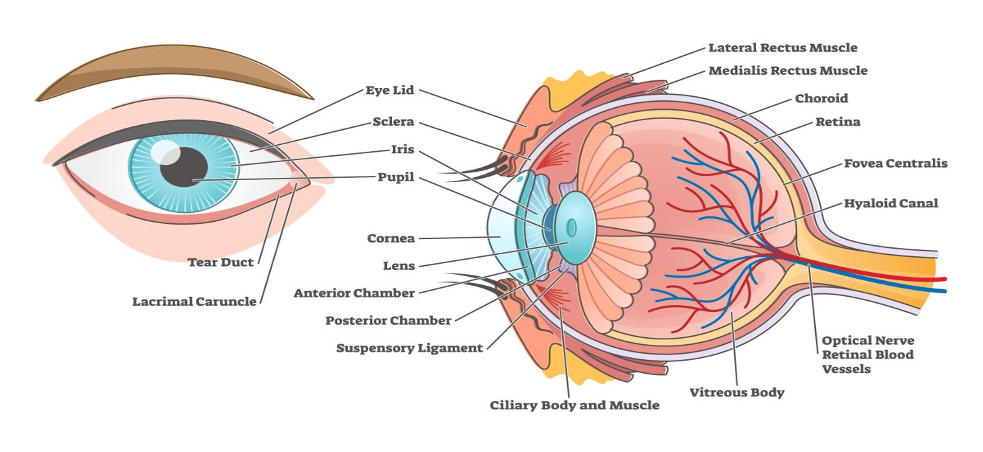
Darwin wrote about how the eye could gradually evolve almost 100 years before the invention of the electron microscope, which gave biochemists a completely different understanding of how the various parts of the eye synchronize to provide sight.
Dr. Gerald Schroeder, an MIT-trained scientist, explains how the eye processes information.
The wind blows and thousands of leaves shimmer in the sun. Your eye sees them all. A million, more probably a billion, ion channels opening and closing along the ganglia of a million optic nerves leading from the retina to thalamus and on to the visual cortex, cycling thirty times a second, as bioelectric signals, the information that records the motion of each of those leaves, reach into your brain. A myriad of chemical reactions, all in parallel, simultaneously recording the data.5
The eye is infinitely more complex than Darwin ever imagined. Instead of whole eyes evolving as he thought, each of over two million working parts would need to have evolved in synchrony with the others to provide sight. Professor of Biochemistry Michael Behe explains how the mystery of biochemical processes in Darwin’s day is like a “black box” that has finally been opened and exposed by the electron microscope. Behe explains,
Now that the black box of vision has been opened, it is no longer enough for an evolutionary explanation of that power to consider only the anatomical structures of whole eyes, as Darwin did in the 19th century….Each of the anatomical steps and structures that Darwin thought were so simple actually involve staggeringly complicated biochemical processes that cannot be papered over with rhetoric.6
An eye can’t see without a pupil, lens, cornea, iris, optic nerve, etc. all fully functioning. And, since the optic nerve processes each visual image in the brain, how could it provide sight before all other parts were fully functioning? And, as a separate organ, how did the brain prepare itself to process information from the optic nerve?
The eye is an example of what Behe calls “irreducible complexity,” where multiple interdependent parts of a biological system or organ are all needed for it to function.
If Darwin’s general theory of evolution is a valid explanation of how life can develop apart from outside intelligence, then it must be demonstrated to be operating at the molecular level. But does Darwin’s theory hold up under such scrutiny?
Not according to Behe. In Darwin’s Black Box, he demonstrates how the electron microscope has revealed a world of irreducible complexity far beyond what Darwin imagined. In the mid-19th century, microscopes and other scientific instruments were nowhere near powerful enough to detect objects at a molecular level.
Behe’s field of biochemistry did not begin until after the advent of the electron microscope. Yet biochemistry is the most critical of all the disciplines for this study, because it analyzes life at the cellular level and observes the molecular foundations of living organisms.
Behe uses the illustration of an ordinary mousetrap as a nonliving example of irreducible complexity. Five basic parts of the trap must work together for it to catch mice:
A mousetrap needs each of these parts functioning properly to kill mice. Each part works interdependently, and so a partially constructed mousetrap serves no function and is worthless. Behe explains,
The point of irreducible complexity is that the mouse trap needs all of its parts to function. The challenge to Darwinian evolution is to get to my trap by means of numerous, successive slight modifications. You can’t do it. Besides, you’re using your intelligence as you try. Remember, the audacious claim of Darwinian evolution is that it can put together complex systems with no intelligence at all.7
Darwin’s Black Box focuses on a handful of examples, though Behe states that any biology book contains dozens of them.
One of the examples he cites is the microscopic bacterial flagellum, which some bacterium use as a miniature whip-like rotary motor to propel itself. The flagellum is a swimming device that works similar to a rotary propeller.8
Working Parts of Bacterial Flagellum
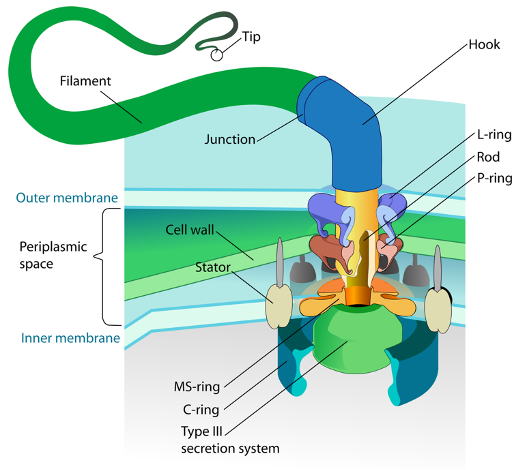
Labeling Darwin’s explanation an “oversimplification,” Macnab questions how a non-functional “preflagellum” could have evolved part by part with each being indispensable to its completed function.9
Although evolutionists attempt to discredit Behe’s example of irreducible complexity, Dr. William Dembski points out the failure of Darwinian evolution to explain such complex systems as the flagellum.
Darwin’s theory, without which nothing in biology is supposed to make sense, in fact offers no insight into how the flagellum arose.10
Behe explains how the electron microscope has given us a new understanding of the complexity of the cell. He writes of the “molecular machines” found in the cell,
As strange as it may seem, modern biochemistry has shown that the cell is operated by machines—literally molecular machines. Like their man-made counterparts (such as mousetraps, bicycles, and space shuttles), molecular machines range from the simple to the enormously complex mechanical, force-generating machines, like those in muscles; electronic machines, like those in nerves; and solar-powered machines, like those of photosynthesis.11
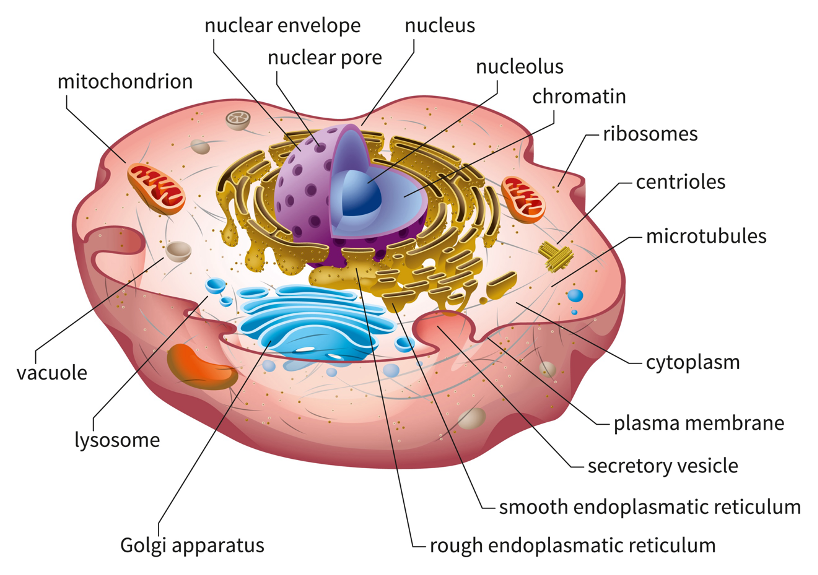
Darwin understood that cells were the building blocks of life and contained a nucleus and nucleolus. But he was unaware of DNA, RNA, genes, or the intricate molecular machinery within them. Without any knowledge of DNA, Darwin attempted to derive his own theory of genetics (pangenesis), but it was eventually proven to be false.
The magnified cell in Darwin’s day looked something like an opaque pancake-like jellyfish with a fuzzy-looking shady spot in the center called the nucleus. It all looked so simple back then. Only recently, under powerful magnification, have the mysteries of the cell’s complexity begun to be unveiled. Molecular biologist Michael Denton uses a metaphor to describe the cell’s complexity:
To grasp the reality of life as it has been revealed by molecular biology, we must magnify a cell a thousand million times until it is twenty kilometers in diameter and resembles a giant airship large enough to cover a great city like London or New York. What we would then see would be an object of unparalleled complexity and adaptive design. On the surface of the cell we would see millions of openings, like the port holes of a vast spaceship, opening and closing to allow a continual stream of materials to flow in and out. If we were to enter one of these openings we would find ourselves in a world of supreme technology and bewildering complexity.12
But, again, it is not simply complexity; it is irreducible complexity. Going back to Behe’s illustration of the mousetrap, everything must be in place for the system to work.
Missing just one component, the whole system is worthless.
Cell Structure
Darwin’s Black Box is a scientific book, not a theological one, but Behe has been joined by an increasing number of open-minded scientists who claim they see the fingerprints of intelligent design within irreducibly complex biological systems. Cosmologist Alan Sandage speaks for many of them:
The world is too complicated in all its parts and interconnections to be due to chance alone. The more one learns of biochemistry the more unbelievable it becomes unless there is some type of organizing principle—an architect for believers.13
It is important to mention here that Darwin’s theory of microevolution, which explains small variations within a particular species, has been verified time and again as valid science through nature as well as by selective breeding.
However, his theory of macroevolution has not been able to explain the irreducible complexity of “organs of perfection” like the eye. In Darwin’s own words, such failure would cause his theory (of macroevolution) to “absolutely break down.”
James Shapiro, a biochemist at the University of Chicago, pronounces his verdict on Darwin’s theory of macroevolution.
There are no detailed Darwinian accounts for the evolution of any fundamental biochemical or cellular system, only a variety of wishful speculations.14
Biochemistry has addressed Darwin’s concern about “organs of extreme perfection,” and found that his theory is incapable of explaining the irreducible complexity found in the eye, the cell, and many other biological “machines.” In his own words, evidence at the molecular level shows that his theory of macroevolution “absolutely breaks down.”
Do Darwin’s predicted fossils really exist? He assumed that massive numbers of transitional fossils would eventually be discovered, proving his theory of macroevolution right. However, he admitted that if such intermediate fossils weren’t discovered he would be proved wrong. So, after over a century and a half, what does the evidence show?
In the next chapter we will see what a century and a half of paleontological evidence has revealed about Darwin’s predicted transitional fossils.
Darwin’s theory of macroevolution states that each species, including human beings, is a link of an evolutionary chain which began billions of years ago with the earliest protocell. His theory states that over several billion years, lower forms of life would gradually evolve into higher species, leaving an abundance of transitional fossils for paleontologists to examine. His theory of human evolution progresses through six key evolutionary stages:
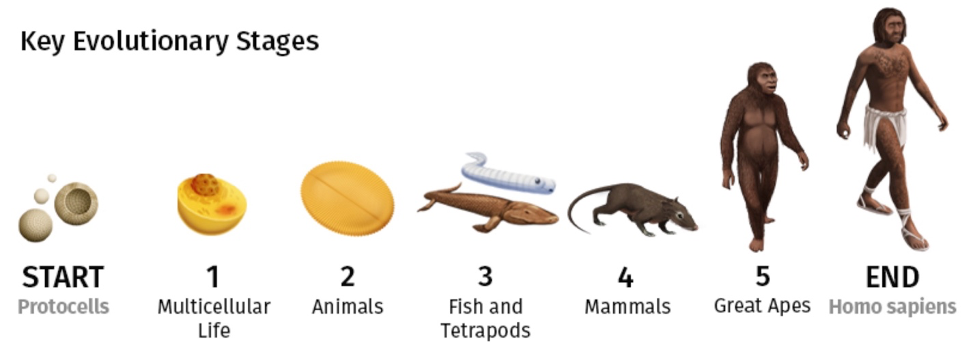
Darwin assumed that paleontologists would discover an abundance of transitional fossils verifying his theory of macroevolution.
The transitional fossils Darwin predicted aren’t those with microevolutionary changes of one type of bird evolving into another (like the finches he observed on Galapagos Islands), or one type of horse evolving into another horse, etc. Those are examples of minor changes within a particular species.
The transitional fossils Darwin predicted in his theory of macroevolution would show the incremental stages of development as one species gradually evolved into another totally different species, a process that he believed would take millions of years. So, if a fish gradually evolved into a mammal, countless intermediate fossils should be discovered showing many different stages between the fish and the mammal.
Darwin predicted that during the gradual evolutionary process, millions of transitional species would leave a trail of fossil evidence, showing how one species changed incrementally into another.
Darwin believed the discovery of transitional fossils would take us from the world of theory to the world of forensics. Fossils are hard evidence, not theoretical probabilities.
There were plenty of fossils for Darwin to evaluate, but he couldn’t understand why his theory’s predicted transitional fossils were absent from the fossil record. He wrote,
Why, if species have descended from other species by fine gradations, do we not everywhere see innumerable transitional forms? Geology assuredly does not reveal any such finely graduated organic chain; and this, perhaps, is the most obvious and serious objection which can be urged against the theory.1
But Darwin blamed the lack of transitional fossils on what he called, “an imperfect geological record.” However, he was still troubled, hoping the fossils would be found.
For nearly two centuries since Darwin began formulating his theory, paleontologists have been busy digging, classifying, and looking for his predicted fossils in a worldwide hunt. Billions of fossils representing about 250,000 species have been meticulously scrutinized.
Let’s see what this lengthy passage of time has revealed about Darwin’s predicted fossils.
We begin with the early Cambrian period. Paleontologists are at a loss to explain how life appeared so rapidly during the Cambrian period. Darwin himself had no explanation for how life could develop so quickly. Neither do paleontologists today.
Prior to the Cambrian period, only fossils of simple life forms have been excavated. Then, suddenly, the fossil record is teeming with more complex life forms than even exist today. It is so extraordinary that paleontologists call it the “Cambrian Explosion.”
Seemingly in an instant of geological time, complex life forms with fully developed eyes appeared during the Cambrian period. Because these complex life forms appeared suddenly in the geological record, paleontologists call it “biology’s big bang.”
What paleontologists find in the Cambrian explosion is not simply the appearance of a few new animals, but an abundance of fifty completely different body types without prior transitions or predecessors. In other words, brand new life forms appeared without an evolutionary trail.
Darwin staked his entire theory on the premise that a new species could never suddenly appear, since that would contradict his theory of natural selection. He said,
If numerous species, belonging to the same … families, have really started into life at once, that fact would be fatal to the theory of evolution through natural selection.2
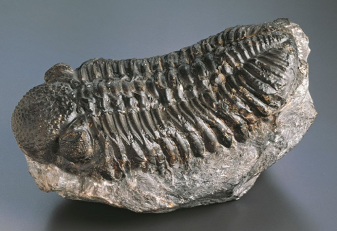
Darwin theorized that complex organs like the eye could only develop gradually over enormous periods of time, traceable to a common ancestor.
Yet five totally different phyla with no hint of a common ancestor all suddenly popped into existence during the Cambrian period, each with fully developed eyes.
As we learned in the last chapter, the eye is an irreducibly complex organ that has no functional value unless all its many parts synchronize to provide sight.3
T. S. Kemp, curator of the zoological collections at the Oxford University Museum of Natural History, is one of the world’s foremost experts on Cambrian fossils. When discussing the sudden appearances of new species, Kemp discloses,
With few exceptions, radically new kinds of organisms appear for the first time in the fossil record already fully evolved. … It is not at all what might have been expected.4
Stephen Jay Gould, a staunch advocate of materialistic evolution, reiterates how the Cambrian explosion is a puzzle to Darwinists, writing,
We do not know why the Cambrian explosion could establish all major anatomical designs so quickly. … The Cambrian explosion was the most remarkable and puzzling event in the history of life.5
The sudden appearance of new life forms in the Cambrian explosion contradicts Darwin’s theory and has been a source of great frustration to materialists.
But the Cambrian explosion of suddenly appearing life forms is not the only contradiction of Darwinian macroevolution.
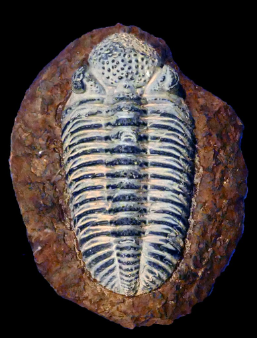
American Paleontologist, Niles Eldredge, shockingly admits the failure of the entire fossil record to provide evidence for macroevolution, stating,
No one has found any such in-between creatures and there is a growing conviction among many scientists that these transitional forms never existed.6 No wonder paleontologists shied away from evolution for so long. It never seems to happen.7
Eldredge also explains the failure of paleontologists to recognize the failure of the fossil record to back up Darwin’s theory of gradualism.
Paleontologists clung to the myth of gradual adaptive transformation even in the face of plain evidence to the contrary.8
Leading atheist Richard Dawkins also clung to the myth of gradualism, admitting,
Without gradualness we are back to a miracle.9
According to paleontologists, the fossil record shows that most species do not change but rather remain virtually the same for millions of years. They call this phenomenon: stasis.
Although some fossils have been identified as possibly transitional (i.e., Archaeopteryx and Tiktaalik roseae), Gould says that evolutionists simply avoid talking about the embarrassing lack of fossil evidence. He confesses the silence regarding the lack of transitional fossils,
It’s not evolution so you don’t talk about it.10
As a committed evolutionary leader, Gould admits to the failure of the fossil record as being the “trade secret of paleontology.”
The extreme rarity of transitional forms in the fossil record persists as the trade secret of paleontology. The evolutionary trees that adorn our textbooks have data only at the tips and notes of their branches; the rest is inference, however reasonable, not the evidence of fossils.11
Paleontologist Whitey Hagadorn, who has comprehensively studied fossils of early marine life notes the absence of transitional fossils.
Paleontologists have the best eyes in the world. If we can’t find the fossils, sometimes you have to think that they just weren’t there.12
Kemp, Gould, Eldredge and Hagadorn are all noted paleontologists who honestly admit that the fossil evidence Darwin predicted of interim species does not exist.
Because the transitional fossils Darwin predicted haven’t been unearthed, both Gould and Eldredge developed the theory that life didn’t evolve gradually over long periods of time, but rather that new species evolved in short spurts. They call their theory “Punctuated Equilibria,” a radical departure from Darwin’s theory of gradualism.
When it comes to the origin of human beings, Darwin’s theory clearly states that we are not unique but rather are the end product of billions of years of evolution from tiny protocells. Gould, who admitted the failure of the fossil record to support Darwinism, stated that our existence as a species was the result of “a glorious accident.” When asked in an interview what the accident was, Gould replied,
The accident is the 60 trillion contingent events that eventually led to the emergence of Homo sapiens.13
60 trillion lucky breaks? Hmm.
Is there any real evidence that humans evolved? Darwin believed the fossil trail would show the progressive evolution of our species from ancient primates and hominids. So, have paleoanthropologists discovered an evolutionary link between hominids and us?
We’ve all seen museum exhibits or artists’ renderings like this drawing depicting slightly erect ape-like creatures that presumably became us.
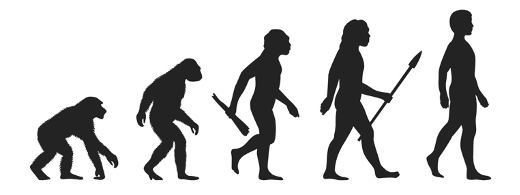
Such exhibits and drawings imply that there is solid fossil evidence to back up the claim that pre-human fossils have been discovered. But have they actually discovered such pre-human fossils?
Paleoanthropologists have uncovered pieces of bones and skull fragments from fossils they consider human ancestors. Ardipithecus ramidus, the oldest of these, is dated at over 4 million years old. Homo habilis and Homo erectus are depicted as more recent members of our family tree. But what evidence supports their belief that these hominid fossils are truly our ancestors?
It all looks and sounds so convincing. However, what sounds like a solid argument for human ancestry unravels when experts analyze the fossils. Henry Gee, the chief science writer for Nature admits,
The intervals of time that separate fossils are so huge that we cannot say anything definite about their possible connection through ancestry and descent.14
The problem is that there is almost no fossil evidence to examine. Paleoanthropologists are attempting to fill in an enormous puzzle with only a few fragments of bones and teeth that according to Gee, could be “fitted into a small box.”15
Although Gould remained an evolutionist, he agreed with the difficulty of connecting an evolutionary trail between hominids and Homo sapiens, stating,
Most hominid fossils, even though they serve as a basis for endless speculation and elaborate storytelling, are fragments of jaws and scraps of skulls.16
Gee and Gould are not the only experts pointing out the absence of transitional fossils between hominids and us. Harvard evolutionary biologist Richard Lewontin also admitted,
When we consider the remote past, before the origin of the actual species Homo sapiens, we are faced with a fragmentary and disconnected fossil record.17
Although small fragments of hominid bones have been discovered, there is a huge jump from such creatures to our own species. Naturalist Ian Tattersall (curator at the American Museum of Natural History) refers to the suddenness with which humans appear in the fossil record.
Something extraordinary, if totally fortuitous, happened with the birth of our species….Homo sapiens is as distinctive an entity as exists on the face of the Earth, and should be dignified as such instead of being adulterated with every reasonably large-brained hominid fossil that happened to come along.18
Darwinists are unable to explain why our species appeared so suddenly. Professor Emeritus of Biology at the University of Sussex, John Maynard Smith, writes,
Something very puzzling happened…. The fossil evidence is patchy, but it seems that hominids suddenly developed brains that, in terms of size, were much like ours.19
The fossil record shows that hominids had small, ape-like brains and no capacity for language. Then, suddenly, man appears with several unique features, including an enlarged brain capacity. Tattersall, Smith and other naturalists are puzzled as to why there are no clear-cut links between hominids without language capacity and Homo sapiens who have both the hardware and the software for language, something unique to our species.
The sudden brain size and language capacity of Homo sapiens in the fossil record presents a huge problem for Darwinists who argue against a designer. In his book, Mapping Human History, evolutionist Steve Olson spells out the problem.
Of course, language could not have come from nowhere. To speak, early humans needed particular vocal and neural mechanisms. But here a notorious problem arises. Any adaptations produced by evolution are useful only in the present, not in some vaguely defined future.20
For human speech to work, the brain structure, the tongue, the larynx, the vocal cords, and many other parts all need to be fully developed in synchrony as if it had been designed. Once again, Darwinism is confronted with its unsolved puzzle of irreducible complexity.
Evolutionary biologist Ernst Mayr, explains the dramatic difference between hominids and us,
Humans have the ability to conceptualize, resulting in the development of art, literature, mathematics, and science. Hominids and all other animals lack this unique human quality, and are only able to communicate by giving and receiving signals.21
The lack of a transitional link from primates to man led Mayr to conclude,
Man is indeed as unique, as different from all other animals, as had been traditionally claimed by theologians and philosophers.22
During an interview with the French science monthly La Recherché, mathematician Marcel Schutzenberger was asked, “The appearance of human beings—is that a miracle?” The brilliant mathematician replied by stating that Darwinism has been unable to explain the uniqueness and sudden appearance of man. He concludes his remarks with,
Naturally. And here it does seem that there are voices among contemporary biologists—I mean voices other than mine—who might cast doubt on the Darwinian paradigm. The reality is that we are confronted with total conceptual bankruptcy.23
Lewontin also poured cold water on claims that a missing link between humans and apes has been discovered. He admitted,
Despite the exciting and optimistic claims that have been made by some paleontologists, no fossil hominid species can be established as our direct ancestor.24
Darwin said, “the most obvious and serious objection” to his theory was the lack of intermediate fossils showing how one species gradually evolved into another species. He also said,
If numerous species, belonging to the same … families, have really started into life at once, that fact would be fatal to the theory of evolution through natural selection.
The Cambrian explosion, as well as the entire fossil record of the past century and a half have confirmed Darwin’s worst fears, that his theory of macroevolution is fatally flawed. Biochemist Michael Denton pronounces his verdict on Darwin’s theory of macroevolution.
One might have expected that a theory of such cardinal importance, a theory that literally changed the world, would have been something more than metaphysics, something more than a myth. Ultimately the Darwinian theory of evolution is not more nor less than the great cosmogenic myth of the twentieth century.25
But the main failure of Darwinism is not just the failure of the fossil record to support macroevolution. It’s Darwin’s premise that life is simply the result of time plus chance without an intelligent primary cause. To most people that just doesn’t make sense, even to open-minded materialists and atheists.
Former atheist Lee Strobel writes of his reasons for rejecting Darwinism.26
I realized that if I were to embrace Darwinism and its underlying premise of naturalism, I would have to believe that:
- Nothing produces everything
- Non-life produces life
- Randomness produces fine-tuning
- Chaos produces information
- Unconsciousness produces consciousness
- Non-reason produces reason
Strobel continues,
Based on this, I was forced to conclude that Darwinism would require a blind leap of faith that I was not willing to make.
The Darwinian belief that life all came about by chance over eons of time has failed to meet Darwin’s own standard of proof. But, if life can’t be explained apart from intelligent design, what did the designer reveal about himself and our purpose here on Earth?
In the final chapter we will see if there is an answer to these all-important questions.