34108 Power Through Spiritual Breathing

Many Christians would name Galatians 5:22-23—the passage about the “fruit of the Spirit”—as among their favorite verses in the Bible. But are you aware that Galatians 5 refers not to one kind of fruit but to two? The Spirit produces love, joy, peace, and all the rest, surely enough, but before that our old nature produces a welter of shameful sins.

“When you follow the desires of your sinful nature, your lives will produce these evil results: sexual immorality, impure thoughts, eagerness for lustful pleasure, idolatry, participation in demonic activities, hostility, quarreling, jealousy, outbursts of anger, selfish ambition, divisions, the feeling that everyone is wrong except those in your own little group, envy, drunkenness, wild parties, and other kinds of sin . . .

But when the Holy Spirit controls our lives, He will produce this kind of fruit in us: love, joy, peace, patience, kindness, goodness, faithfulness, gentleness, and self-control.” (Galatians 5:19-23)

The fruit of the sinful nature correspond to the filthy clothing we are to remove, while the fruit of the Spirit correspond to the clean clothes of righteousness.

The twist is this: while the Colossians 3 passage about changing clothes implies that we have to make a personal effort at combating sin, the Galatians 5 passage about fruit bearing brings out more strongly the role of the Holy Spirit in our godliness. If the Spirit has control of our lives, we will live in a way that reflects the holiness of God. It is as natural as a healthy grapevine bearing big, juicy grapes.

As you seek to substitute holiness for the habitual sin in your life, remember that the effort is a cooperative endeavor between you and God. Of course, you have your own part to play—you have to decide to act in accordance with God’s holy commands and then follow through. But even more importantly, the Holy Spirit is at the same time working in you to help you stop doing what is wrong and start doing what is right. His help is primary and crucial to your deliverance from sin. His power is what makes it happen.

Filled with Power

Maybe you need a new filling of the Holy Spirit so that you can reengage your enemy (your sin habit) with a powerful ally (the Spirit) by your side. In the words of P. T. Forsyth, “Unless there is within us that which is above us, we shall soon yield to that which is about us.”

We all receive the Holy Spirit when we come to believe in Christ. But each of us can receive a fresh filling of the Spirit from time to time if we will seek God for it. Ask God to send His Spirit to you in greater fullness than ever, then attune your spirit to what God’s Spirit is telling you.

Personal effort is part of the solution. But nothing helps in the battle to be sin-free and virtue-full more than the Holy Spirit. “Wherever the Spirit of the Lord is, He gives freedom” (2 Corinthians 3:17). Indeed, freedom from sin and the freedom to be holy can be yours only through the Spirit.

Becoming a person of virtue means not only taking off the rags of sin but also putting on robes of righteousness. It means not only pruning away the fruit of the sinful nature but also letting the fruit of the Spirit ripen to perfection.

Does that sound like something that’s easier said than done? Well, you are right. But there is a way to do it, and it is through a process called “spiritual breathing.”

Spiritual Breathing

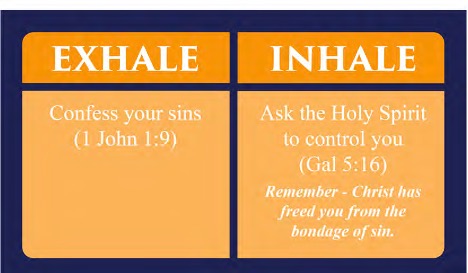
In the process of breathing, our lungs expel carbon dioxide (dangerous to our health) and take in oxygen (needed for proper tissue function). Similarly, spiritual breathing is “exhaling” guilt through confession and “inhaling” grace through filling by the Holy Spirit.

Whenever we have sinned, we can “breathe” in this way.

The main difference between the two kinds of breathing is this: physical breathing is automatic, while spiritual breathing is voluntary. We choose to breathe spiritually.

The key to spiritual breathing is stopping a sin as soon as we are convicted of it. Otherwise, we will just reinforce a sin habit. Rather than letting the sin go on, we bring it before God and ask His forgiveness. Assuming our repentance is real, we can be confident that He will forgive. “If we confess our sins to Him, He is faithful and just to forgive us and to cleanse us from every wrong” (1 John 1:9).

But we do not stop there. We seek God further for grace to obey Him in the future. As the apostle John said, “I am writing this to you so that you will not sin. But if you do sin …” (1 John 2:1). In other words, while we may be freed from habitual sins, we will never be free from temptation and human weakness as long as we live in this world. Sin always remains a possibility, and so we never outgrow the need for grace.

God is faithful. He is like a kind father who gives his children what they need.² Our God gladly gives us what we ask for, as long as it is in line with His will, and so of course He gives the resources we need to escape temptation. His mercy is what makes it possible for us to be filled with virtues where formerly we were full of sin.

Spiritual breathing does something wonderful for us. It helps us achieve and maintain holiness. And holiness is another name for Christ-likeness.

Exhaling and Inhaling Spiritually

If you become aware of an area of your life (an attitude or an action) that is displeasing to the Lord, even though you are walking with Him and sincerely desiring to serve Him, simply thank God that He has forgiven your sins–past, present, and future–on the basis of Christ’s death on the cross.  Claim His love and forgiveness by faith and continue to have fellowship with Him.

If you retake the throne of your life through sin–a definite act of disobedience–breathe spiritually.  Spiritual breathing (exhaling the impure and inhaling the pure) is an exercise in faith that enables you to experience God’s love and forgiveness.

1.  Exhale:  Confess your sin–agree with God concerning your sin and thank Him for His forgiveness of it, according to 1 John 1:9 and Hebrews 10:19-23.  Confession involves repentance–a change in attitude and action.

“But if we confess our sins, he is faithful and righteous, forgiving us our sins and cleansing us from all unrighteousness.” —1 John 1:9

2.  Inhale:  Surrender the control of your life to Christ and receive the fullness of the Holy Spirit by faith.  Trust that He now directs and empowers you, according to the command of Ephesians 5:18 and the promise of 1 John 5:14-15.

“And do not get drunk with wine, which is debauchery, but be filled by the Spirit,” —Ephesians 5:18

“And this is the confidence that we have before him: that whenever we ask anything according to his will, he hears us. And if we know that he hears us in regard to whatever we ask, then we know that we have the requests that we have asked from him.” —1 John 5:14-15


34110 Confront Your Problem

Anger receives a great deal of attention in mental health clinics and counseling centers all over the country. So do guilt feelings. A mother feels guilty because she screams at her children. A young man feels guilty because he no longer adheres to the behavioral standards by which he was reared. Another youth has been involved very intimately with a girl and feels guilty but cannot seem to help himself.

Another malady that plagues many people is fear. Some psychologists maintain that the causes of anger and the causes of fear are identical. In the case of anger, something has already happened. In the case of fear, there is the prospect that something will happen. This view makes these Bible verses come alive: “For God has not given us a spirit of fear, but of power and of love and of a sound mind” (2 Timothy 1:7). “There is no fear in love; but perfect love casts out fear, because fear involves torment. But he who fears has not been made perfect in love” (1 John 4:18)

These are emotions that are in us. Once we accept the fact that the wrath or fear or guilt is in us, we can deal with it. And that is the good news for everyone filled with anger and malice and bitterness. The people in your life may never change their ways.

Circumstances may be beyond your control. But fortunately you can do something about yourself. You can open your heart to God, who is able to fill it with bountiful grace. But whether you allow God to give you His grace is your decision.

Strangely, most persons who seek counsel will argue that they have the right to be angry. “Under my circumstances, can you blame me?” they will say in stout defense. Of course they have the right to be angry, but as long as they argue in defense of their wrath, they will see no need nor have any desire to change and thus be delivered from the unhappiness of anger.

But to say, “I am like that,” is going only halfway. Admission leads nowhere unless it implies a desire to change. It must mean that the mother sincerely wants help with her temper and the young people with their conduct, and that they turn to God for help.

How precise 1 John 1:9 is on this point: “If we confess our sins, He is faithful and just to forgive us our sins and to cleanse us from all unrighteousness.” The person who confesses this way–having faith that God is able and willing to help them and having a desire for God’s help–is well on the way to peace. The person who admits, “I’m like that,” but does nothing about changing, will not find genuine inner peace. Nor will the person who denies responsibility for the wrong they know they have done.

Most people cause their own misery. Their guilt is not imaginary, but real. An inward look and a backward look can give the reasons and point the way to peace of mind. Yet such self-views are not easy to achieve. We tend to flee from the truth about ourselves: “Men loved darkness rather than light, because their deeds were evil” (John 3:19).

When an individual discovers hatred in their heart, they usually find other disorders as well. Their personality may resemble an iceberg. Perhaps only jealousy shows, or envy, or temper. But submerged are other disastrous emotions that deny them peace. And one emotion can hardly be dealt with singly; every emotion must be exposed to the light.

34112 Responsibility for Your Inner Life

To get out of the gloomy pit of despair, bitterness, hostility, jealousy, and the accompanying aches, pains, and misery, you must take personal responsibility for your own character, no matter what someone else does–or did. If a person is miserable, it is his or her choice. Our woe is not the result of our background, or the people around us, or our environment, but of a choice, either deliberate or vague, to continue in the direction that we have been heading.

Spiritual maturity brings peace, as the psalmist indicated: “Mark the blameless [mature] man, and observe the upright; for the future of that man is peace” (Psalm 37:37).

Do not avenge yourselves; live peaceably with all men; love, bless, forgive. These words place the responsibility for your decision squarely on your own shoulders. This is the essence of good mental health–it depends on you. You reap the results of your own decisions, your own reactions.

So it is with unhappiness. No matter the origin (and the unhappy person can usually explain how he got that way), it is now his responsibility and his alone to take proper steps to correct the condition that is causing his unhappiness. But it should be mentioned here that understanding alone, without changing one’s course, is a dead-end street. Man is miserable when he does not take responsibility for his own inner life, his own reactions and behavior toward the people and circumstances that come his way.

Jesus stated an obvious truth, “In the world you will have tribulation” (John 16:33). We all have our share of trouble and always will. But the presence of trouble does not alter personal responsibility. “For it is written: ‘As I live,’ says the Lord, ‘every knee shall bow to Me, and every tongue shall confess to God.’ So then each of us shall give account of himself to God” (Romans 14:11-12). Also, “For we must all appear before the judgment seat of Christ, that each one may receive the things done in the body, according to what he has done, whether good or bad” (2 Corinthians 5:10).

Being either clearly or vaguely aware that we are answerable for our own conduct, is it any wonder that more and more people become miserable as they forsake biblical principles?

Past history shapes you. In counseling, I generally find that the unhappy person who has been rejected rejects others; the victim of mean, angry, hateful people is also mean, angry, and hateful; the person who grew up in an atmosphere of suspicion is suspicious of others. People seem to reproduce in themselves what they are exposed to.

We would agree that a person’s circumstances seem to rub off on them, thereby giving them cause for happiness or discomfort. There is the mark of parents, experiences with brothers and sisters, relationships gained through church and school activities. We are the product of our family’s economic status, our education, our bodies, our talents and our opportunities.

People who are unhappy have been mistreated. A woman who is withdrawn and sullen often has a mother who was withdrawn and sullen. People appear to be caught up in a circle, a vicious one, forged by generation after generation of example.

It is true that a child tends to absorb the atmosphere in which he was raised. It is also true that people tend to keep on going in the direction in which they are headed. But the Bible says, “You are inexcusable, O man, whoever you are who judge, for in whatever you judge another you condemn yourself; for you who judge practice the same things” (Romans 2:1).

An unhappy person must come to terms with the people in his past, forgive them, and seek to understand the effect they have had on him. But this Bible verse says he has no grounds for reproducing the pattern, once he understands it.

If your anxiety is due to your violation of a biblical principle, then this is good news. It is good news because you can do something about such a violation. You can confess your sin, acknowledge it before the Lord, and look at it the same way He looks at it–with hatred and disdain. David admitted his sin before God and asked for cleansing from it: “Wash me thoroughly from my iniquity, and cleanse me from my sin. For I acknowledge my transgressions… Create in me a clean heart, O God… Restore to me the joy of Your salvation” (Psalm 51:23a, 10a, 12a).

You cannot erase the past. You cannot decide what your marriage partner will do. You cannot control the conduct of your associates or the turn of world events. But you can do something about your sin, which cuts you off from personal inner peace.

This is indeed good news. It is not someone else’s wrongs toward you that cause your anxieties and tensions. It is your own sin. And you can do something about it by coming just as you are to God for His forgiveness and cleansing.

The choice is yours.

34114 Emotions Affect the Body

There is a relationship that exists between the mental/emotional state of a person and the workings of his body. For a better understanding of how this relationship functions, we must turn to the physician.

O. Spurgeon English, former chairman of the Department of Psychiatry at the Temple University School of Medicine, speaks from long study of this relationship between mind and body. He tells us that there are certain emotional centers in the brain that are linked to the entire body through the autonomic nervous system. He describes charges of emotions that are relayed from the brain, down the spinal cord, and through the autonomic nerves to the blood vessels, muscle tissues, mucous membranes, and skin.

Under emotional stress, he points out, all parts of the body can be subject to physical discomfort because of a change in blood nourishment, glandular function, or muscle tone (The Autonomic Nervous System, Sandoz Pharmaceuticals).

You may have wondered, “How can thoughts and feelings going through my mind cause pain in some part of my body far from my brain?” Dr. English explains: An emotion such as fear can cause the mouth to become dry. This means that the blood vessels have constricted and the blood supply and glandular activity have been reduced. This dryness will occur, for example, in someone who must make a speech and is afraid. Various emotions, which have their source in the brain, find their way through definite pathways to the stomach. When a troublesome person can’t be coped with, we say we can’t “stomach” him – and that may be literally true.

Dr. English points out that a poorly functioning personality can be the reason for psychosomatic disorders of the digestive tract:

For decades it has been known that a personality problem which cannot be solved by the mind itself is prone to be “turned over” or “taken up” by some other part of the body. When an irritating friend or a troublesome family member cannot be coped with, the patient becomes “sick,” he can’t “stomach” it, or it “gripes” him. The physician knows that the cause of these gastrointestinal disturbances is emotional conflict. He knows it is the attitudes of generosity and responsibility struggling with an opposing wish to escape them (The Emotional Cause of Symptoms, Sandoz Pharmaceuticals).

Dr. English’s description of the conflict within a person is surprisingly like the one the Apostle Paul presented in Galatians 5:17: “For the whole energy of the lower nature is set against the Spirit, while the whole power of the Spirit is contrary to the lower nature. Here is the conflict, and that is why you are not free to do what you want to do.” The physician and the Bible describe the same problem–the struggle between what ought to be done and the contrary wish to evade it.

The physical effects of this conflict are often referred to as “nerves.” “My nerves are shot,” a woman says. “I’m on edge,” explains another person.

Fortunately, the Bible points the way to a cure: “Let there be no more resentment, no more anger or temper, no more violent self-assertiveness, no more slander, and no more malicious remarks. Be kind to one another; be understanding. Be as ready to forgive others as God for Christ’s sake has forgiven you” (Ephesians 4:31-32).

The Bible’s admonition is to confess your hurtful emotions–your sins–and God will be faithful to forgive your sins and to cleanse you from all unrighteousness (1 John 1:9). Admit to God that these things are true of you, and then cleansing–fellowship with the Lord and inner peace–will be yours.

The refreshing cleansing that comes from God is capable of washing away all aches and pains brought on by a troubled mind.

34116 Peace through Repentance

Are you angry or frustrated because of other people’s behavior, trying to act the way you think a “Christian” should act, hiding your true feelings, agonizing on the inside?

Maybe you’re spending hours talking your problem out with a professional or a trusted friend. They listen, and you feel better because you have talked things through, but you don’t really experience lasting peace. The professional or your friend may be telling you that you just need to readjust your environment to find peace. That may be true, but it’s also true that you need to deal with what is inside of you. What are you holding on to?

One of the toughest things to do when we’re wrong is to admit fault to ourselves, and admit to the Lord that we’ve sinned. Sin is not a very popular word these days, and it’s an even harder behavior to admit when it is your own. But the good news is that sin is the simplest thing to deal with!

The victory message of the Church today is found in the Bible: Jesus Christ came to this earth to die for your sins and to enable you to walk in the Spirit. The question is: How can you free yourself from sin?

Freeing yourself from sin involves repentance, and repentance can be broken down into five practical steps.

The first step is to admit and say to God, “I’m wrong.” King David knew he was wrong when he committed adultery. But until that reality moved from his head to his heart, he didn’t want to repent. Human nature hasn’t changed. Before you can move to the next step, you need to admit your sin to God.

Step two is saying to God, “I’m sorry.” However, it’s important to remember that you aren’t simply telling God you’re sorry in order to make yourself feel better. It’s saying, “I’m sorry God,” and really meaning it. According to 2 Corinthians 7:9-13, “The world’s sorrow brings death, but a Godly sorrow brings life.”

Step three follows: “God, forgive me.” Not, “God forgive me because I feel guilty, and I don’t like that feeling.” That’s not repentance; that’s just wanting to feel better. You need to say from your heart, “God, forgive me for the wrong that I’ve done.”

And you’ll know God’s forgiveness has come when you are able to go on to the fourth step and can say in all sincerity, “God, cleanse me. I’m not just wanting relief from my sin. I want a change of life. I want you to restore fellowship with me as though I’ve done nothing wrong.” Isn’t that what you really want with your Heavenly Father?

That will lead you into step five, where you admit you can’t walk in the Spirit in your own flesh, and you say “God, I don’t have it in and of myself to be a loving individual in this relationship. I’m at the end of my rope, so please empower me.”

Being empowered is asking God to fill you full of His Spirit where you’ll experience a peace that passes all understanding, and the kind of joy that is humanly impossible to attain. God wants to give you the ability to live a Spirit-filled life in the midst of your difficult situations. Are you willing to allow Him to bring you peace?

Take a step . . .

Memorize Psalm 139:23-24:

“Search me, O God, and know my heart; try me, and know my thoughts: And see if there be any wicked way in me, and lead me in the way everlasting.”

34118 Freedom from Others

Does your serenity, peace of mind, and joy depend upon a choice another person makes?

Think of your favorite person. They have good points and faults. You don’t have problems with their strengths, but when they won’t do something that’s important to you, you have a choice to make. One of your options is to resent them, become bitter, and/or dwell on the fact that there’s some little thing this person isn’t doing that you want them to do, and it can ruin your relationship.

Dr. S. I. McMillian, a physician, in his book None of These Diseases, says, “The moment I start hating a man, I become his slave.”

Has this happened to you? A person you dislike begins to control your work time, pleasure time, sleep time, etc., because they’re controlling your thoughts. If you want to be free, and not be a slave to what others do, you need to be happily aware of the whole person, including his strong points and his weak points.

King Solomon must have had a similar experience, for he wrote in Proverbs 15:17, “Better a meal of vegetables where there is love than a fattened calf with hatred” (NIV).

The Apostle Paul, trying to be helpful to his friends, the Corinthians, said to them, “I brethren, could not speak unto you as unto spiritual, but as unto carnal” (1 Corinthians 3:1, KJV). In verse 3, he describes what he means: “Is there envying?” That is, if you’re annoyed, disgruntled and uncomfortable over somebody else’s success, opportunities, or their wealth, and you can’t enjoy these folks because you envy them, that’s carnality. Carnal behavior also displays itself through arguing, quarreling, striving, divisions, and unresolved conflicts.

We need to live our lives “spiritually” – as men and women who have at our fingertips, in our inner lives, the resources of God.

Maybe you’re crying out to God for help, and He doesn’t seem to hear you.

Isaiah 59:1-2 says, “The Lord’s hand is not shortened, that it cannot save; neither is his ear heavy, that it cannot hear” (KJV). He does hear you!

Approach God, not in terms of telling Him about someone else, but in terms of yourself.

Isaiah 53:6 (KJV) says, “All we like sheep have gone astray; and we have turned everyone to his own way.” Do things always have to be your way? The remainder of this verse says, “The Lord hath laid on him the iniquity of us all.” Jesus has paid for our selfishness and desire to always have life on our terms.

Each person needs to come face-to-face with the fact that each one of us has a tendency to want our own way. And the only way to deal with that tendency is to come to Jesus Christ. That’s why we need a Savior – to be saved from ourselves, from having our own way.

Take a step . . .

If you haven’t already done so, invite Jesus Christ to come into your life as your Savior. Confess wanting to have things your own way, asking God to forgive you. Ask God to fill you with the Holy Spirit and to give you the power to let go of your tendency to want your own way.

34120 Choose the Right Response

Are you troubled by things you’ve done, by what you’ve said to people, or by what people have said to you? Are your words typically supportive, or do you find yourself often critical, caustic or hostile?

Colossians 3:17 says “Whatever you do in word or deed, do all in the Name of the Lord Jesus, giving thanks unto God and the Father by Him.” (KJV)

When you speak or act in a way that you know in your heart to be wrong, you pay with your emotions. You chip away at your own self-respect. But one of the most important principles that you can apply to your life is that your mental health is in your control. YOU are the one who must CHOOSE how to respond to individuals and situations in your life that are less than perfect.

You might say, “If only this person would change, then all these wonderfully warm friendly qualities would be released in me.” Not so. Nobody can cause you to be angry, stubborn, immovable, inflexible, and easily irritable. Your behavior is determined by your spirit, and your spirit involves you and God. It’s a unique relationship. It has nothing to do with anyone else.

Romans 13:1-2 says “Let every soul be subject unto the higher powers for there is no power but of God and the powers that are ordained of God. Whosoever therefore resists the power resists the ordinance of God, and they that resist shall receive unto themselves damnation” (KJV). The NIV puts it in a gentler way:  “will bring judgment on themselves.” You see, your behavior makes a difference to you.

Don’t allow yourself to drift away from allowing the Lord to fill your heart with His Spirit day by day. Nobody can stop you from calling on God to fill you with His love, joy, peace, gentleness, kindness, and patience. Do what you’re doing and saying in His Name, as though He were right there with you. Let Him help you feel the relief of walking through life with a thankful spirit.

Philippians 2:2-4 tells us to “let nothing be done through strife or vain glory; but in lowliness of mind let each esteem the other better than themselves” (KJV).

Becoming preoccupied with the negative qualities of anyone or anything in your life causes you to lose sight of good things. The Creator of the universe laid down His life for you. He has chosen to put the emphasis on your spiritual life. He has chosen to give you of His Spirit, and to make your burden light. He gives you the ability to honor him in all that you do and say.

Take a step . . .
Are you presently holding on to a heavy burden? Open your heart to God’s Spirit and let Him fill your life with joy, peace, love, kindness, and gentleness. Take a moment to pray this prayer:

Lord, help me to be conscious of the fact that You have something to say about the way I interact with people and situations in my life. Help me to be more aware of my response to the tasks that are given to me and how I interact with people. Today I choose to commit what I do and say to You, looking to You for that spirit of joy that you died to give me, doing it in Your Name. Help me to remember I do this with You by my side. In Jesus Name, I pray. Amen.

Read Colossians 3:17, Romans 13:1-2, and Philippians 2:2-4.

34122 Facing Your Shortcomings and Failures

What is your reaction when a friend confides, “I’m going to be very frank. There’s something about you that I wish were not true”? If he has a compliment, you are only too glad to have him say it; you don’t even draw him apart from the crowd to hear it. But how hard it is to have your faults pointed out. We all have a built-in resistance to seeing our shortcomings.

We react to reproof as we react to pain. The tendency is to shrink away, to protect ourselves from what we wish were not so. James bluntly described our sinful nature in his epistle:

But what about the feuds and struggles that exist among you-where do you suppose they come from? Can’t you see that they arise from conflicting passions within yourselves? You crave for something and don’t get it; you are murderously jealous of what others have got and which you can’t possess yourselves; you struggle and fight with one another. You don’t get what you want because you don’t ask God for it. And when you do ask He doesn’t give it to you, for you ask in quite the wrong spirit–you only want to satisfy your own desires (James 4:1-3).

Reproof, however, is good – like the surgeon’s scalpel or the dentist’s drill. The process is painful, but the result is health.

In human relations, it appears more sensible – at least easier – to ignore one’s own fault or that of another. But the results are strained relations, strife, discord, and personal misery. A simple, effective alternative is, “If we walk in the light as He [God] is in the light, we have fellowship with one another, and the blood of Jesus Christ His Son cleanses us from all sin” (1 John 1:7).

As the truth about you emerges from some probing stimulus, you will either face it directly or turn from it. You will mellow or harden, depending on what you choose to do about your discovery.
John wrote in his first epistle:

If we refuse to admit that we are sinners, then we live in a world of illusion and truth becomes a stranger to us. But if we freely admit that we have sinned, we find God utterly reliable and straightforward–He forgives our sins and makes us thoroughly clean from all that is evil. For if we take up the attitude, “we have not sinned,” we flatly deny God’s diagnosis of our condition and cut ourselves off from what He has to say to us (1 John 1:8-10).

You will get fleeting glimpses of your true self (and sometimes a very clear picture) as you interact with other people, as you read the Bible, and as the ministry of others touches your life. The natural reaction is to shrink away from your findings. But you need not run from yourself and thereby add trouble on trouble. The resources of heaven are yours to apply against the character defects you discover. Jesus died to forgive your sins:

“In whom we have redemption through His blood, the forgiveness of sins” (Colossians 1:14).

Furthermore, God will give you daily strength if you let Him:

“Present yourselves to God as being alive from the dead, and your members as instruments of righteousness to God. For sin shall not have dominion over you, for you are not under law but under grace” (Romans 6:13-14).

“But now having been set free from sin, and having become slaves of God, you have your fruit to holiness, and the end, everlasting life” (Romans 6:22).

“The fruit of the Spirit is love, joy, peace, long-suffering, kindness, goodness, faithfulness, gentleness, self-control” (Galatians 5:22-23).

34124 Constructive Speech

How would you describe the way you talk? Are your words positive, constructive, comforting, supportive, and uplifting? Or are the words that come out of your mouth most often cutting, negative, and hurtful?

According to Proverbs 15:4 (KJV), “A wholesome tongue is a tree of life: but perverseness there in is a breech in the spirit.” What does it mean to have a “wholesome” tongue? A tongue that speaks good of people and situations. A tongue that builds up people (yourself and others). A tongue that is gentle. A tongue that is kind. A tongue that builds others up.

Psalm 34:13-14(NIV) says, “Keep your tongue from evil, and your lips from speaking deceit. Depart from evil, and do good; seek peace, and pursue it.”

The Bible makes it very clear in Matthew 12:36 (NIV) that we need to be careful about the things that we say: “I tell you that men will have to give account on the day of judgment for every careless word they have spoken. For by your words you will be acquitted, and by your words you will be condemned.”

We all need to give a little more thought to what we say before we say it. “Biblical speech” involves applying God’s Word to our lives daily. It means we allow the principles of scripture to influence our words and how we use them. It means we build people up, we use words of challenge in loving ways, we use words of grace.

Proverbs 21:23 (NIV) gives good advice:  “He who guards his mouth and his tongue keeps himself from calamity.” Griping, grumbling, or complaining often don’t accomplish anything. And engaging in this kind of talk can also make you feel awful.

Titus 3:2 (NIV) instructs us “to slander no one, to be peaceable and considerate, and to show true humility toward all men.”

According to God’s Word, our behavior and our words should reflect our devotion to God. We need to pay attention to the way we conduct ourselves! Our words impact our lives, the lives of others, and our relationship with God. Commit yourself to studying God’s Word and applying His principles to your speech.

Take a step . . .

Memorize Psalm 19:14 (NIV): “Let the words of my mouth and the meditations of my heart be acceptable to you, O Lord, my rock and my redeemer.”

34126 Choose to Forgive

Have you suffered emotionally and perhaps physically at the hands of others?

Have emotions such as anger, resentment, hate, hostility, bitterness and revenge entered your heart and mind? Have you become filled with an unforgiving spirit?

Unforgiveness can be a hidden disease. It can make you a prisoner within yourself.

The Bible says “If you forgive men their trespasses, your Heavenly Father will forgive you. If you do not forgive men their trespasses, neither will your Heavenly Father forgive your trespasses” (Matthew 6:14-15, KJV).

That may seem harsh. But why shouldn’t God expect you to forgive those who have offended you, when He has forgiven you of so much?

Choosing to forgive is a choice of your will. When you make that choice your heart is then open and ready for the Lord’s cleansing.

Choosing not to forgive is also a choice of your will. But the door of your heart is then shut and God will not do His cleansing work.

When an unforgiving spirit lives inside you, it isn’t bothering those who have wronged you. They’ve gone on their way. But you are still holding onto something that has taken control of your thoughts, actions, and words. It eats away at you like a poisonous cancer, and you find yourself bound, with no peace. In reality, you are punishing yourself.

But to forgive in your own power is futile, because your heart must first be cleansed of all the things that unforgiveness creates. Only Jesus can make that happen. He laid down His life and shed His blood to give us the gift of salvation and clean up our hearts. Through Him, there is freedom and victory.

God says “Come unto Me, all you that labor and are heavy laden, and I will give you rest” (Matthew 11:28, KJV). Isn’t rest what we long for when filled with the torture of an unforgiving spirit?

According to 1 John 1:9, ”If we confess our sins, He is faithful and just to forgive our sins and to cleanse us from all unrighteousness” (KJV). So why not invite Christ into your heart? Cast your cares upon Him. Let Him do the cleansing. Let Him take that unforgiving spirit out of your heart and give you a new heart with a forgiving spirit. You could pray a prayer like this: “Lord Jesus, forgive me for bearing a grudge toward the person who has wronged me. Come into my heart, take control of my life. Cleanse me of this unforgiving spirit, and fill me with a forgiving spirit.”

One man who prayed a similar prayer said, “I’ve got peace in my heart, and I’ve got love in my heart for those who have wronged me. One of the greatest possessions I own now is a forgiving heart.” His burden had been surrendered, and freedom was his.

Take a step . . .

Are you harboring an unforgiving spirit? What’s preventing you from letting it go? Remember, your unwillingness to forgive is harming you far more than the person who has made you angry. Give it to God and ask Him to cleanse your heart and free you to experience His love and grace.