When Charles Darwin published Origin of Species in 1859, materialists rejoiced. Darwin was their hero because he created a new paradigm where God was squeezed out of science. No longer was the biblical view of creation considered scientifically credible.
No scientific theory has impacted civilization more than Darwin’s theory that all of life began and developed naturally without a Creator.
Darwin’s theory of macroevolution, that all life evolved over time from the first primordial creature into every species that has ever existed, changed the landscape of biological science as well as our culture.
Although Darwin never intended his theory to be a foundation for evil, both Hitler and Stalin justified their atheism and racial oppression on his theory that only the fittest survive. If we are simply the result of random mutations, what meaning would human life have? His view that certain races were inferior to others promoted racism and led to slavery of blacks.
Darwin’s theory that life could be explained apart from God was a source of moral freedom for materialists. Atheist, Richard Dawkins, stated his personal satisfaction with Darwin’s theory because the reason for our existence could be explained without God. He wrote,
Darwin’s theory of evolution…is satisfying because it shows us…how unordered atoms could group themselves into ever more complex patterns until they ended up manufacturing people. Darwin provides a solution, the only feasible one so far suggested, to the deep problem of our existence.1
DARWIN’S TWO THEORIES
Many people think of Darwin’s theory of evolution as just one theory. However, Darwin actually proposed two theories: Microevolution and Macroevolution. His theory of microevolution was based on indisputable evidence, but macroevolution was hypothetical, without scientific evidence to support its claims. Let’s look at the significant difference between his two theories.
Microevolution: While visiting the Galapagos Islands in 1831, Darwin observed finches had evolved with different beaks to help adapt to their unique food source. Creatures that adapt to their environment survive better than those that don’t, passing on favorable mutations to their offspring. Selective breeding of animals uses the same principle. Darwin was correct about microevolution. Just as his finches adapted to their unique environment, so do all species adapt, whether by natural selection or by selective breeding.
Macroevolution: The big leap Darwin took from minor changes within a species was his assumption that over billions of years favorable mutations due to natural selection changed one species into another species, the tiniest microbe through several stages eventually becoming a human being. His big assumption was that every species has evolved from lower forms of life.
DARWIN’S BIG CONCERNS
Darwin did have concerns whether evidence would support his theory of macroevolution. There were two primary claims his theory made that he said would either prove or disprove macroevolution:
Complex Organs: Darwin realized that complex organs appear designed, but stated,
If it could be demonstrated that any complex organ existed which could not possibly have been formed by numerous, successive, slight modifications, my theory would absolutely break down.2
Transitional Fossils: Darwin predicted “truly enormous” numbers of intermediate varieties in the fossil record. However, he was greatly concerned that his predicted transitional fossils weren’t being found. In the next chapter, “Where are Darwin’s Fossils,” we examine the fossil evidence to see if his prediction holds true.
In his Origin of Species, Darwin dedicated a chapter to“Organs of Extreme Perfection and Complication,” where he tried to explain how complex organs like the eye could evolve, even though sight wouldn’t be possible until all its parts were fully functional.
Darwin assumed the eye began as a light-sensitive cell in a primordial creature, giving it a survival advantage which evolved into a fully functional eye over millions of years. He based his belief partially on the fact that various forms of eyes exist in different species.
But Darwin admitted having no idea how that first primordial creature developed a light-sensitive cell, dismissing its origin as unimportant. In Origin of Species he wrote,
How a nerve comes to be sensitive to light hardly concerns us more than how life itself originated.3
In 1859 when Darwin published his theory, biologists were unaware of how intricately complex organs like the eye function at the molecular level. He only dealt with the eye as a complete organ, not as a highly integrated organ with millions of working parts.
Darwin’s theory that complex organs like the eye gradually evolved over millions of years has been invalidated by the new evidence revealed by the electron microscope. The new discoveries of how the eye works at a molecular level have stunned evolutionists.
DARWIN SHUDDERS AT THE EYE
Next to the brain, the eye is the most complex organ in the human body, with over two million working parts at the molecular level. Sight is only possible if all its parts work together in synchrony. Yet, if each part needed to evolve before being functional, how could a partial eye provide a survival advantage during the millions of years it took to develop?
Was Darwin’s speculation on how the eye evolved just wishful thinking? He realized that if his theory couldn’t explain how complex organs like the eye evolved, his entire theory of macroevolution would “absolutely break down.” Several years after he had written his world-changing theory Darwin admitted his fear in an 1860 letter to botanist Asa Gray,
The eye to this day gives me a cold shudder.4
And it is no wonder that he was concerned. Darwin’s big problem was answering the question of how a non-seeing eye kept gradually evolving toward its ultimate function of sight without any foreknowledge of what that function was. Darwin still maintained his speculative idea that the eye evolved in successive steps over millions of years by chance.
The Human Eye and its Primary Functioning Parts
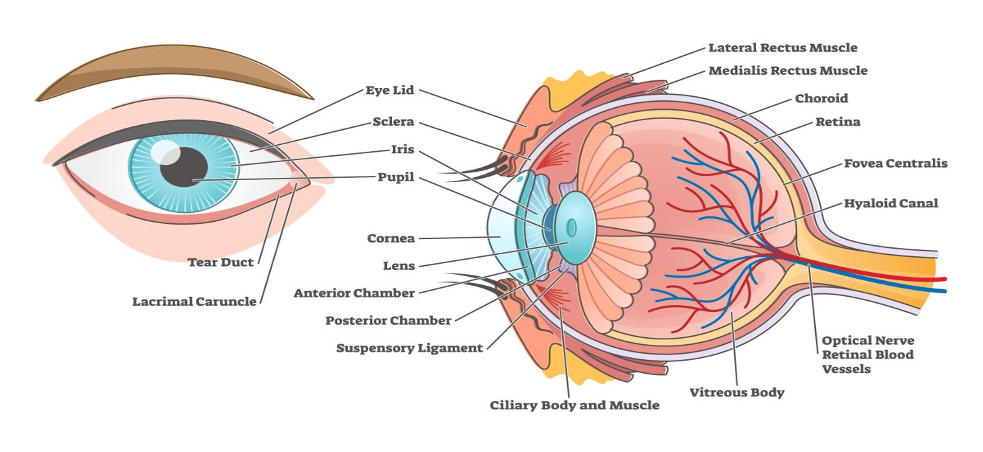
- Cornea: The clear dome-like structure that bends light as it enters the eye.
- Pupil: The center of the eye that opens and closes in response to light intensity.
- Iris: Muscles that control the pupil— contracting the pupil in bright light and expanding the pupil in low light.
- Sclera: This fibrous tissue that protects the inner structures of the eye.
- Lens: This transparent structure focuses light onto the retina.
- Ciliary body: This structure contains a muscle that helps to focus the lens.
- Vitreous humor: The clear jelly-like substance that fills the central cavity of the eye.
- Retina: The light-sensitive membrane responsible for transforming light signals into electrical impulses to be sent through the optic nerve to the brain.
- Rods and Cones: Photoreceptors located in the retina, responsible for processing light signals. Rods allow you to see shapes, while cones allow you to see colors.
- Macula: Responsible for central vision, and vision for fine details.
- Optic Nerve: A bundle of nerve fibers that contains more than one million nerve cells responsible for carrying visual information from the retina to the brain.
Darwin wrote about how the eye could gradually evolve almost 100 years before the invention of the electron microscope, which gave biochemists a completely different understanding of how the various parts of the eye synchronize to provide sight.
Dr. Gerald Schroeder, an MIT-trained scientist, explains how the eye processes information.
The wind blows and thousands of leaves shimmer in the sun. Your eye sees them all. A million, more probably a billion, ion channels opening and closing along the ganglia of a million optic nerves leading from the retina to thalamus and on to the visual cortex, cycling thirty times a second, as bioelectric signals, the information that records the motion of each of those leaves, reach into your brain. A myriad of chemical reactions, all in parallel, simultaneously recording the data.5
The eye is infinitely more complex than Darwin ever imagined. Instead of whole eyes evolving as he thought, each of over two million working parts would need to have evolved in synchrony with the others to provide sight. Professor of Biochemistry Michael Behe explains how the mystery of biochemical processes in Darwin’s day is like a “black box” that has finally been opened and exposed by the electron microscope. Behe explains,
Now that the black box of vision has been opened, it is no longer enough for an evolutionary explanation of that power to consider only the anatomical structures of whole eyes, as Darwin did in the 19th century….Each of the anatomical steps and structures that Darwin thought were so simple actually involve staggeringly complicated biochemical processes that cannot be papered over with rhetoric.6
An eye can’t see without a pupil, lens, cornea, iris, optic nerve, etc. all fully functioning. And, since the optic nerve processes each visual image in the brain, how could it provide sight before all other parts were fully functioning? And, as a separate organ, how did the brain prepare itself to process information from the optic nerve?
The eye is an example of what Behe calls “irreducible complexity,” where multiple interdependent parts of a biological system or organ are all needed for it to function.
DARWIN NEVER SAW THIS
If Darwin’s general theory of evolution is a valid explanation of how life can develop apart from outside intelligence, then it must be demonstrated to be operating at the molecular level. But does Darwin’s theory hold up under such scrutiny?
Not according to Behe. In Darwin’s Black Box, he demonstrates how the electron microscope has revealed a world of irreducible complexity far beyond what Darwin imagined. In the mid-19th century, microscopes and other scientific instruments were nowhere near powerful enough to detect objects at a molecular level.
Behe’s field of biochemistry did not begin until after the advent of the electron microscope. Yet biochemistry is the most critical of all the disciplines for this study, because it analyzes life at the cellular level and observes the molecular foundations of living organisms.
Behe uses the illustration of an ordinary mousetrap as a nonliving example of irreducible complexity. Five basic parts of the trap must work together for it to catch mice:
- a flat wooden platform
- a spring with tension
- a sensitive catch that releases when pressure is applied
- a metal bar that connects to the catch and holds the hammer back
- a hammer that releases to kill the mouse
A mousetrap needs each of these parts functioning properly to kill mice. Each part works interdependently, and so a partially constructed mousetrap serves no function and is worthless. Behe explains,
The point of irreducible complexity is that the mouse trap needs all of its parts to function. The challenge to Darwinian evolution is to get to my trap by means of numerous, successive slight modifications. You can’t do it. Besides, you’re using your intelligence as you try. Remember, the audacious claim of Darwinian evolution is that it can put together complex systems with no intelligence at all.7
Darwin’s Black Box focuses on a handful of examples, though Behe states that any biology book contains dozens of them.
One of the examples he cites is the microscopic bacterial flagellum, which some bacterium use as a miniature whip-like rotary motor to propel itself. The flagellum is a swimming device that works similar to a rotary propeller.8
Working Parts of Bacterial Flagellum
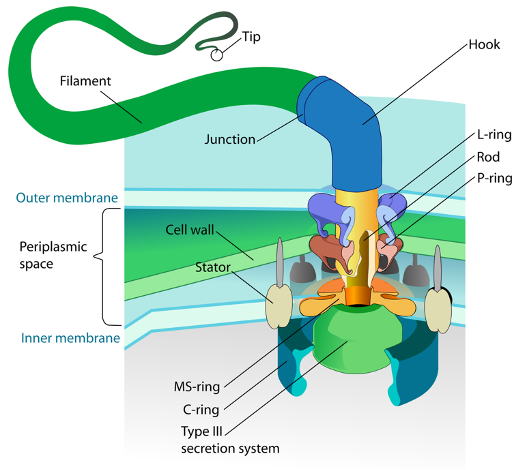
Labeling Darwin’s explanation an “oversimplification,” Macnab questions how a non-functional “preflagellum” could have evolved part by part with each being indispensable to its completed function.9
Although evolutionists attempt to discredit Behe’s example of irreducible complexity, Dr. William Dembski points out the failure of Darwinian evolution to explain such complex systems as the flagellum.
Darwin’s theory, without which nothing in biology is supposed to make sense, in fact offers no insight into how the flagellum arose.10
MYSTERIES OF THE CELL REVEALED
Behe explains how the electron microscope has given us a new understanding of the complexity of the cell. He writes of the “molecular machines” found in the cell,
As strange as it may seem, modern biochemistry has shown that the cell is operated by machines—literally molecular machines. Like their man-made counterparts (such as mousetraps, bicycles, and space shuttles), molecular machines range from the simple to the enormously complex mechanical, force-generating machines, like those in muscles; electronic machines, like those in nerves; and solar-powered machines, like those of photosynthesis.11
Darwin understood that cells were the building blocks of life and contained a nucleus and nucleolus. But he was unaware of DNA, RNA, genes, or the intricate molecular machinery within them. Without any knowledge of DNA, Darwin attempted to derive his own theory of genetics (pangenesis), but it was eventually proven to be false.
The magnified cell in Darwin’s day looked something like an opaque pancake-like jellyfish with a fuzzy-looking shady spot in the center called the nucleus. It all looked so simple back then. Only recently, under powerful magnification, have the mysteries of the cell’s complexity begun to be unveiled. Molecular biologist Michael Denton uses a metaphor to describe the cell’s complexity:
To grasp the reality of life as it has been revealed by molecular biology, we must magnify a cell a thousand million times until it is twenty kilometers in diameter and resembles a giant airship large enough to cover a great city like London or New York. What we would then see would be an object of unparalleled complexity and adaptive design. On the surface of the cell we would see millions of openings, like the port holes of a vast spaceship, opening and closing to allow a continual stream of materials to flow in and out. If we were to enter one of these openings we would find ourselves in a world of supreme technology and bewildering complexity.12
But, again, it is not simply complexity; it is irreducible complexity. Going back to Behe’s illustration of the mousetrap, everything must be in place for the system to work.
Missing just one component, the whole system is worthless.
Cell Structure
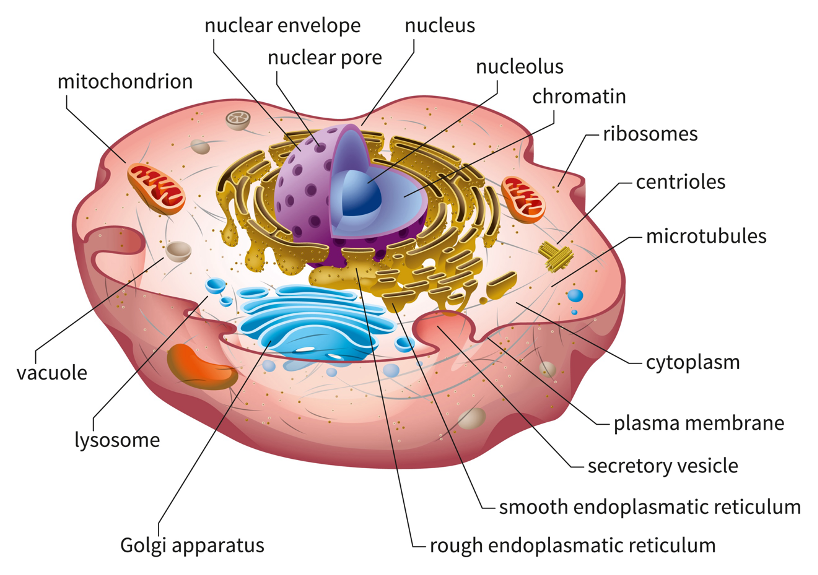
Darwin’s Black Box is a scientific book, not a theological one, but Behe has been joined by an increasing number of open-minded scientists who claim they see the fingerprints of intelligent design within irreducibly complex biological systems. Cosmologist Alan Sandage speaks for many of them:
The world is too complicated in all its parts and interconnections to be due to chance alone. The more one learns of biochemistry the more unbelievable it becomes unless there is some type of organizing principle—an architect for believers.13
It is important to mention here that Darwin’s theory of microevolution, which explains small variations within a particular species, has been verified time and again as valid science through nature as well as by selective breeding.
However, his theory of macroevolution has not been able to explain the irreducible complexity of “organs of perfection” like the eye. In Darwin’s own words, such failure would cause his theory (of macroevolution) to “absolutely break down.”
James Shapiro, a biochemist at the University of Chicago, pronounces his verdict on Darwin’s theory of macroevolution.
There are no detailed Darwinian accounts for the evolution of any fundamental biochemical or cellular system, only a variety of wishful speculations.14
Biochemistry has addressed Darwin’s concern about “organs of extreme perfection,” and found that his theory is incapable of explaining the irreducible complexity found in the eye, the cell, and many other biological “machines.” In his own words, evidence at the molecular level shows that his theory of macroevolution “absolutely breaks down.”
DARWIN’S HUGE PREDICTION
Do Darwin’s predicted fossils really exist? He assumed that massive numbers of transitional fossils would eventually be discovered, proving his theory of macroevolution right. However, he admitted that if such intermediate fossils weren’t discovered he would be proved wrong. So, after over a century and a half, what does the evidence show?
In the next chapter we will see what a century and a half of paleontological evidence has revealed about Darwin’s predicted transitional fossils.