Initial impressions are lasting and sticky. If you do not arouse the emotions and interest of the audience in the first few minutes, you may not recover. Start a fire! Throw some sticky buns!
Should be clear.
Thoughts must be in order and specific so the audience can engage their minds in the sermon without distraction. You do not want the audience wondering or wandering for 10 minutes not knowing where this message is going. “Tell them, what you are going to tell them.”
Should have unity.
Only one idea should be presented. Multiple ideas will confuse your audience. Do not try to ‘wow’ them with various theological thoughts in your introduction.
Should be brief.
Nobody likes a long drawn out introduction. The audience is annoyed when half the time of delivery is spent on introducing the theme.
Should be modest.
Even in starting a fire your introduction should contain a conversational tone even when you are passionate. If your introduction is that amazing, you will likely underwhelm the audience with the remainder of the sermon.
Should be unapologetic.
Do not apologize in your introduction. If the item that you wish to discuss demands apology it probably should be avoided. IE Don’t apologize for being tired or sick. This will bring unneeded attention and will distract from the message itself. Remember that controversial is not the same as confrontational.
Various materials may be used in the preparation of introduction.
Sermons are written because of a reason. Sometimes that reason can be stated and other times it cannot. Use materials (listed under materials/argument) in the process of writing the introduction
Points (the meat of the message)
Exposition: Explain the original intended meaning of the point in the text
Illustration: Use a specific situation to “picture” the point being made
One word (bread, salt, light)
Analogy (like farmer sowing seeds and waiting for harvest)
Anecdote (personal true story)
The story (fictional story)
Application (persuasion): Apply the Scripture truth to contemporary situations
Sermon should instruct and inspire but above all else, persuade
Ideal sermon will have the necessary pieces to:
instruct the mind
impress the will
hold the attention
stir the emotions and move to action
Conclusion
Like the introduction, it should be clear, have unity and also be brief. This is the call to action or the climax of persuasion. Your audience cannot handle a variety of items or calls to action within one conclusion. Like your introduction it should have one theme, and one call to action which should be representative of your entire message.
The conclusion should be intense. This does not mean volume, but moral and spiritual intensity. It should be wrapped with Godly zeal and passion. A preacher that cannot be intense in his appeal for decisions that have eternal consequences is in dire trouble.
Types of Conclusions
The lesson – Often common for teaching sermons that require no immediate decision, this kind of conclusion sums up the ‘moral of the story’.
The summary – Briefly repeating the points to aid in retention; also typical of a teaching sermon that does not require an immediate decision.
The appeal – Urges immediate decision, action or obedience. Even if a decision can be made in one’s seat, it’s always necessary for a public profession of faith. An appeal is most effective when it’s not been expected. If someone is pre-prepared for the conclusion and your appeal, their thoughts are likely to wander elsewhere.
Textual – a sermon that refers often to a particular Biblical text for a subject and the main divisions. The main points are clearly inferred by the passage; however, the subdivisions are invented as in the same construction of a topical sermon. Two methods for making textual divisions.
Analysis, or ‘taking apart,’ involves an explanation of the parts of a particular text, along with their relationships to one another.
Synthesis, or ‘putting together,’ involves a rearrangement of points or the construction of an outline from points supplied by the text. (rearranging framework, majoring on a minor theme or superimposing design to create vividness)
For week 4:
Volunteer(s) for 10-15(max) presentation of Topical Message
Please select another theme as we begin to look at the Textual Message
This training material was provided by Joshua Nations (JoshuaNations.org).
Textual – a sermon that refers often to a particular Biblical text for a subject and the main divisions. The main points are clearly inferred by the passage; however the subdivisions are invented as in the same construction of a topical sermon. Two methods for making textual divisions.
Analysis, or ‘taking apart,’ involves an explanation of the parts of a particular text, along with their relationships to one another.
Synthesis, or ‘putting together,’ involves a rearrangement of points or the construction of an outline from points supplied by the text. (rearranging framework, majoring on a minor theme or superimposing design to create vividness)
A Textual Sermon and an Expository Sermon are very similar, and are constructed in the same manner. The main difference is the subdivisions and meat of the sermon. A Textual sermon often uses the text as a skeletal structure whereas the Expository sermon uses the entire passage. This often means the passage in the Expository sermon is much longer than that of the Textual.
We will focus on the analysis of the text as a way to dig and discover and then the synthesis to arrange and construct.
Questions to ask in analysis:
Who is the speaker?
Why is this said?
Who is addressed?
What is required?
What are the conditions of success?
What lessons are taught?
What promises are made?
What ideas are expressed?
What doctrines are taught?
What qualities are displayed?
Examples to build in class:
Philippians 1:5-6
for your fellowship in the gospel from the first day until now, being confident of this very thing, that He who has begun a good work in you will complete it until the day of Jesus Christ;
Day of Conversion
Day of Opportunity
Day of His Return
Colossians 3:12-14
Therefore, as the elect of God, holy and beloved, put on tender mercies, kindness, humility, meekness, longsuffering; bearing with one another, and forgiving one another, if anyone has a complaint against another; even as Christ forgave you, so you also must do. But above all these things put on love, which is the bond of perfection.
The Christians Attire
Turban of Humility
Tunic of Compassion and Kindness
Sandals of Longsuffering
Cloak of Forgiveness
Sash of Love
Matthew 7:13-14
“Enter by the narrow gate; for wide is the gate and broad is the way that leads to destruction, and there are many who go in by it. Because narrow is the gate and difficult is the way which leads to life, and there are few who find it.”
Once you have completed the analysis and extracted various ideas, concepts, ‘raw data’ then it is necessary to move onto the next step of synthesis. Synthesis is important as it is the process of compiling or arranging these concepts and information into a structured format with some unity.
Example: Classifying a rubber tree as roots, trunk and branches would be analysis. Making these things into a tire would be synthesis. Identifying bricks, wood, nails, sheetrock etc. would be analysis – putting them together into a house would be synthesis.
Synthesis is necessary when there is no clear order, theme or structure built into the chosen text.
This training material was provided by Joshua Nations (JoshuaNations.org).
Topical – a sermon that has a topic in mind prior to consulting the text, and then search for one or more biblical texts that address the topic chosen beforeand.
May be composed by displaying its aspects or point of view (way of looking at a subject)
Prayer – necessity, method, results
May be constructed by stating its proofs (best for controversial themes)
Messiah – OT Prophecy, Christ’s Work, Christ’s Claims, Power of the Gospel
May be developed by advancing illustrations of the theme taken from Bible incidents and biographies, or even by illustrations from church history.
Influence of Godly Mother – Moses, Samuel, Timothy
May be developed according to the kinds of materials used in a sermon: explanations, argument, illustration and application.
Tithing – Explain it, Prove it, Illustrate it, Apply it
May be developed by treating the subject part by part or step by step, when such a sermon can be given spiritual significance.
Courtroom of Life – Judge, Accuser, Advocate, Verdict
Organizing Your Sermon
Why Organize your sermon
Facilitates delivery.
More pleasing to the hearer.
Easier to remember
Easier to understand.
Increases effectiveness.
Qualities of an organized sermon:
Unity (one theme prevails through all divisions).
Coherence (parts related to common theme and adhere to one another).
Steady progressSymmetry.
Should have climax.
*To have an organized sermon, you must also have organized study.*
Steps / Checklist for Preparation (one process for construction of sermon)
Once the exegetical study is made of a selected passage and the audience need is understood, the following steps are suggested.
Step #1 State a theme for preaching
The theme should be in harmony with the Scripture passage and a specific contemporary human need. Sermon title comes from the theme.
Step #2 State the truth you want to establish
There should be a statement in sentence form, which pulls together the exegetical idea and the human need, expressing precisely what principle you want to have established by the end of the sermon.
Step #3 State an audience-centered purpose
There should be a statement in attitude/behavior terms, which expresses precisely what purpose you have in establishing the above truth. It should be agreeable with the original purpose of the passage. It should be in terms of “How to” or “Ought to”
Step #4 Select points you want to use (minimum of two)
These should be an outgrowth of your exegetical study. All points should come from the passage(s) being used. They do not have to be in the same order as in the text
Step #5 State the response you hope the sermon will produce
It should be in line with the passage. It should be expressed in objective terms.
Step #6 Decide where to place the exegesis
Introduction, body and/or conclusion – To draw out the hidden meaning of Scripture. To interpret. The art of expounding Scripture. Explanation or critical interpretation. Letting the Scripture speak for itself. In exegesis, it is always invalid to read a meaning into Scripture, which was never intended by the original author. The exposition sets forth the true meaning in an appropriate and effective order.
Step #7 Write introduction
Start with perspective of the Scripture and move to need, or start with the need and move to the perspective of the Scripture
Step #8 Fill in outline
For each point, use the following pattern: Exposition: Explain the original intended meaning of the point in the text Application: Apply the Scripture truth to contemporary situations Illustration: Use a specific situation to “picture” the point being made
Step #9 Write Conclusion
Conclude with an overall summary or on the basis of the final point
Step #10 Express the Appeal
The appeal should be specific; it should be simple and measurable. You should express precisely what you want the audience to do.
Deductive and Inductive Study
The deductive method of reasoning moves toward necessary conclusions derived from correct connections between premises which are all either given or assumed to be true.
The inductive method of reasoning moves toward possible conclusions derived from hypothetical connections between premises (observations) which are selected from among all possible true premises (observations).
Ideally, the deductive method of reasoning is objective in its conclusions (the conclusions are necessarily true), but subjective in its premises (the premises are assumed to be true).
Ideally, the inductive method of reasoning is subjective in its conclusions (the conclusions are not necessarily true), but objective in its premises (the premises are observed to be true).
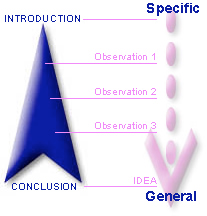
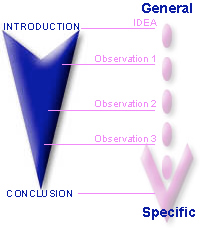
The deductive method reasons from certain premises to a necessary conclusion. It is often described as reasoning from the general to the specific.
Premise: All men are mortal Premise: Socrates is a man Conclusion: Socrates is mortal
If the premises are true, and the form is correct or valid, then the conclusion is necessarily true. However, if the form is invalid, then the conclusion is not necessarily true.
Some men are mortal. Socrates is a man. Therefore, Socrates is mortal.
Though we may know that Socrates is mortal, nevertheless that does not logically flow from the premises of this argument. If we only know that some men are mortal, then Socrates might be among some men who are not mortal. The form of the argument is not valid.
The inductivemethod reasons in the opposite direction of the deductive method. It begins with specific observations and reasons to a generalization about the observations. It is often described as reasoning from the particulars to the general.
I have examined ten thousand dogs. Every dog I have examined has fleas. Therefore, all dogs have fleas.
The conclusion (really, a generalization) may possibly be true there is no observation which contradicts the conclusion but it is not necessarily true there are still more observations which could be made.
If, indeed, I had examined all dogs (which, of course, nobody could possibly do), and all dogs examined had fleas, then I could conclude that all dogs do indeed have fleas. Based on my sample of dogs, it appears that all dogs have fleas. But the first dog I found which did not have fleas would contradict and therefore disprove my conclusion. So all that I actually know is that some dogs have fleas.
Inductive Bible Study
Inductive Bible study on the basic level is simply careful instruction in the meaning of the Biblical text. A better name for this might be analytic Bible study [Greek: analuein to undo, to loosen back (to the elements)] because it breaks down Bible texts into parts or principles in order to examine its meaning and relationship to other texts.
One common way of doing an inductive study is to choose a large passage to examine word by word, phrase by phrase, paragraph by paragraph with a series of such questions as Who? What? Where? When? Why? How? What kind of? How many? Which help to draw out some of the meaning of the text
We begin with the observation level, determining what the text says
We next move to the interpretation level, determining what the text means by what it says.
Finally we move to the application level, determining how to apply what the text means to issues of modern life.
One common way of doing a deductive study is for the student to examine a selected series of Bible texts, then to answer specific questions about each text questions which will draw out and pull together the logical inferences so that the student can think for himself step-by-step through the logic of the doctrine.
Of course, in deductive Bible study the student must place a reasonable amount of trust in his teacher to guide him through the doctrines. Nevertheless, there are some things hard to understand, which untaught and unstable persons twist to their own destruction, as they do also the rest of the Scriptures. (2 Peter 3:16) The danger of the deductive study is that, regardless of the teachers intentions, we may be mislead. So the student must also examine for himself the Bible texts in their contexts to see if they say what the teacher thinks they say, and He must test the logical connections to make sure they prove what the teacher thinks they prove. The Bereans were more fair-minded than those in Thessalonica, in that they received the word [of the Apostles doctrine] with all readiness, and searched the Scriptures daily to find out whether these things were so. Therefore many of them believed. (Acts 17:11-12) Both the teacher and the student are accountable to the Lord, as well as to each other in the Lord.
DEDUCTIVE REASONING
Deductive reasoning begins with a hypothesis, which basically means a “good guess.” After this guess is made, a person would gather evidence to prove the point. If the hypothesis is correct, the evidence will support it. If the hypothesis is wrong, the evidence will not support it. We all use this line of reasoning every day to draw conclusions about our world. Deductive reasoning is basically a “trial & error” method.
INDUCTIVE REASONING
Inductive reasoning demands that one studies, observes, gathers evidence (the specific part) and then draws conclusions (the general part) based on all the above. This is a much stronger way to establish truth than any other method of Bible study. Deductive reasoning is used at every stage of observation but the main idea is stated only after all observations are made. In this way, each observation leads to a new discovery of truth.
Topical Sermon (error)
Sometimes God doesn’t care
God turned His back on Jesus
How much more will He despise humanity if He turned his back on His son
Matthew 27:46 2.
God punishes us at will
God is full of anger and wrath and will chastise you
Leviticus 26:28
Your guilt will be so heavy you might as well hang yourself
Even an apostle cannot escape the guilt of humanity
Matthew 27:5
This training material was provided by Joshua Nations (JoshuaNations.org).
(7) Also Jeshua, Bani, Sherebiah, Jamin, Akkub, Shabbethai, Hodijah, Maaseiah, Kelita, Azariah, Jozabad, Hanan, Pelaiah, and the Levites caused the people to understand the law, and the people [stood] in their place.
(8) So they read distinctly from the book, in the Law of God; and they gave the sense, and helped them to understand the reading.
(Amplified Bible): “…helped the people to understand the law; and the people remained in their place, So they read from the book of the Law of God distinctly, faithfully amplifying and giving the sense, so that the people understood the reading.”
Definitions and Terms
Biblical: Ideas and concepts presented in the sermon are in harmony with the original intent and purpose of the original author of the Scripture and being used in the sermon.
A sermon is Biblical only if the Scripture being used is founded upon the meaning of the original author
A sermon fails to be Biblical if the Scripture being used departs from the original meaning of the first author of the Scriptures.
Preaching: A proclamation of Divine Truth with the express purpose of causing a change in a person’s behavior. Always delivered with persuasion.
The art of moving men from a lower to a higher life
The art of inspiring men toward a nobler manhood
The art of inspiring men so as to incite them to action
Speech that moves men to action
Reveals God to man
The communication of truth by man to men
Webster’s Dictionary
To proclaim publicly
To deliver a sermon
To urge acceptance or abandonment of an idea or course of action
The communication of God’s truth by God’s servant to meet the needs of the people (Wierbe)
The bringing of truth through personality (Philip Brooks)
Teaching:
To cause to know a subject.
To cause to know how.
To guide the studies of.
To instruct by precept, example, or experience.
To provide instruction.
Audience Needs: This means that people can and do have on a regular basis, observable problems in life situations, which can be addressed in public sermons.
All sermons must be the express purpose of addressing human needs or else there would be no reason to preach.
Cross-Cultural Truths: Scripture contains truths, which are not bound by one culture.
Exegesis: To draw out the hidden meaning of Scripture. To interpret. The art of expounding Scripture. Explanation or critical interpretation. Letting the Scripture speak for itself. In exegesis, it is always invalid to read a meaning into Scripture, which was never intended by the original author. The exposition sets forth the true meaning in an appropriate and effective order.
Hermeneutics: The science of interpretation. The study of the methods and principles of interpreting the Bible.
Various Methods of Hermeneutics:
The Literal Method: Interpretation gives to each word the same exact meaning if would have in normal, ordinary, customary usage, whether employed in writing, speaking or thinking. The customary, socially acknowledged designation of a word is the literal meaning of that word. The meaning is to be determined by both grammatical and historical determination.
The Allegorical Method: The literal sense is only a vehicle for a more spiritual and profound sense.. This historical meaning is either denied or ignored and the emphasis is placed entirely on a secondary sense so that the original words or events have little or no significance. This method results from the desire to unite Greek Philosophy and the Word of God. (Greek Philosophy was considered to be of divine Origin)
The Anti-Supernatural Method: To explain all miracles-events in terms of some natural occurrences.
The Dogmatic Method: Starts with a Dogma or Doctrine and makes all Scripture fit into a certain mold. The method is determined by man’s statement of truth as set forth in a Creed or a Denomination or Church’s Statement of Doctrine.
The Devotional Method: Meaning out of Scripture by some inner thought or impression of your own.
Personal Philosophy Method: Starts with one’s own view of life and finds Scripture which “support” that viewpoint.
The Commentary Method: This pulls together different ideas from selected Commentaries forming a composite interpretation.
Homiletics: The study and delivery of sermons. The science that teaches the principles of adapting the discourses of the pulpit to the spiritual needs and benefits of the hearers.
Homily: A lecture or moral conduct. A religious discourse delivered to a congregation – conversation – discourse. A serious admonition or exhortation upon a course of conduct.
Text: A verse or passage of Scripture chosen especially for the subject of a sermon or for authoritative support (as for a doctrine).
Theme: Argument, Main Point, Subject, Topic. The principle phrase idea or term of logical proposition on which a sermon or speech is based.
Title: Premise, Thesis, Name, Term Theme. A descriptive or general heading, the name of a written, printed, or filmed production, a label.
Proposition: The sermon’s intent or “big idea,” expressed in a clear, biblical, and relevant sentence.
This sentence is to the sermon what the spine is to the skeleton, and the foundation to the house. It holds things together and helps to determine what the final product will become.
The proposition should be Biblical (Timeless Truth worth preaching about) Important and relevant to the needs of the people. It should be definite and clear, accurate and honest and interesting so the listener is encouraged to want to listen to the development of the theme in the sermon.
It should always be stated in the present tense. (What God does for us today?)
Kinds of Preparation
Impromptu – A speech that is made or done on the spur of the moment. Something that is done with sudden notice. Very little time given to prepare.
Extemporaneous – Carefully prepared but delivered without notes or text. It could happen very suddenly and often unexpectedly. A speech that results from sudden thoughts flowing through the mind of the speaker.
Formal – Rigid, methodical relating to the outward from of something. Following an established form, rule or custom
Types of Sermons
Topical – a sermon that has a topic in mind prior to consulting the text, and then search for one or more biblical texts that address the topic chosen beforeand.
Textual – a sermon that refers often to a particular Biblical text, but does not take the main point of the text as its own..
Expositional – a sermon which takes the point of the text as the point of the sermon.
Biographical – a sermon in which the preacher traces the life of a biblical character and draws contemporary moral implications..
Anecdotal – a sermon in which the preacher primarily tells engaging stories with a moral lesson.
Illustrative – using a prop to help communicate and bridge the gap from Scripture to today’s life.
Selecting a Theme
Select a Theme (due on 2nd week)
Theme should express the whole aim of the sermon
Theme should be biblical
Theme should be dynamic. It should start hearers in a certain direction and stir mental activity
Theme should be specific and not general or broad
Choosing and Interpreting a Text
Select a real text. One that is a complete statement, precept or narrative used with the sense intended by the author.
Select the great doctrinal and ethical texts of the Bible.
Avoid texts known to be interpolations (things that have crept into later manuscripts)
Avoid the sayings of uninspired men when choosing texts (Jobs friends)
Do not choose texts simply because they are odd or unusual.
Interpret the text in the light of the context.
Interpret the text in harmony with the teaching of the whole Bible.
The text must be interpreted in harmony with sound, systematic doctrine.
A text should be taken literally unless it’s obviously figurative or unless a literal interpretation would lead to an absurdity or impossibility.
If possible, consult the original languages as a help to interpretation
If you are unable to or do not understand the original text, consult several different translations of the bible (NKJV, Young’s Literal, Interlinear, Amplified, etc.)
Consult parallel passages
Consult a good critical, exegetical commentary
This training material was provided by Joshua Nations (JoshuaNations.org).
Sir Robert Anderson, The Coming Prince (Grand Rapids, MI: Kregel Publications, 1975, 19th edition), 155.
Bertrand Russell, Why I Am Not a Christian (New York: Touchstone, 1957), 16.
C. S. Lewis, “Predictions of the Second Coming,” quoted in: http://www.atkinsmarketingsolutions.com/wp/2011/05/21/rapture-marketing-c-s-lewis-end-of-the-world-predictions/
John McManners, ed., The Oxford History of Christianity (New York: Oxford University Press, 2002), 28.
Darrell L. Bock, Breaking the Da Vinci Code (Nashville: Nelson, 2004), 114.
Bock, 119-120.
Ibid.,13.
Norman Geisler and Ron Brooks, When Skeptics Ask (Grand Rapids, MI: Baker, 1998), 156.
Quoted in Robinson, 126.
Quoted in Lutzer, 32.
Quoted in Josh McDowell, The New Evidence that Demands a Verdict (San Bernardino, CA: Here’s Life, 1999, 37.)
Acts 13:1-3, 33.
Gospel of Barnabas, 94:1.
John 1:1-3, 14. NIV [See http://www.biblegateway.com/passage/?search=John%201:1-14&version=NIV].
Norman Geisler & Abdul Saleeb, Answering Islam (Grand Rapids, MI: Baker, 2002), 303-307.
Geisler & Saleeb, Ibid.
Geisler & Saleeb, Ibid.
J. Slomp, “The Gospel Dispute,” ochristiana, 68.
Norman L. Geisler and Paul K. Hoffman, eds., Why I Am a Christian (Grand Rapids, MI: Baker, 2001), 150.
William F. Albright, “Toward A More Conservative View,” Christianity Today, January 18, 1993.
This early reference might have been to one of the other books named after the apostle Barnabas: the Epistle of Barnabas or the Acts of Barnabas. Scholars question that it refers to the Gospel of Barnabas because there is no other historical document supporting it.
Geisler & Saleeb, Ibid.
Josh McDowell, The New Evidence That Demands a Verdict (Nashville: Thomas Nelson, 1999), 33–68
Paul Johnson, “A Historian Looks At Jesus,” Speech to Dallas Theological Seminary, 1986.
William F. Albright, “Toward A More Conservative View,” Christianity Today, January 18, 1993.
A. H. McNeile, Introduction to the New Testament (Oxford: Clarendon Press, 1955), 463, 464
The title Lord is freely used in both Testaments to refer to God and Jesus. In the Old Testament the Hebrew word for Lord was Adonai. In the Septuagint and the New Testament, the word translated “Lord” is Kurios. Both Adonai and Kurios were used for God by the Jews.” Josh McDowell & Bart Larson,Jesus: A Biblical Defense of His Deity (San Bernardino: Here’s Life, 1983), 33.
Paul L. Maier, Ed, Eusebius, The Church History (Grand Rapids, MI: Kregel, 1999), 149.
Although most early Christians believed in Jesus’ divinity, the church didn’t clarify what that meant until the Council of Nicaea in 325 A. D., when the Roman emperor Constantine convened church leaders together to deal with Arius’s view that Jesus was a created being. However, after an intense debate over the meaning of the apostles’ words about Jesus in the New Testament, all but two of 318 church leaders reaffirmed the majority Christian belief that he is fully God, co-eternal, co-equal and with the Father and Holy Spirit (See “Was there a Jesus Conspiracy?”).
Jehovah’s Witnesses argue that the Greek word for God (theos) should be translated, “a god”, rather than “God.” However, the vast majority of scholars disagree. Walter Martin writes, “Contrary to the translations of The Emphatic Diaglott and the New World Translation, the Greek grammatical construction leaves no doubt whatsoever that this (“the Word is God”) is the only possible rendering of the text…. in their New World Translation Appendix 773-777 attempt to discredit the Greek text on this point, for they realize that if Jesus and Jehovah are “One” in nature their theology cannot stand….” Walter Martin, The Kingdom of the Cults (Minneapolis, Minn: Bethany, 1974), 75.
F. F. Bruce, The Deity of Christ (Manchester, England: Wright’s [Sandbach] Ltd., 1964
D. Guthrie & J. A. Motyer, The New Bible Commentary: Revised (Grand Rapids, MI: Eerdmans, 1973), 1144.
F. F. Bruce, “The ‘Christ Hymn’ of Colossians 1:15-20,” Bibliotheca Sacra (April-June 1984): 101.
Although the author of Hebrews is unknown, some scholars believe it was written by Paul.
The Amplified Bible, Zondervan
Kenneth S. Wuest, Word Studies in the Greek New Testament, Vol. II (Grand Rapids, MI:, Eerdmans, 1986), 41.
John Piper, The Pleasures of God (Sisters, OR: Multnomah, 2000), 33.
Norman Geisler & Peter Bocchino, Unshakable Foundations (Minneapolis, MN: Bethany House, 2001), 297.
Peter Kreeft & Ronald K. Tacelli, Handbook of Christian Apologetics (Downers Grove IL: InterVarsity Press, 1994), 152.
Were the eyewitnesses, who heard Jesus’ words and saw his miraculous deeds, convinced that he is equal in every way with his Father? Or did they think that Jesus was merely a higher created being or a great prophet like Moses?
To sort out truth from fiction, we need to go back to the words of the apostles who were there when Jesus walked the earth and wrote their testimonies of what they saw and heard. We also want to examine what the early church fathers believed and taught since several of them knew and heard the apostles teach.
The Eyewitnesses
Jesus spent three years with his disciples, teaching them about God and explaining to them the deep truths of God’s Word. During those three years, Jesus performed numerous miracles, made audacious claims, and lived a righteous life. After his resurrection, these eyewitnesses wrote down many of Jesus’ words and deeds.
Simon Peter, one of Jesus’ disciples, wrote of Jesus’ glory after his resurrection:
We saw it with our own eyes: Jesus resplendent with light from God the Father…. We couldn’t be more sure of what we saw and heard—God’s glory, God’s voice (2 Peter 1:16-17, The Message).
But does the fact that the apostles saw God’s glory and heard God’s voice through Jesus mean that they regarded him as God? New Testament scholar A. H. McNeile explains,
…no sooner had the Life of Jesus ended in apparent failure and shame than the great body of Christians—not an individual here and there, but the mass of the Church—passed over at once to the fixed belief that He was God.1
Those who deny Jesus’ deity say that the apostles taught that Jesus is God’s supreme creation, and that the Father alone is the eternal God. So, to clarify their beliefs about Jesus, we will examine their words, asking three essential questions:
Did the apostles and early Christians worship Jesus and pray to him as Lord?
Did the apostles teach that Jesus is the Creator written of in Genesis?
Did the apostles worship Jesus as Preeminent in the universe?
Did the Apostles Pray to Jesus as Lord?
After Jesus ascended, the apostles stunned both Jew and Roman by proclaiming Jesus as “Lord”.2 Both the apostles and early Christians did the unthinkable and worshiped Jesus, even praying to him as if he was God. Stephen prayed, “Lord Jesus, receive my spirit” as he was being stoned to death (Acts 7:59).
Other believers soon joined Stephen, who even while they were facing death, “never ceased for a single day…to teach and to proclaim the Gospel of Jesus” (Acts 5:42). The apostles, most of whom were martyred, passed on their knowledge of Jesus to church fathers who carried their message onto the next generation.
Although letters from early church fathers were written too late to be included in the New Testament, they strongly emphasize the apostles’ teaching that Jesus is both God and man.
For example, Ignatius, a disciple of the apostle John, wrote about Jesus’ 2nd coming, “Look for him that is above the times, him who has not times, him who is invisible.” In a letter to Polycarp, who was also a disciple of the apostle John, Ignatius states, “Jesus is God”, “God incarnate,” and to the Ephesians he writes, … “God Himself appearing in the form of a man, for the renewal of eternal life” (Epistle of Ignatius to the Ephesians 4:13). Clement of Rome in AD 96 also taught Jesus’ deity, saying, “We ought to think of Jesus Christ as of God” (2nd Epistle of Clement to the Corinthians 1:1).
So, the idea that belief in Jesus’ deity was invented by the church decades after the apostles were dead simply doesn’t agree with the historical facts. It’s clear that the early church was merely continuing the apostles’ belief in Jesus’ deity.
As the early church grew, Gnostics and other cults began teaching that Jesus was a created being, inferior to the Father. This came to a head in the fourth century when Arius, a popular preacher from Libya, persuaded many leaders that Jesus wasn’t fully God.
Then in AD 325, at the Council of Nicaea, church leaders met to resolve the issue of whether Jesus is the Creator, or merely a creation.3 Over 300 church leaders overwhelmingly affirmed the long-held Christian conviction and New Testament teaching that Jesus is fully God.4
Did the Apostles Believe Jesus was the Creator?
But did the apostles believe Jesus was the one who created everything—including us?
In Genesis the God of the Bible is revealed as Creator of everything from tiny quantum particles to over a trillion galaxies averaging 100 billion stars each. He also created the complex coding of DNA that organizes proteins to develop all living life forms including us.
The prophet Isaiah confirms that God (Yahweh) is the Creator:
I (Yahweh) am the one who made the earth and created people to live on it…. I stretched out the heavens…. All the millions of stars are at my command!” (Isaiah 45:11a, 12, 13b).
The fact that God created the universe and everything in it is foundational to both Old Testament and New Testament theology.
The Apostle John’s Testimony
When Jesus’ disciples gazed at the stars on dark evenings, they didn’t dream or imagine that the Creator of those stars was in their very presence. Although Jesus healed the blind and deaf, calmed storms, and even raised Lazarus from the dead, John and the other disciples saw him as a man with real physical needs for food, rest and sleep.
Yet once they saw Jesus alive after his crucifixion, their eyes were open to his deity. They immediately began spreading the word that Jesus was both God and man.
The apostle John, inspired by the Holy Spirit, begins his Gospel by revealing Jesus as the eternal “Word” who created everything:
In the beginning there was the Word. The Word was with God, and the Word was God. He was with God in the beginning. All things were made by him, and nothing was made without him. In him there was life, and that life was the light of all people (John 1:1,3-4, NCV).
Let’s look closely at what John, under the direction of the Holy Spirit, is saying here:
the “Word” existed before creation
the “Word” is the Creator who created everything
the “Word” is God5
John has told us that the Word is eternal, created everything that exists, and is God. But he doesn’t tell us whether the Word is just a force or a person until verse 14, which makes it clear that John is speaking about Jesus as the Son of God.
The Word became a human and lived among us. We saw his glory—the glory that belongs to the only Son of the Father—and he was full of grace and truth (John 1;14, NCV).
John also refers to Jesus as the Word in his epistle,
Christ is the Word of Life. He was from the beginning. We have heard Him and have seen Him with our own eyes. We have looked at Him and put our hands on Him (1 John 1:1, NIV).
The apostle John tells us that “nothing exists that he (Jesus) didn’t make.” If nothing existed apart from him, it follows that Jesus couldn’t have been a created being.
Paul’s Testimony
Unlike John, the apostle Paul, (formerly Saul) was a bitter opponent and persecutor of Christians until Jesus revealed himself to him in a vision. Years later, Paul writes about Jesus as the Creator to the Colossians:
He (Jesus) is the image of the invisible God, the first-born of creation. For by Him all things were created…all things have been created by Him and for Him. And He is before all things, and in Him all things hold together (Colossians 1:15-17, NASB).
Paul reveals several important things in this passage:
Jesus is the exact image of God.
Jesus is the “first-born” of creation.
Jesus created everything.
Jesus is the reason for creation.
Jesus existed before everything.
Jesus holds creation together.
What does “exact image of God” mean? Bible scholar F. F. Bruce remarks: “To call Christ the image of God is to say that in Him the being and nature of God have been perfectly manifested–that in Him the invisible has become visible.”6 Thus, God being visible in Christ coincides with Jesus’ own words to Philip, “Anyone who has seen me has seen the Father” (John 14:9).
In verse 15, the Greek word for “first-born” (prototokos) means ‘”supreme’ rather than in the temporal sense of ‘born after.”7 According to Bruce, Paul is referring to “Christ’s pre-existence and cosmic activity in creation, and “denotes not only Jesus’ priority but also his primacy.”8 What makes this clear is verse 16 which tells us that everything in the universe was created both through Jesus Christ, and also for him.
In verse 17 we see the eternal Christ sustaining creation. According to Paul, every atom, each DNA strand, and trillions of galaxies are held together by the power of Jesus Christ.
The Book of Hebrews’ Testimony
The New Testament book of Hebrews9 also reveals Jesus as the Creator of everything. Its opening passage mirrors Paul’s words to the Colossians:
In the past God spoke to our ancestors through the prophets at many times and in various ways, but in these last days he has spoken to us by his Son, whom he appointed heir of all things, and through whom also he made the universe. The Son is the radiance of God’s glory and the exact representation of his being, sustaining all things by his powerful word (Hebrews 1:1-3, NIV).
Just as John and Paul reveal, the author of Hebrews tells us that prior to Jesus becoming a man, God created the universe through him. And Hebrews also reveals Jesus Christ as the one who sustains it.
Hebrews 1:3 speaks of Jesus as the “perfect imprint and very image of God’s nature.”10 The Greek word here means that “the Son is the effulgence, the out-raying of the glory of God’s glory.”11 This statement, that Jesus is the “perfect imprint” of the infinite God, confirms that the apostles believed Jesus is fully God.
The author of Hebrews then goes on to tell us that Jesus is not only superior to the prophets, but he also is far above the angels. “This shows that God’s Son is far greater than the angels, just as the name God gave him is far greater than their names” (Hebrews 1:4).
John Piper explains why Jesus is vastly superior to angels:
No angel in heaven ever received such honor and affection as the Son has received from all eternity from his Father. As great and wonderful as angels are, they do not rival the Son…. The Son of God is not an angel—not even the highest archangel. Rather God says, “Let God’s angels worship him!” (Hebrews 1:6). The Son of God is worthy of all the worship that the hosts of heaven can give—not to mention ours.”12
The author of Hebrews then removes all doubt regarding Jesus’ deity:
“But as to the Son, He [the Father] says to Him, ‘Your throne, O God, is forever and ever….’” (Hebrews 1:8, Amplified).
Later in Hebrews, we learn that Jesus Christ “is the same yesterday, today, and forever,” a clear statement of his eternal Deity (Hebrews 13:8). A created being is not the same today as yesterday because there would have been a time when he didn’t exist.
It would be difficult to construe these passages in Hebrews to mean anything other than the fact that Jesus is the God spoken of in the Old Testament, who along with His Father and the Holy Spirit, created the universe.
Pre-Eminent One
The early Christians were accused by the Romans of stealing glory from Caesar, and by the Jews of robbing glory from God (Yahweh). Christianity is criticized by some as being “too Jesus focused.” But is that what the apostles thought? Let’s hear again from Paul as he writes to the Colossians about Jesus.
He is the beginning, the firstborn from the dead, that in everything he might be preeminent. For in him all the fullness of God was pleased to dwell (Colossians 1:19, ESV).
Paul writes that God is pleased to have Jesus as the preeminent person in the universe. But the Old Testament clearly teaches that God will never relinquish his preeminence to a created being (Deuteronomy. 6:4-5; Psalm 83:18; Proverbs 16:4; Isaiah 42:11). Isaiah speaks clearly of God’s (Yahweh’s) preeminence.
Let all the world look to me for salvation! For I am God; there is no other. I have sworn by my own name, and I will never go back on my word: Every knee will bow to me, and every tongue will confess allegiance to my name (Isaiah 45:22-23, NLT).
But how can both Jesus and Yahweh be preeminent? In Genesis the Hebrew word used for God the Creator is plural (Elohim). And, when Isaiah states that God alone created everything, the Hebrew word for God (Yahweh) is also plural. Dr. Norman Geisler concludes,
Biblically speaking, there is more than enough evidence to conclude that the fundamental nature of God is portrayed by the Scriptures as a plural oneness.13
Paul attributes to Jesus the same words of honor Isaiah attributes to Yahweh:
Though he was God, he did not demand and cling to his rights as God. He made himself nothing; he took the humble position of a slave and appeared in human form. And in human form he obediently humbled himself even further by dying a criminal’s death on a cross.
Because of this, God raised him up to the heights of heaven and gave him a name that is above every other name, so that at the name of Jesus every knee will bow, in heaven and on earth and under the earth, and every tongue will confess that Jesus Christ is Lord, to the glory of God the Father (Philippians 2:6-11, NLT).
This passage reveals that before Jesus became a man, he had the full rights of the Godhead. Paul concludes by attributing to Jesus the worship Isaiah said belongs only to Yahweh, “that every knee will bow and every tongue will confess that Jesus Christ is Lord.”
Over seven hundred years before Christ, God tells us through Isaiah, “every knee shall bow to him (Yahweh).” That he is “the Lord, the King of Israel.” “The Redeemer.” “The First and the Last.” Zechariah speaks of God as “the King, the Lord of Hosts who will judge the earth.”
Note the parallels between Yahweh in the Old Testament and Jesus in the New Testament:
“Every Knee shall bow to Jesus” (Philippians 2:11,12)
Jesus is the “Alpha and Omega—God” (Revelation 21: 6, 7)
Jesus is the “First and the Last—God” (Revelation 21:7-22:13)
Jesus is the “Beginning and the End—God” (Revelation 21:6, 7)
Jesus is the “Almighty Lord” (Revelation 1:8)
Jesus is the King of Kings” (Revelation 17:14)
Jesus is the “Lord of Lords” (Revelation 17:14)
Conclusion
The Christian message is that God the Creator came to earth, allowed men to spit on him, mock him, and nail him to a cross as a supreme sacrifice for our sins. God’s perfect justice could only be satisfied by a mediator who was both man and God, taking on himself payment for our sin. No angel or created proxy would suffice. Such an act of condescension demonstrates the immensity of God’s love and grace, as well as the high value He places upon each of us.
In his parting words to the Ephesian elders, Paul encouraged them to “shepherd the church of God, which he purchased with His own blood (Acts 20:28 NASB). Paul is echoing Zechariah’s prophecy where God (Yahweh) says,
“In that day the Lord will defend the inhabitants of Jerusalem….and they will look on Me whom they have pierced, and they will mourn for Him, as one mourns for an only son (Zechariah 12:8a,10b).
Zechariah reveals that the one pierced on the cross was none other than God, himself. Jesus Christ brings Old and New Testaments together like separate instruments harmonizing to create a beautiful symphony. “For, unless Jesus is God, Christianity loses its central theme. But if Jesus is God, all other major Christian doctrines fit together like pieces of a puzzle.”
Kreeft and Tacelli explain:14
“If Christ is divine, then the incarnation, or ‘enfleshing’ of God, is the most important event in history. It is the hinge of history. It changes everything.”
“If Christ is God, then when he died on the cross, heaven’s gate, closed by sin, opened up to us for the first time since Eden. No event in history could be more important to every person on earth than that.”
“If Christ is God, then, since he is omnipotent and present right now, he can transform you and your life right now as nothing and no one else possibly can.”
“If Christ is divine, he has a right to our entire lives, including our inner life and our thoughts.”
The apostles made Jesus Lord of their lives, wrote of him as the Creator, and worshiped him as preeminent. These firsthand eyewitnesses were absolutely convinced that God had visited planet earth in the Person of Jesus Christ, who will return as King of kings and Lord of lords, as well as our eternal Judge.
It was because of the apostles unswerving conviction that Jesus was God in the flesh that they willingly gave their lives proclaiming him as both Savior and Lord.
There is solid historical and textual evidence to support the New Testament’s accounts of Jesus and the apostles. But many wonder why other so-called gospels aren’t included. Two of the most discussed writings that people wonder about are the Gnostic Gospels and the Gospel of Barnabas. We’ll look at the Gnostic Gospels first.
Are There Secret Writings About Jesus?
In 1945 a discovery was made in Upper Egypt, near the town of Nag Hammadi. Fifty-two copies of ancient writings, called the Gnostic gospels were found in 13 leather-bound papyrus codices (handwritten books). They were written in Coptic and belonged to a library in a monastery.
A few Gnostic scholars have gone so far as to assert that these recently discovered writings are the authentic history of Jesus instead of the New Testament.
But does their faith in these documents square with the historical evidence? Let’s take a deeper look to see if we can separate truth from fiction.
Secret “Knowers”
The Gnostic gospels are attributed to a group known as the Gnostics. Their name comes from the Greek word gnosis, meaning “knowledge.” These people thought they had secret, special knowledge hidden from ordinary people.
As Christianity spread, the Gnostics mixed some doctrines and elements of Christianity into their beliefs, morphing Gnosticism into a counterfeit Christianity. However, for their system of thought to fit with Christianity, Jesus needed to be reinvented, stripped of both his humanity and his absolute deity.
In The Oxford History of Christianity John McManners wrote of the Gnostics’ mixture of Christian and mythical beliefs.
Gnosticism was (and still is) a theosophy with many ingredients. Occultism and oriental mysticism became fused with astrology… They collected sayings of Jesus shaped to fit their own interpretation (as in the Gospel of Thomas) and offered their adherents an alternative or rival form of Christianity.1
Early Critics
A mild strain of Gnostic philosophy was already growing in the first century just decades after the death of Jesus. The apostles, in their teaching and writings, went to great lengths to condemn these beliefs as being opposed to the truth of Jesus, of whom they were eyewitnesses.
Check out, for example, what the apostle John wrote near the end of the first century: “Who is the great liar? The one who says that Jesus is not the Christ. Such people are antichrists, for they have denied the Father and the Son” (1 John 2:22, NIV).
Following the apostles’ teaching, the early church leaders unanimously condemned the Gnostics as a cult. Church father Irenaeus, writing 140 years before the Council of Nicaea, confirmed that Gnostics were condemned by the church as heretics. He also rejected their “gospels.” But, referring to the four New Testament Gospels, he said, “It is not possible that the Gospels can be either more or fewer in number than they are.”2
Christian theologian Origen wrote this in the early third century, more than a hundred years before Nicaea:
I know a certain gospel which is called “The Gospel according to Thomas” and a “Gospel according to Matthias,” and many others have we read—lest we should in any way be considered ignorant because of those who imagine they possess some knowledge if they are acquainted with these. Nevertheless, among all these we have approved solely what the church has recognized, which is that only four gospels should be accepted.3
Mystery Authors
When it comes to the Gnostic gospels, just about every book carries the name of a New Testament character: the Gospel of Philip, the Gospel of Peter, the Gospel of Mary, and so on. But could they have even been written by their purported authors? Let’s take a look.
The Gnostic gospels are dated about 110 to 300 years after Christ, and no credible scholar believes any of them could have been written by their namesakes. In James M. Robinson’s comprehensive The Nag Hammadi Library, we learn that the Gnostic gospels were written by “largely unrelated and anonymous authors.”4
New Testament scholar Norman Geisler writes,
The Gnostic writings were not written by the apostles, but by men in the second century (and later) pretending to use apostolic authority to advance their own teachings. Today we call this fraud and forgery.5
Mystery Versus History
The Gnostic gospels are not historical accounts of Jesus’ life but instead are largely esoteric sayings, shrouded in mystery, leaving out historical details such as names, places, and events. This is in striking contrast to the New Testament Gospels, which contain innumerable historical facts about Jesus’ life, ministry, and words.
Consider the following two statements, the first from the Gnostic Gospel of Thomas (c. AD 110-150), and the second from the New Testament’s Gospel of Luke (AD 55-70)
Gospel of Thomas: “These are the hidden sayings that the living Jesus spoke, and Judas Thomas the Twin recorded.”6
Gospel of Luke: “Many people have written accounts about the events that took place among us. They used as their source material the reports circulating among us from the early disciples and other eyewitnesses of what God has done in fulfillment of his promises. Having carefully investigated all of these accounts from the beginning, I have decided to write a careful summary for you, to reassure you of the truth of all you were taught” (Luke 1:1-4, NLT).
Hidden sayings in the Gnostic gospels compared with factual accounts in the New Testament. Noted professor Raymond Brown has said of the Gnostic gospels,
We learn not a single verifiable new fact about the historical Jesus’ ministry, and only a few new sayings that might possibly have been his.7
Such contrast between the New Testament and the Gnostic writings is devastating to those pushing conspiracy theories.
In summary, the Gnostic gospels simply don’t meet the high standards required by scholars for inclusion in the New Testament. New Testament historian F. F. Bruce wrote,
There is no body of ancient literature in the world which enjoys such a wealth of good textual attestation as the New Testament.8
The Gospel of Barnabas: Secret Bible?
A Turkish official discovered a 1,500-year-old ancient leather-bound text, secretly hidden for 12 years, that could be an authentic version of the Gospel of Barnabas.
According to this “secret Bible,” Barnabas was one of Jesus’ original twelve apostles. However, in the book of Acts, Luke introduces Barnabas as an apostle who came after the original twelve and was a fellow missionary with the apostle Paul. In their travels, Paul and Barnabas boldly declared Jesus’ death, resurrection and lordship in the first century.9
A Different Jesus?
Although the document entitled the Gospel of Barnabas contains much of the same information as the four New Testament Gospels, it differs greatly about the identity of Jesus Christ. A few of the significant differences are that the Gospel of Barnabas:
Denies Jesus’ deity
Rejects the Trinity
Denies Jesus’ crucifixion
Let’s look at what the Gospel of Barnabas says about Jesus’ deity.
Gospel of Barnabas:
I confess before heaven, and call to witness everything that dwells upon the earth, that I am a stranger to all that men have said of me, to wit, that I am more than man. For I am a man, born of a woman, subject to the judgment of God; that live here like as other men, subject to the common miseries.10
Clearly the Gospel of Barnabas depicts Jesus denying his deity, whereas the apostle John clearly writes of Jesus as God the Son, Creator of the world.
Gospel of John:
In the beginning was the Word, and the Word was with God, and the Word was God. He was with God in the beginning. Through him all things were made; without him nothing was made that has been made…. The Word became flesh and made his dwelling among us. We have seen his glory…11
In this passage, John claims he actually saw Jesus. Later he tells us he touched him, traveled with him and heard him teach for three years. He speaks about Jesus as a close companion. But the writer of the Gospel of Barnabas makes no such claim.
Both writings also differ regarding Jesus’ crucifixion. The Gospel of Barnabas presents Judas Iscariot as the one who died on the cross instead of Jesus, whereas in the New Testament, Judas betrays Jesus.
Both messages can’t be true since the New Testament says Jesus clearly died on the cross and the Gospel of Barnabas states otherwise. So how can we know which Jesus is real?
The best way to know the truth about whether or not Jesus died on the cross is to check the historical record. Even secular historians are convinced that Jesus did truly die on the cross.
Another important way to verify whether the Gospel of Barnabas or the New Testament is portraying events truthfully is to compare the reliability of the two different accounts.
Although scholars use several tests to determine a manuscript’s reliability, the most important is whether it is an eyewitness account. In a criminal trial, eyewitness testimony is always considered far superior to the testimony of someone who didn’t witness the crime. If either gospel can be traced back to the first century, the likelihood of its reliability greatly increases. So, what does the evidence tell us? Let’s begin with the Gospel of Barnabas.
Is The Gospel of Barnabas an Eyewitness Account?
In order for the Gospel of Barnabas to have been an eyewitness account, it would need to have been written during Jesus’ lifetime in the first century. Since we don’t have the original writings for either the Gospel of Barnabas or the New Testament, we need to verify their dating by both historical evidence and the evidence from ancient manuscript copies.
There are only two ancient manuscripts of the Gospel of Barnabas other than the one discovered in Turkey: an Italian manuscript which dates to the 15th or 16th century, and a Spanish copy from around the same period which has been lost.12 The text in the newly discovered Turkish manuscript is in Aramaic. None of these copies are in Greek, the language of Barnabas and the apostles.
Two early Christian lists of apocryphal works, one from the 5th century and one from the 7th century, mention “A Gospel of Barnabas.” If these refer to the same Gospel, it would place its writing 400-500 years after Christ or earlier. But that still is several hundred years after the 1st century.
The Acts of Barnabas is a 5th century apocryphal work directed to the church of Cyprus that is sometimes mistakenly confused with the Gospel of Barnabas.
The only book from the 1st century attributed to the apostle Barnabas is the Epistle of Barnabas, which is an apocryphal writing not in the New Testament. This 1st century letter speaks of Jesus as the crucified and resurrected Lord. Scholars believe it was written by Barnabas between AD 70 and 90.
But if Barnabas writes of Jesus as Lord in the 1st century Epistle of Barnabas, why would he then write of Jesus as merely a prophet in the Gospel of Barnabas? Why would he write two contradictory accounts of Jesus?
The Epistle of Barnabas is accepted by scholars as an authentic 1st century account of Jesus that agrees with the New Testament. However, the Gospel of Barnabas is a completely different book with a completely different timeline.
The following evidence suggests that the Gospel of Barnabas wasn’t recognized as a 1st century gospel by early Christians or non-Christians:13
No non-Christian writer refers to it until the 15th or 16th century.
No Christian writer refers to it from the 1st to the 15th century.
The earliest reference to it was made in the 5th century, but it is in doubt.
It cites historical facts that didn’t exist until hundreds of years later.14
Medieval Forgery?
Christian writers such as Irenaeus wrote extensively about anti-Christian documents such as the Gnostic gospels, classifying them as heretical. Yet not one of Irenaeus’ letters or documents mentions the Gospel of Barnabas. There is simply no mention of it from any early writer.
Perhaps most indicative of its late date is that the Gospel of Barnabas describes medieval life in Western Europe, as well as a 100-year Jubilee, which wasn’t declared until the 14th century. How would Barnabas or any 1st century writer know such historical detail hundreds of years before it was declared?
Dr. Norman Geisler concludes, “The evidence that this was not a 1st century gospel, written by a disciple of Christ, is overwhelming.”15
Not only does the evidence argue against it being written by Barnabas in the 1st century, but some scholars believe the Gospel is a forgery. One expert writes, “In my opinion scholarly research has proved absolutely that this ‘gospel’ is a fake.”16
Is The New Testament an Eyewitness Account?
History provides clues from three primary sources regarding the date of origin for the 27 books of the New Testament:
Testimony of Church Enemies
Early Christian Accounts
Early Manuscript Copies
The first clue is a partial list of New Testament books made by enemies of the Church called heretics. As outlaws of the Church, heretics wouldn’t have been concerned about agreeing with Church leaders about the authorship or dating of the New Testament. Yet, two early heretics, Marcion and Valentinus, did attribute the writings of several New Testament books and passages to the apostles.
In AD 140, the heretic Marcion listed 11 of the 27 New Testament books as being the authentic writings of the apostles.
At about the same time, another heretic, Valentinus, alludes to a wide variety of New Testament themes and passages.
What this tells us is that by the middle of the 2nd century many New Testament books had been in circulation for some time. Even heretic “outlaws” accepted these New Testament accounts as the eyewitness reports from the apostles.
Early Christian Accounts
Our second clue is the vast number of early Christian letters, sermons, commentaries, and creeds referring to Jesus as the resurrected Lord. They appeared as early as five years after his crucifixion.
The number of these documents is impressive; more than 36,000 complete or partial writings, some from the 1st century, have been discovered.17 Their words could replicate virtually the entire New Testament except for a few verses.18
So how does that compare with the Gospel of Barnabas? We have already noted that there are only two citations of it prior to the 15th century, and it is doubtful those references were to the “Gospel of Barnabas” in question.19
The earliest writings outside the New Testament were from men who knew and followed Paul, Peter, John and the other apostles. These early church leaders were not eyewitnesses to Jesus but learned about him from those who had actually seen and heard him.
The most important of these early writings outside the New Testament are from Clement of Rome, Ignatius of Antioch, and Polycarp of Smyrna.
In AD 96, Clement of Rome wrote a lengthy letter to the church at Corinth in which he cited Matthew, John, and 1 Corinthians. Some believe he is the Clement mentioned by Paul in Philippians 4:3. Since Clement’s letter was written in AD 96, these three books must have been written earlier.
In about AD 110, Ignatius of Antioch, a disciple of the apostle John, wrote six letters to churches and one to a fellow bishop, Polycarp, in which he refers to six of Paul’s letters. Polycarp of Smyrna, also a disciple of the apostle John, refers to all 27 New Testament books in his letter to the Philippian church (AD 110-135).
Therefore, the Gospels must have been in existence in the 1st century when eyewitnesses (including John) were still alive. We have seen that no such early reference to the Gospel of Barnabas exists.
Early Manuscript Copies
Our third clue is the abundance of early New Testament manuscripts which have helped scholars determine the approximate time they were originally composed.
Archaeologists have discovered over 5,600 manuscript copies of the New Testament in the original Greek language, some complete books, and some mere fragments. Counting other languages, there are over 24,000.20 However, only three copies of the Gospel of Barnabas have been discovered.
Furthermore, archaeologists have discovered New Testament fragments that date to within a generation or two after Christ, compared with hundreds of years later for the Gospel of Barnabas.
Scholars’ Consensus
Prior to these findings, German critical scholars from the late 19th and early 20th centuries had argued that the New Testament was written by unknown authors in the 2nd century. But this new evidence reveals that its books were all written in the 1st century. Historian Paul Johnson writes:
The late nineteenth-early twentieth-century notion that the New Testament was a collection of late and highly imaginative records can no longer be seriously held. No one now doubts that St. Paul’s epistles, the earliest Christian records, are authentic or dates them later than the A.D. 50s.21
Archaeologist William Albright states the entire New Testament was written at “very probably sometime between about 50 A.D. and 75 A.D.”22
The following chart illustrates the significant difference between the writing of New Testament and the Gospel of Barnabas.
RELIABILITY TESTS
NEW TESTAMENT
GOSPEL OF BARNABAS
Date of Original
AD 40-95
AD 400-1500
Earliest Verified Copies
AD 117-138
AD 400-1500
Gap from Original
22-98 years
Undetermined
Years after Christ
7-30
370-1,470
Number of Manuscripts in Original Language
5,600+
None
Number of Manuscripts in All Languages
24,000+
3
Citations in other Historical Documents
36,000+
2
Conclusion
Whereas the “secret Bible” called the Gospel of Barnabas was written 400-1500 years after Christ, the Gospels of Matthew, Mark, Luke and John were written in the 1st century, within one generation of his life.
Neither the Gnostic Gospels nor the Gospel of Barnabas meet the stringent standards early church fathers used to determine which books were the authentic eyewitness reports of the apostles. They were excluded for their late dating, fraudulent authorship and inconsistency with the eyewitness accounts of the apostles.
As one reads the New Testament, it becomes apparent that the writers made every attempt to honestly record the life, words and events surrounding Jesus. Luke, the writer of both the Gospel of Luke and the book of Acts, puts it this way,
Many people have set out to write accounts about the events that have been fulfilled among us. They used eyewitness reports circulating among us from the early disciples. Having carefully investigated everything from the beginning, I also have decided to write a careful account for you, most honorable Theophilus, so you can be certain of the truth of everything you were taught.23