I. INTRODUCTION
An important characteristic of Christian leadership is character, specifically, a character modeled on Christ’s servant heart. The key focus is on how Christ-centered servant leaders empower those they lead to fulfill their potential in God’s service. Therefore, one essential tool for the Christian leader is coaching, which we will explore.
- Myths about mentoring:
- “I don’t need a mentor.”
- “You need one mentor for life.”
- “Mentors have to be over 60 years old.”
- “A mentor has to be a perfect person.”
- “I could never be a mentor.”
II. DEFINITION OF TERMS
The concepts of mentoring and coaching are often used interchangeably, and the definitions can sometimes be unclear. In our study, we will treat them as two distinct aspects of the leadership training and development process, each with its own unique role.
- Mentor:
- Robert Clinton defines mentoring as “… a relational experience in which one person empowers another by sharing God-given resources.”
- Mentoring promotes personal growth and is influenced by context. For instance, a parent mentors their child to mature and develop the life skills required in their culture. In an organization, a mentor’s role is to assist individuals in their growth by cultivating the skills necessary for their roles on the team while fully embracing and embodying the organization’s core values.
- Coach:
- According to Bob Logan, “Coaching is the process of helping people develop their God-given potential.”
- A coach is a leader who leads from the sidelines. He focuses on serving and empowering others—unlocking their potential and helping them fulfill God’s purpose for their lives.
- All leaders are coaches. A coach is someone who leads the team. They train, encourage, and assist the team captain to help bring out the best in all their players. A coach can transform a group of people into a team and elevate a good team into a great team.
- Coaching focuses on developing the technical competence of an individual or group in a specific skill or area of expertise. Therefore, a sports team is coached to enhance both individual skills and capabilities, as well as to work together cohesively as a single unit, all with the aim of achieving success. These principles translate directly to organizational settings; only the skills and capabilities vary. When it comes to developing “softer” skills, coaching begins to merge with mentoring.
- Coaching is about more than just developing technical skills through one-on-one instruction. It involves enabling the person being coached to transform problems into learning opportunities and to cultivate skills for the future. This process empowers them to think critically and resolve issues independently. As a result, the person being coached will take greater ownership of the task at hand and feel that their contribution is valued and significant.
III. BIBLICAL BASIS FOR MENTORING AND COACHING
- Coaching, instructing, and mentoring relationships are prevalent throughout the scriptures. Here, we see one person nurturing and stirring the gifts of another, helping them to fulfill God’s purposes for their lives.
- Jethro and Moses (Exodus 18:1-27)
- Elijah and Elisha (1 Kings 19:19-21)
- Barnabas and Paul (Acts 4:36-37; 9:26-30; 11:22-30)
- Barnabas and John Mark (Acts 15:36-39)
- Priscilla and Aquila and Apollos (Acts 18:1-3, 24-28)
- Paul and Timothy (Acts 16:1-3; Philippians. 2:19-23; 2 Timothy. 2:1-4)
- In 2 Timothy 2, Paul instructs Timothy to mentor and disciple those within his circle of influence, doing so in a way that ensures this pattern continues in the lives of others.
- “You then, my son, be strong in the grace that is in Christ Jesus. And the things you have heard me say in the presence of many witnesses entrust to reliable men who will also be qualified to teach others” 2 Timothy 2:2.
IV. THE BENEFITS OF COACHING
- Builds relationships
- Communicates value to people (Listen)
- Builds ownership and independence
- Empowers self-discovery (‘aha moment’)
- Encourages confidence
- Grows people
- It is accessible – everyone can lead.
- Helps us learn from both failure and success.
- Coaching as a Tool to Improve Learning:
- Studies show that training requires support from coaching to have a truly beneficial effect. In this case, coaching involves applying what has been learned in everyday situations. It is a process that helps convert the training into behavior and embeds new behavior into regular practice.
- Studies indicate that training without this type of coaching tends to be only about 5% effective, while when paired with coaching, it can reach an effectiveness of up to 80%.
- Therefore, when someone you lead completes a training course, it is well worth your effort to arrange coaching sessions to help them apply the training effectively.
- For you, it will be extremely beneficial to find a trusted person with whom you can share what you are learning about leadership. This connection will enable you to discuss the application of these concepts and integrate them into your leadership approach and practice.
V. THE GROW COACHING MODEL FOR THE CHRISTIAN LEADER
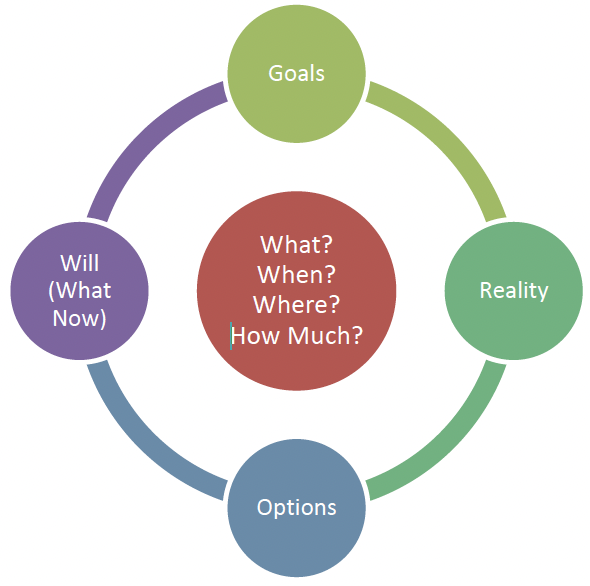
There are many coaching models. One widely used approach is GROW. It neither focuses on the coach nor primarily on the result, although that is in view. Instead, it focuses on the individual, the person being coached. This means it supports those in Christian leadership who seek to exhibit a Christ-centered servant leadership style, which emphasizes the needs of those they lead over their own position and status. Additionally, because it provides a general framework, the coach does not need to have a deep understanding of the area in which the person they are coaching operates.
- Note: Remember that the goal of coaching is not just to mentor an individual, but to impart coaching skills so they too can share these practices with others in the same way they were given to them. Let’s look briefly at the GROW model of coaching.
- Goals Step one: When sitting down with the person or people you are coaching, determine what the goal will be. What do they want? What needs the most work right now? What is the biggest obstacle they are facing now? What is the most critical issue they are struggling with?
- Reality Step two: After establishing the goal, we need to assess the person’s current situation in relation to the goal they want. What is the reality of the circumstance? What is currently happening? How does reality appear at this moment? How long have they been in this situation? What factors are preventing the achievement of this goal?
- Options Step three: Ask, “What could you do to achieve your goal?” Pose questions beginning with “suppose” or “if.” There likely won’t be a single solution that addresses every obstacle at once, so address the obstacles one at a time.
- Will (Way Forward) Step four: Considering what we have just discussed, what will the person or people do next? What are one, two, or three actions they will take? What timeline will they establish? Who needs to be involved in making this happen? What additional resources will they need?
Grow Model Application:
Now that we have examined the GROW model and understand the significance of coaching, we need to implement it. In pairs or groups of three, complete the following exercises.
Exercise 1:
A pastor approaches you who has been leading the same church for nearly three years. During that time, the church has remained consistent at around 21 adults, with a few families moving away and a couple of new families joining. The church has great dynamics; everyone is friends, and they engage in many activities together outside of church life.
The pastor truly desires to see his church grow and engage in evangelism, but he has struggled to motivate those involved to become genuinely interested in doing anything outside their usual activities.
The pastor genuinely wants to see the church leadership grow; however, no one in the church is willing to take on leadership roles.
What might be some initial questions you would ask in this situation?
Goal:
________________________________________________________________________
________________________________________________________________________
________________________________________________________________________
Reality:
________________________________________________________________________
________________________________________________________________________
________________________________________________________________________
Options:
________________________________________________________________________
________________________________________________________________________
________________________________________________________________________
Will:
________________________________________________________________________
________________________________________________________________________
________________________________________________________________________
VI. COACHING VERSUS TELLING
- When we ‘tell,’ we are downloading, whereas when we coach, we uplift.
- Below are a few examples of the difference between “telling” and “coaching,” based on Whitmore, John, Coaching for Performance: Growing People, Performance and Purpose, 1996 edition, p. 107.
- Coach/supervisor: “You are a terrible leader.”
- This type of statement is a personal criticism that undermines confidence and will, without a doubt, negatively impact performance in the future.
- Coach/supervisor: “The event was a shambles.”
- This comment targets the program rather than the individual, yet it still undermines self-confidence and offers no actionable information for the learner.
- Coach/supervisor: “The idea of the event was solid, but the way it was organized lacked energy and leadership.”
- This statement avoids criticism while offering the learner some information. However, the information is insufficient and lacks ownership.
- Coach/supervisor: “How do you feel the event went?”
- The learner/performer now has ownership but is likely to respond with a non-response such as “fine” or make a value judgment like “great,” rather than providing a more useful or reflective description.
- Coach/supervisor: “What was the main purpose of the event?” “To what extent did you/your team achieve that?” “What went well?” “What didn’t go so well?” “What did you learn?”
- In response to a series of questions, the individual being coached can provide a detailed, non-judgmental, and non-defensive description of the program and the rationale behind it. This example enhances learning and boosts awareness and performance. The student or learner also takes ownership of their work and becomes more self-reliant. They assume greater responsibility for their actions, decisions, and performance.
VII. THE ROLE OF THE COACH
- The major role of the coach is to help someone move forward:
- to help them identify blockages that are hindering their performance
- to help them identify actions they can take
- to give them the tools and power to act
- to increase their confidence and decision-making ability
Exercise 2: Asking good questions is fundamental to effective coaching. Transforming statements into questions is a skill that we can cultivate through practice. Given below is an exercise to help you ask the right questions. Take a moment to write down the question that would be suitable for the statement given below:
| Statement | Question |
| “That’s a stupid idea” | |
| “You’re not following through” | |
| “It’s not as bad as you think” | |
| “If you don’t improve your program, you’ll lose people” | |
| “You’re neglecting your family” | |
| “You are not empowering your team” |
The coach’s goal is not to fix people’s problems or to swoop in at the last minute to save them from their situations; rather, it is to unlock the answers within each person and help them solve their problems on their own.
Exercise 3:
Pick an area in your life that you would like to receive coaching in, whom could you ask?
_____________________________________________________________________
_____________________________________________________________________
_____________________________________________________________________
This lesson was provided by Joshua Nations (JoshuaNations.org).