This Bible study lesson is based on Chapter 4 of The Abiding Room, a book by Kevin Seacat.
* * * * * * *
The blessings of living in the Holy Spirit are quite stunning when you think about it. God has placed His Holy Spirit in you so you can live with joy and peace regardless of your circumstances. And the Holy Spirit gives you guidance and the power to carry out the work He has planned for you. This is truly the abundant life Jesus spoke of: “I came that they may have life and have it abundantly” (John 10:10 NIV).
Even when the world around you is in chaos, by the presence and power of the Holy Spirit living within you, you can have joy and peace. You no longer have to be controlled by life’s ups and downs. You now have it within you to be in control of your attitude and reaction to every moment and event of every day!
That’s what Jesus told His disciples on the last night before His death. Their world would present them with trouble, but they could have Jesus’ joy and peace in the midst of it because of the indwelling Holy Spirit. His followers were about to begin experiencing a new, miraculous inner calm despite life’s tribulations.
The same Holy Spirit whom Jesus promised the disciples lives in you as well. You, too, can experience the daily hope He promised them: “I have told you this so that my joy may be in you and that your joy may be complete” (John 15:11 NIV). “I have told you these things, so that in me you may have peace. In this world you will have trouble. But take heart! I have overcome the world” (John 16:33 NIV).
Experiencing Joy and Peace in Your Daily Life
“But the Helper, the Holy Spirit, whom the Father will send in my name, he will teach you all things and bring to your remembrance all that I have said to you” (John 14:26 NIV).
The translation above describes the Holy Spirit as Helper. Other translations of the Bible give the Holy Spirit different descriptive names such as Advocate, Counselor, and Comforter. Let’s briefly explore the wonderful promise of peace Jesus made to His disciples the night before He went to the cross: “Peace I leave with you; my peace I give to you. Not as the world gives do I give to you. Let not your hearts be troubled, neither let them be afraid” (John 14:27 NIV).
Through your relationship with the Holy Spirit, you can have contentment in any situation. Far beyond being a mere coping mechanism, God the Father has placed the Holy Spirit within you to guide you through every situation of your life: “But the fruit of the Spirit is love, joy, peace, patience, kindness, goodness, faithfulness, gentleness, self-control; against such things there is no law” (Galatians 5:22–23 NIV).
The joy and peace Jesus spoke of on His last night before going to the cross is part of the fruit of the Holy Spirit. When you are walking in the Spirit, you will experience all of the fruit of the Spirit, including joy and peace. This joy and peace, which far surpasses the world’s fickle happiness that ebbs and flows with life’s uncontrollable circumstances, is available to you regardless of your situation.
Happiness comes from the external world, while joy comes from the indwelling Holy Spirit. Happiness comes and goes with your often unmanageable situations, while joy can flow from your relationship with Jesus in any situation. “Let not your hearts be troubled. Believe in God; believe also in me” (John 14:1 NIV).
Learning to trust Jesus and experience the power of the Holy Spirit takes practice. As you trust Him in the minor details of ordinary days, you’re preparing to trust Him when life’s bigger challenges arise. Yes, there will still be sadness and grief, but relying on His indwelling presence in the person of the Holy Spirit will bring you hope. You become increasingly better at handling life’s uncertainties, disappointments, and heartbreaks in ways that would otherwise be impossible. You develop the understanding that, through the Holy Spirit, you have the ability to persevere through circumstances you could never handle in your own strength. What an exceptional blessing you have in the Holy Spirit!
You Are the Permanent Residence of the Holy Spirit
On His last night before going to the cross, Jesus foreshadowed the coming of the Holy Spirit to the disciples. Amazingly, He said it would be better for Him to leave so they could have the Helper—the Holy Spirit: “Nevertheless, I tell you the truth: it is to your advantage that I go away, for if I do not go away, the Helper will not come to you. But if I go, I will send him to you” (John 16:7 NIV).
Jesus said that since they had been with Him, they had already experienced the presence of the Holy Spirit. And beginning at Pentecost, though Jesus would be gone from the earth, the Holy Spirit would now be in them. Jesus told them: “The Spirit of truth. The world cannot accept him, because it neither sees him nor knows him. But you know him, for he lives with you and will be in you” (John 14:17 NIV).
The same is true for you today. When God forgave your sins and saved you, you crossed over from death to life. You received the greatest gift of all, eternal life, when you were forgiven for your sins and became a child of God. At that moment, He gave you a guarantee of eternal inheritance by placing the person of the Holy Spirit in your heart. “When you believed, you were marked in him with a seal, the promised Holy Spirit, who is a deposit guaranteeing our inheritance until the redemption of those who are God’s possession—to the praise of his glory” (Ephesians 1:13–14 NIV).
You were born again spiritually and received the person of the Holy Spirit to live in you forever. The Holy Spirit now dwells in you, which means He actually lives within you. He doesn’t live in temples built by men, but has instead made your heart His permanent home. As we will explore further in chapter 10, you are now the very temple of the Holy Spirit. “Do you not know that your body is a temple of the Holy Spirit within you, whom you have from God? You are not your own” (1 Corinthians 6:19 NIV).
Jesus promised the disciples, “And I will ask the Father, and he will give you another Helper, to be with you forever” (John 14:16 NIV). He said the Holy Spirit would indwell them forever. And the same is true for you! The Holy Spirit doesn’t come and go as He did in Old Testament times. He is always present and living within you, even when you sin. He’s sealed you as a child of God, and guaranteed your salvation, regardless of your future actions. The Holy Spirit is your new spiritual DNA, and He will never leave you. He has come to lead, teach, comfort, and empower you. You are a new person, forever indwelt with the Holy Spirit of God. “Therefore, if anyone is in Christ, he is a new creation. The old has passed away; behold, the new has come” (2 Corinthians 5:17 NIV).
God has given you the person of the Holy Spirit to help you live the life He has planned for you. You lack nothing you need to live a life pleasing to Him now that you have received the Holy Spirit. The Bible says He “poured out” His Holy Spirit on you at the time of your salvation: “But when the kindness and love of God our Savior appeared, he saved us, not because of righteous things we had done, but because of his mercy. He saved us through the washing of rebirth and renewal by the Holy Spirit, whom he poured out on us generously through Jesus Christ our Savior” (Titus 3:4–6 NIV).
God didn’t give you the Holy Spirit just so you can be certain you are going to heaven when you die. He gave you the Holy Spirit so you can joyfully be a part of bringing heaven to earth while you live! What a supremely rich blessing He has given you in the person of the Holy Spirit! The key is to learn, by faith, the secrets of keeping in step with the Holy Spirit throughout each day.
Peace Surpassing Human Understanding
What Spills Out When You Are Bumped? We all need the power of the Holy Spirit for when life “spills a latte” on us. The majority of your life is not made up of big, dramatic experiences. It consists mostly of smaller daily events and little surprises, both good and bad. Life has its share of unexpected annoyances and disappointments. But if you are led by the Spirit, you can handle these undesirable events joyfully. The world is watching to see how you, as a follower of Jesus, react when life disappoints you.
“The Lord is near. Do not be anxious about anything, but in every situation, by prayer and petition, with thanksgiving, present your requests to God. And the peace of God, which transcends all understanding, will guard your hearts and your minds in Christ Jesus” (Philippians 4:5–7 NIV).
These are the words the apostle Paul penned to the Philippian church while under house arrest and chained to a Roman guard. Despite his circumstances, he was filled with peace rather than anxiety because he had prayed and surrendered his life and its difficulties to God. He was not only instructing the Philippian church and us, but also giving us an example of how he was personally thriving in the midst of unjust imprisonment.
He had an inner tranquility that was beyond human understanding. Because you have within you the same Holy Spirit Paul had, that same tranquility is available to you today. It isn’t just peace from God, it is the peace of God. The indwelling Spirit’s peace is not always explainable, but it is always available to you as you ask Him for it.
Your Life in the Spirit
The Bible describes your life with the Holy Spirit in many ways, such as being filled with the Spirit, walking in the Spirit, keeping in step with the Spirit, living in the Spirit, and others. They all mean the same thing—living by the power of the Holy Spirit and not our own, flawed flesh. They all result in experiencing and exhibiting the fruit of the Spirit.
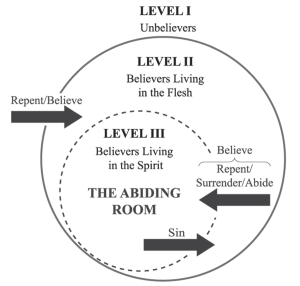
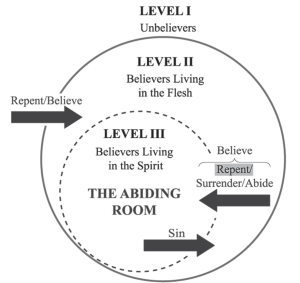
Now that you have been indwelt by the Holy Spirit forever, the question constantly before you is: How much of the time are you living in the power and fullness of the Holy Spirit? That is, what percentage of the time are you living in the flesh in Level II, and what percentage of the time are you living as He intends you to live, in the power and presence of the Spirit in Level III?
The objective of the remainder of this series is to help you greatly increase the amount of time you live empowered by the Holy Spirit. God desires for you to live a life pleasing to Him and influential to others. He wants your life to have meaning and purpose and has given you the Holy Spirit to guide, teach, and empower you in your journey!
ABIDING TRUTH: When you walk in the Spirit, you will experience love, joy, and peace.
Reflection Question
What are some of the ways you’ve already adopted to walk in the Spirit so you can experience more of the Holy Spirit’s joy and peace? Why is it important for us as believers to build habits that push us to remember the Holy Spirit’s presence? What new habits do you sense the Holy Spirit is giving you to begin?
Write down your answer to the box below (“Your Response or Question”) and send it to us. It will appear in Messages.
This Bible study lesson is based on Chapter 5 of The Abiding Room, a book by Kevin Seacat.
* * * * * * *
You may have read the story of Pentecost described in Acts 2 many times. For most followers of Jesus, much like Easter, we never tire of hearing about the miraculous, world-changing day of Pentecost that took place over 2,000 years ago. Everything was made new that day when the Holy Spirit was given by God to live in the hearts of each person who repented and put their faith in Jesus. On that day, the Church was born.
Let’s look briefly at the days leading up to Pentecost. After Jesus died on the cross and was resurrected from the dead, He appeared to the disciples and many others on earth for forty days. He walked, talked, and ate with them, leaving no doubt that He’d overcome death and was alive and living among them physically.
But His followers didn’t know what to expect when Jesus told them to wait in Jerusalem and said: “But you will receive power when the Holy Spirit has come upon you” (Acts 1:8 NIV). Nevertheless, you can only imagine the sense of wonder and excitement they experienced when they heard Jesus’ promise. Then miraculously, He flew up into the clouds and out of sight.
But unlike the discouragement they faced after Jesus’ death on the cross, this time they stayed together, obediently waiting on the arrival of the promised Holy Spirit. This time when Jesus departed, His followers’ waiting was completely different. The first time Jesus departed, He was dead (John 19:33 NIV). This time, He was alive (John 20:14–18 NIV). The first time He departed, it looked as if death had won over Him (Luke 23:46 NIV). This time, everybody knew He had won over death (Luke 24:33–48 NIV). The first time He departed, it appeared Satan had won (Luke 22:53 NIV). This time, it was obvious Satan had lost (1 John 3:8 NIV). The first time He departed, He was placed in a tomb (Mark 15:46 NIV). This time, God the Father placed Him on the throne (Hebrews 10:12 NIV).
Therefore, knowing something special was on the horizon, Jesus’ followers behaved in a completely different manner. Instead of being hopeless (John 20:11–13 NIV), this time His followers were hopeful (John 20:19–20 NIV). Instead of hiding because of their fear of others (John 20:19 NIV), this time they sang praises because of their great hope in God (Luke 24:53 NIV). Instead of scattering (John 20:10 NIV), this time they stayed together and prayed, waiting for the arrival of the promised Holy Spirit (Acts 1:14 NIV). They were not disappointed! Ten days later, as thousands gathered at the large Jewish festival called Pentecost, God sent His Holy Spirit, and the world and eternity were changed forever.
Pentecost
Here’s a portion of the account of the day of Pentecost: “When the day of Pentecost arrived, they were all together in one place. And suddenly there came from heaven a sound like a mighty rushing wind, and it filled the entire house where they were sitting. And divided tongues as of fire appeared to them and rested on each one of them. And they were all filled with the Holy Spirit and began to speak in other tongues as the Spirit gave them utterance” (Acts 2:1–4 NIV).
Then Peter, filled and empowered by the Holy Spirit, preached what was essentially the first sermon of the new church, concluding: “This Jesus God raised up, and of that we all are witnesses. Being therefore exalted at the right hand of God, and having received from the Father the promise of the Holy Spirit, he has poured out this that you yourselves are seeing and hearing … Let all the house of Israel therefore know for certain that God has made him both Lord and Christ, this Jesus whom you crucified” (Acts 2:32–36 NIV).
The account goes on to say: “Now when they heard this they were cut to the heart, and said to Peter and the rest of the apostles, ‘Brothers, what shall we do?’ And Peter said to them, ‘Repent and be baptized every one of you in the name of Jesus Christ for the forgiveness of your sins, and you will receive the gift of the Holy Spirit. For the promise is for you and for your children and for all who are far off, everyone whom the Lord our God calls to himself.’ And with many other words he bore witness and continued to exhort them, saying, ‘Save yourselves from this crooked generation.’ So those who received his word were baptized, and there were added that day about three thousand souls” (Acts 2:37–41 NIV).
At Pentecost over 2,000 years ago, God sent His Holy Spirit into His followers’ hearts in a one-time, dramatic display no one could miss, and that event has been recounted endlessly! While the filling of the Spirit isn’t as dramatic today, the same power is nevertheless real, available, and just as life-changing.
The Great Provision of the Holy Spirit
Shortly before He ascended into heaven, Jesus gave His disciples two important messages. First, He gave them (and us) their marching orders on what they were to do after His departure in what has come to be known as the Great Commission: “Go therefore and make disciples of all nations, baptizing them in the name of the Father and of the Son and of the Holy Spirit, teaching them to observe all that I have commanded you. And behold, I am with you always, to the end of the age” (Matthew 28:19–20 NIV).
Then, just a little later, Jesus told them how they were to carry it out. He instructed them to wait in the city of Jerusalem until they had received the person and the power of the Holy Spirit. “And behold, I am sending the promise of my Father upon you. But stay in the city until you are clothed with power from on high” (Luke 24:49 NIV). “But you will receive power when the Holy Spirit has come upon you, and you will be my witnesses in Jerusalem and in all Judea and Samaria, and to the end of the earth” (Acts 1:8 NIV).
We’ll call the gift of the Holy Spirit indwelling us the Great Provision. The Great Commission of Jesus had to wait on the Great Provision of the Holy Spirit. God gave the Great Provision of the Holy Spirit who lives in the heart of every follower of Jesus to carry out the Great Commission that is a command to every follower of Jesus. God’s plan is to use people as His witnesses throughout the world by the power of the Holy Spirit. The Great Provision of the Holy Spirit enables the Great Commission of Jesus.
This was true with the birth of the church at Pentecost and has continued to be true throughout history right up to today. We are able to carry out the Great Commission because we are not doing the witnessing and teaching. Rather, it’s the Holy Spirit living in and through us. What God commands, He empowers through the Great Provision of the person and power of the Holy Spirit.
Dynamic Power
The Greek word dunamis, (pronounced doo-nam-is), means power. This is the word Jesus used when He told of the power of the Holy Spirit. It’s the same word from which we get our English word dynamite.
As a follower of Jesus, you have inside you the dynamic power of the Holy Spirit. But that power needs to be triggered by a spark. The spark that sets off the explosion of the dynamic power of the Holy Spirit within you is faith. Without faith, your power is dormant—almost as if it doesn’t exist. As seen in the chocolate milk video on abidingroom.com, followers of Jesus in whom the power lies dormant have lives that look pretty much the same as the lives of unbelievers; that is, until the spark of faith ignites the power of the Holy Spirit and unleashes the potential God has planned for them.
Obedience Keeps the Power Flowing
After that spark has been ignited and you are living empowered by the Holy Spirit, you continue to stay empowered by obedience. Obedience maintains your living in the Spirit. Disobedience, on the other hand, causes what the Bible calls “quenching the Spirit.” “Do not quench the Spirit” (1 Thessalonians 5:19 NIV).
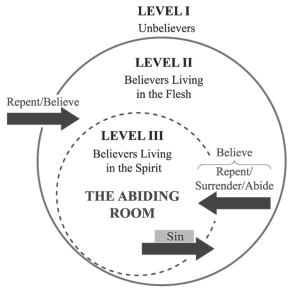
Just as we can choose to live by the Spirit and not sin, we can choose instead to live by our no-good flesh and sin. When we sin, we quench the power of the Holy Spirit. Because God is love, no sin can expel the permanent presence of the Holy Spirit. But when we choose to sin, we extinguish the Holy Spirit’s full power in our lives.
In a previous lesson, we saw that our sin grieves the person of the Holy Spirit. Now we see that our sin also quenches the power of the Holy Spirit.
When we trust God and are obedient to do what He’s instructing us to do, He will send His Helper to come alongside us. Not only do we get to see Him work in our lives, but other people—many of them who aren’t following the Lord—will also get to see Him at work in undeniable ways.
Empowered Living
What does a Spirit-empowered life look like? Let’s look at four purposes of the power of the Holy Spirit in your life:
Power for daily living
Power to keep God’s commands
Power over sin
Power to share your faith
Power for Daily Living
Through the Holy Spirit, God has given you the ability to handle life’s difficulties in a godly manner. When you harness the power of the Holy Spirit, you have the power to control your tongue. You have the power to control your anger. You have the self-control to resist temptation. You are able to be gentle when others are harsh to you. You can be kind when others mistreat you. You can be patient toward others. The Holy Spirit gives you the power to genuinely love disagreeable, nasty people. You are even able to laugh when your spouse bumps you and your coffee spills all over your head!
The Bible confirms that when you live by the power of the Holy Spirit, you have capabilities you wouldn’t otherwise have. “For God gave us a spirit not of fear but of power and love and self-control” (2 Timothy 1:7 NIV).
And in John 15, Jesus says it is impossible to live the Christian life apart from Him. That means it is also impossible to live it apart from the empowerment of the Helper, the Holy Spirit. While you can trust the Holy Spirit to empower you for daily living, there is no evidence in the Bible that says when you are living by the Spirit, your life will be one continuous string of phenomenal, emotional experiences.
These experiences are wonderful when they occur, but they are the exception, not the norm. Life in the Spirit doesn’t mean freedom from problems, it means power to live with them in a new way. Thankfully, the power of the Holy Spirit is available to you every minute of every day!
By accessing the power of the Holy Spirit within you, you can live through difficult circumstances and handle tough problems with tranquility. Because you are indwelt by the Holy Spirit, each one of the fruit of the Spirit is available to you throughout your day. It’s a matter of choosing to live each moment by the Spirit and not the flesh. With practice, over time, these choices become a normal part of your new way of living. Day by day, as you live by the power of the Holy Spirit, God is continually developing greater Christlike character in you.
Power to Keep God’s Commands
Jesus told the disciples that when the Holy Spirit came to live within them, they would receive power (Luke 24:49 NIV; Acts 1:8 NIV). This includes the power to obey biblical commands. When you are filled with and led by the person of the Holy Spirit, He empowers you to carry out the commands found in the Bible.
Only by the power of the Holy Spirit are we able to be obedient to biblical instruction, such as for all of us to honor our mothers and fathers (“Honor your father and your mother” (Exodus 20:12 NIV)), for husbands to love their wives as Christ loved the church (“Husbands, love your wives, as Christ loved the church” (Ephesians 5:25 NIV)), and for fathers to not exasperate their children (“Fathers, do not exasperate your children” (Ephesians 6:4 NIV)).
We’re able to live out what is referred to as the Golden Rule—to do to others as you would have them do to you (“Do to others as you would have them do to you” (Matthew 7:12 NIV)). The Holy Spirit gives you the power to obey challenging commands such as love others as Christ has loved you (“A new command I give you: Love one another. As I have loved you, so you must love one another” (John 13:34 NIV)), forgive as God has forgiven you (“Bear with each other and forgive one another if any of you has a grievance against someone. Forgive as the Lord forgave you” (Colossians 3:13 NIV)), and love your enemies (“Love your enemies and pray for those who persecute you” (Matthew 5:44 NIV)).
When you see that challenging list, does it make you feel as if you need some help with those commands? I certainly do! But thankfully, when we are filled, led, and empowered by the Holy Spirit, He enables us to live them out. God never commands anything He doesn’t enable through the power of the Holy Spirit.
Power Over Sin
“For the law of the Spirit of life has set you free in Christ Jesus from the law of sin and death. For God has done what the law, weakened by the flesh, could not do. By sending his own Son in the likeness of sinful flesh and for sin, he condemned sin in the flesh, in order that the righteous requirement of the law might be fulfilled in us, who walk not according to the flesh but according to the Spirit” (Romans 8:2–4 NIV).
Using only the words shown in bold above, let’s piece together God’s Word, assuring you that you have power over sin: “The Spirit of life has set you free … from the law of sin … in order that the righteous requirement … might be fulfilled in us, who walk … according to the Spirit.” Part of the fruit of the Spirit is self-control. Self-control gives you the ability to not sin. You now have the power to do the right thing and not the wrong thing.
Any persistent sin that seems to have control over you absolutely does not! You were given power over that sin when you were given the Holy Spirit. It is a matter of appropriating the power you have already been given. “So you also must consider yourselves dead to sin and alive to God in Christ Jesus. Let not sin therefore reign in your mortal body, to make you obey its passions. Do not present your members to sin as instruments for unrighteousness, but present yourselves to God as those who have been brought from death to life, and your members to God as instruments for righteousness. For sin will have no dominion over you, since you are not under law but under grace” (Romans 6:11–14 NIV).
When you became a believer in Jesus, you became a new creation. You received new desires to do good and to please God. Along with these new desires, God also gave you the Holy Spirit who enables you to live a righteous life. The Holy Spirit gives you both the will and the power to not sin. The minority of Christians who live most of each day in the power of the Holy Spirit know the refreshing reality of seeing sin that used to rule their lives now be overcome by living by the Spirit. And that is exactly what God desires for you and why He has given you the Holy Spirit to enable you to live out the life He has planned for you!
Power to Share Your Faith
In spite of the many missteps the disciples made during the three years they had been with Him, Jesus told them that through the power of the Holy Spirit they would become effective witnesses for His name not only locally but throughout the world. “But you will receive power when the Holy Spirit has come upon you, and you will be my witnesses in Jerusalem and in all Judea and Samaria, and to the end of the earth” (Acts 1:8 NIV).
You have received the same Holy Spirit the disciples received. God didn’t give you the Holy Spirit so you can use Him for your purposes; He gave you the Holy Spirit so He can empower you for His purposes. Just like the disciples, you can’t do this by your own strategy or ingenuity. But as you let the Holy Spirit guide and empower your words and actions, you can be an effective witness for Jesus too.
Power for Everything You Need
We have just seen that God has made some remarkable promises to you in the Bible. By faith in Jesus and by the power of the Holy Spirit, you can experience the life God has planned for you. The apostle Peter sums it up by reminding us God has graciously given you power for everything you need to live a godly life. “His divine power has given us everything we need for a godly life through our knowledge of him who called us by his own glory and goodness” (2 Peter 1:3 NIV).
ABIDING TRUTH: As a follower of Jesus, you are indwelt by the Holy Spirit. He gives you the power to carry out God’s commands and live a life of freedom from sin.
Reflection Question
How can you explain to a new believer how the power of the Holy Spirit works? What are some of the questions you still have about this?
Write down your answer to the box below (“Your Response or Question”) and send it to us. It will appear in Messages.
This Bible study lesson is based on Chapter 6 of The Abiding Room, a book by Kevin Seacat.
* * * * * * *
“Be filled with the Spirit” (Ephesians 5:18 NIV).
As we learned, the arrival of the Holy Spirit in the hearts of believers changed everything. As a follower of Jesus, the Holy Spirit indwells you. That is, He lives inside you. Your loving heavenly Father has placed His Spirit in you to accompany you everywhere, guiding you and empowering you to live a life pleasing to Him.
The distinguishing characteristic of you as a follower of Jesus is the indwelling presence of the Holy Spirit. It’s not a question of if you have the Holy Spirit—all followers of Jesus do. It’s also not a question of how much of the Holy Spirit you have—all followers of Jesus have the entire person of the Holy Spirit. The real question is how much of you does the Holy Spirit have? Are you filled with the Spirit?
In the book of Acts, believers in the early church are consistently described as being “filled with the Spirit.” In letters to the early churches, Paul instructs them to live Spirit-filled lives by using terms such as “walk in the Spirit,” “led by the Spirit,” “live by the Spirit,” “keep in step with the Spirit,” and “be filled with the Spirit.” Each of these terms instructs believers to operate by the power of the Holy Spirit, not the flesh. Each phrase has a similar meaning and intent—the Holy Spirit (and not your flesh) is leading you.
We’ve seen the Bible clearly illustrates The 3 Levels of Life. When you’re filled with the Spirit, you’re in the Abiding Room, where you’re living a Level III life, as the next diagram reminds us:
God’s Temple
In the Old Testament, God’s Spirit lived among His people in a tabernacle, or temple. Today that temple is no longer a man-made structure. Now the new temple housing God’s Holy Spirit is you!
“Do you not know that your bodies are temples of the Holy Spirit, who is in you, whom you have received from God? You are not your own; you were bought at a price. Therefore honor God with your bodies” (1 Corinthians 6:19–20 NIV).
Every follower of Jesus is the temple of God and indwelt with the person of the Holy Spirit. It’s God’s desire that you, your body, and your life put His glory on display. This is accomplished when you are filled with His Spirit.
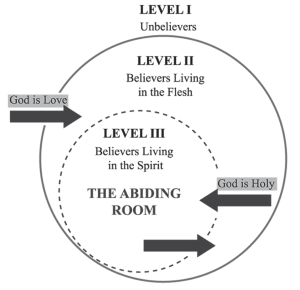
You never have to be concerned the Holy Spirit might leave you. He has made you His permanent home. It is true that when you sin, because God is holy, the Holy Spirit is grieved (“And do not grieve the Holy Spirit of God, by whom you were sealed for the day of redemption” (Ephesians 4:30 NIV)) and His power quenched (“Do not quench the Spirit” (1 Thessalonians 5:19 NIV)). Nevertheless, because God is love, His Spirit will not depart. You were saved once and forever because God is love, but you are constantly being refined because He is holy.
Be Filled with the Spirit
What does it mean to “be filled with the Spirit”?
“Be filled” is a command. You are commanded to be filled with the Spirit. But while you are commanded to be filled with the Spirit, you are never commanded to be indwelt with the Spirit. When used in reference to the Holy Spirit, the words “filled” and “indwelt” are not synonymous. That’s because all believers are permanently indwelt with the Spirit at salvation, but are not permanently filled with the Spirit. The question is not whether you’re indwelt with the Holy Spirit, but whether you’re filled with the Holy Spirit at any given moment.
The filling is an ongoing process. “Be filled” actually means “be, being, continuously filled.” It is not a one-time event, but rather an ongoing, moment-by-moment experience throughout our lives. The filling of the Holy Spirit enables our obedience to God’s commands. And as we will see again later, as we continue to be obedient to what the Spirit prompts us to do, we continue to be filled with the Spirit. Continued obedience maintains the continuous filling. We’re indwelt by the Holy Spirit once at salvation, but we need to be filled with the Spirit continually.
Being filled with the Spirit brings an experiential understanding of the phrase itself. Jesus told the disciples they would receive the Holy Spirit, but they had to experience it to understand it. In fact, the book of Acts is one surprising life lesson after another to the early church of what the abiding, Spirit-filled life entails.
Many in the early church had never seen Jesus face-to-face, and they didn’t have the Bible to read, but their Spirit-filled lives were writing it! They had received minimal teaching about the Holy Spirit coming to indwell them, but the new believers knew without a doubt they were filled with Him. Each account of the Spirit’s work in the early church told in the book of Acts serves as a reminder that a personal experience of the Holy Spirit is the best teacher about the Holy Spirit.
God desires for you to experience Him personally, not just academically or intellectually. While we now have the Bible to guide us and explain the role of the Holy Spirit, there’s still no substitute for personally experiencing the Spirit to give us a fuller understanding of the biblical instructions themselves. The more you’re obedient to biblical instructions, the more you’ll experience the Holy Spirit in your life. That will, in turn, give you greater insight into the instructions’ meaning. Obedience keeps us “stirred up!”
Many Fillings of the Spirit
It’s not uncommon for followers of Jesus to incorrectly believe they are always filled with the Spirit. As mentioned earlier, we are always indwelt, but not always filled with the Spirit.
Here’s an example of what is implied when Paul says, “Be filled with the Spirit.” Let’s say you drop your kids off at someone’s house. You say to your kids, “Be good.” When you say, “Be good,” it implies you know they can also choose to be bad. You wouldn’t say, “Be good,” if they were always good.
Likewise, Paul wouldn’t say, “Be filled with the Spirit,” if the only option was to be filled with the Spirit. He’s talking to followers of Jesus in the church of Ephesus who already have the Holy Spirit, so he isn’t imploring unbelievers to be saved. He’s instructing the believers to be continuously filled with the Spirit. Therefore, we can conclude followers of Jesus are not always filled with the Spirit. The presence of the Holy Spirit is permanent and unconditional, but the filling and the fullness of His power are conditional upon our life choices.
Paul wouldn’t say, “Be filled with the Spirit,” if the only thing we as believers can be is filled with the Spirit. His exhortation to be filled implies followers of Jesus are not always filled with the Holy Spirit. Again, the filling of the Holy Spirit in your life is a continuous process you as a believer need to continually seek. You had one salvation, but you’re instructed to seek many, continuous fillings.
As we discussed previously, the words and diagrams we’re using to describe our relationship with the Holy Spirit have limitations. Is a person we’ve described as “filled with the Spirit” absolutely 100 percent filled with the Spirit, but a person who is 99 percent led by the Spirit, not filled with the Spirit? No, it is simply a way to describe whether we’re living primarily in the Spirit or the flesh.
Yet, the Bible doesn’t mince words by saying, “Be partially filled,” or “Be almost filled.” It’s another statement made in absolutes to emphasize the point that the matter at hand is critical. In situations where we use the phrase “be filled with the Spirit,” we might also say, “be continuously, predominantly filled, led, and empowered by the Holy Spirit.” Don’t get tangled up in the semantics of the words, but rather be inspired by their promises for your life!
Importantly, there’s no connection between the filling of the Spirit and your biblical head knowledge or the length of time you’ve been following Jesus. A head full of knowledge isn’t the prerequisite for having a humble heart filled with the Spirit. God has no trouble finding and filling your fully surrendered heart!
It is the emptying of the heart of self that cleanses the temple for the filling of the Spirit. The first group of believers who were filled with the Spirit at Pentecost had very little idea of what was about to happen. They were just ordinary people obediently praying while they waited on God for the promised Holy Spirit.
God wants to fill you with His Spirit even more than you want to be filled. He already knows how He is going to use you for His kingdom purposes when you are fully empowered for His glory. If you take care of the preparation, God will take care of the visitation!
Your Life Is Your Ministry
Did you know you have an important ministry right now? You may not have a formal ministry with an official name, but if you’re a follower of Jesus, you’ve already been given a ministry. The world is watching you and the character you display. The most significant ministry anyone can have is to lead a life empowered by the Holy Spirit that is seen by a watching world as they go about their day-to-day activities.
Today, when you walk out the front door and encounter people, make no mistake, you are bearing witness to Jesus. Will your witness be of a person walking in the Spirit or in the flesh? People are watching you and drawing conclusions from your life about who Jesus is. It’s not a question of if your life will bear witness as to who Jesus is; the real question is what type of witness you will bear. Will it be your fleshly character or the Christlike character of Jesus?
When you’re living out the Spirit-filled life and exhibiting the fruit of the Spirit, who does that look like? Jesus! The integrity and character of Jesus that was so attractive to you when you first believed becomes noticeable to others because it’s actually Jesus they are seeing through your life! Isn’t that remarkable?
Jesus promised His disciples the Holy Spirit would speak to them. In John 16:15 He said, “All that the Father has is mine; therefore I said that he [the Holy Spirit] will take what is mine and declare it to you” (John 16:15 NIV). That promise is still true today.
Recognizing when it’s the Holy Spirit speaking and when it’s just our imagination takes a lifetime of practice. We will never fully get it right in this life.
The Blessings of the Spirit-Filled Life
Being filled with the Spirit means you are experiencing the joy of confidently resting in submission to the ongoing direction of the Holy Spirit. When you’re filled with the Spirit, you have a greater ability to both know God’s will and have the power to carry it out. The commands He’s given you are meant to be carried out by the power of the Holy Spirit—not by you living in your own strength.
You can have peace in the midst of turmoil. You can have joy when things go wrong. You can experience inner stability in times of instability. When you are filled, led, and empowered by the Holy Spirit, you can live in a way that distinguishes you from the world because it is the Holy Spirit, not you, who is at work in and through you.
When you’re filled with the Spirit, you will experience the blessings described in the previous lessons on the Holy Spirit:
You will exhibit the fruit of the Spirit, not the flesh.
You will experience joy and peace in your life.
You will receive power for daily living—power to keep God’s commands, power to not sin, and power to share your faith.
Most importantly, you will bring glory and attention to God! How extraordinary and desirable does that sound?
ABIDING TRUTH: As a follower of Jesus, you are always indwelt with the Spirit. And as you are obedient, you will be filled with the Spirit.
Reflection Question
What would you say to someone who told you they don’t think they’ve ever been filled with the Holy Spirit? How would you help them understand this concept at a deeper level?
Write down your answer to the box below (“Your Response or Question”) and send it to us. It will appear in Messages.
This Bible study lesson is based on Chapter 7 of The Abiding Room, a book by Kevin Seacat.
* * * * * * *
The purpose of this lesson is to explain the important connection between being filled with the Holy Spirit, which we explored in the previous lesson, and abiding in Jesus.
To find a significant portion of Jesus’ teaching on the abiding, Spirit-filled life, we can look at the end of His ministry on the night before He went to the cross. This Bible passage includes what is commonly known as the Last Supper. The apostle John tells us about it in his gospel, the book of John, in chapters 13 through 17. For the first time, Jesus laid out both how the Holy Spirit was about to be given to His disciples, as well as a new way to live—abiding in Him.
As the evening begins, the disciples and Jesus are about to sit down for the Last Supper, and the disciples are talking among themselves. After three years of Jesus teaching them they should be humble, meek, and servant-hearted rather than promoting themselves, what are the disciples doing? Arguing about who among them is the greatest (“A dispute also arose among them as to which of them was considered to be greatest” (Luke 22:24 NIV)).
Jesus starts their time together with a new command, “Love one another.” “A new command I give you: Love one another. As I have loved you, so you must love one another. By this everyone will know that you are my disciples, if you love one another” (John 13:34–35 NIV).
He then shows them an example of what love looks like by washing their feet.
Maybe we should give the disciples a little credit. At least they believed Jesus was the Messiah sent by God the Father, and they knew they were onto something big. That’s why they had left everything to follow Jesus—to be part of the next big thing. That’s why they were arguing over who was going to be at the top of this movement they believed was about to take off—they were gripped by selfish ambition.
Actually, they were underestimating the impact Jesus was about to have on time, heaven, earth, and eternity. They were still thinking in terms of merely an earthly kingdom. They didn’t understand they were part of the biggest events in human history—Jesus going to the cross to die for the sin of humanity, rising from the dead, and sending the Holy Spirit to indwell them. They didn’t understand this was to be the birth of the church.
The Foreshadowing of the Abiding, Spirit-Filled Life
It is very likely Jesus didn’t tell His guys about the abiding, Spirit-filled life until the last night at dinner because they wouldn’t be able to grasp it until they experienced it. And that wouldn’t happen for another fifty-three days, when the Holy Spirit came in fullness within them at Pentecost.
But even though the disciples were unable to comprehend what was coming, Jesus gave them a sneak peek at the Last Supper. Previewing the coming of the abiding, Spirit-filled life at Pentecost, Jesus said: “I have told you now before it happens, so that when it does happen, you will believe” (John 14:29 NIV).
Both then and now, the abiding, Spirit-filled life must be experienced to be believed!
Love, Joy, and Peace
As we examine Jesus’ last night before the cross, we’ll see abiding in Jesus (remaining in constant fellowship with Him) is what also brings about the filling of the Holy Spirit.
Chapters 13 through 17 comprise only 25 percent of the book of John. But, 75 percent of the time John uses the words “love,” “joy,” and “peace” in his gospel is within these five chapters. Why are these chapters so packed with these three words? Because love, joy, and peace are fruit of the Holy Spirit.
When Jesus began foreshadowing the abiding, Spirit-filled life to His guys on that last night, He naturally talked about part of its blessing—love, joy, and peace. These fruit of the Spirit are evidence of the presence of the work of the Holy Spirit in the lives of Jesus’ followers, both then and today.
The Great 2 for 1
Two very important commands regarding the abiding, Spirit-filled life are wonderfully connected. These two commands are Jesus saying, “Abide in me” (John 15:4 NIV), and the apostle Paul instructing us to “be filled with the Spirit” (Ephesians 5:18 NIV).
What is seldom understood is that when we are obedient to the first command to abide, Jesus completes our obedience to the second command to be filled as well. And He does this without any effort on our part! This means we are doubly blessed. The promise of the blessings of both abiding in Jesus and walking in the power of the Holy Spirit flows from simply remaining connected to Jesus. As we abide in Jesus, we are also being filled with the Holy Spirit.
In his book, The Holy Spirit: Activating God’s Power in Your Life, the late, world-famous evangelist Billy Graham wrote, “We are being filled as we abide in Christ.”
Abiding in Jesus and being filled with the Spirit are like different sides of the same coin. Just as a coin always has both “heads” and “tails,” when you abide in Jesus, you always get filled with the Spirit.
Therefore, abiding in Jesus and being filled with the Spirit are linked, essentially forming a two for one spiritual reality available to us at all times. We will call this “The Great 2 for 1.”
Let’s take a further look at the relationship between abiding in Jesus and being filled with the Spirit from two perspectives: (1) continuous nature, and (2) active versus passive nature.
Continuous Nature: Abiding in Jesus and being filled with the Spirit are similar in that both are continuous. Abiding means remaining in constant fellowship with Jesus. It is not permanent but rather an ongoing obedience.
Likewise, as we have already seen, being filled with the Spirit is not permanent, but also the result of ongoing obedience. So, both abiding in Jesus and being filled with the Spirit are to be maintained through our ongoing, moment-to-moment obedience.
Active versus Passive Nature: Abiding in Jesus and being filled with the Spirit are different in that abiding is active while being filled is passive. Abiding is the active part we do. When Jesus says, “Abide in me,” He’s instructing us to take action. It’s our choice to engage in ongoing fellowship with Jesus.
On the other hand, being filled with the Spirit is passive. It is done for us by God as a result of our obedience to abide in Jesus. Being filled with the Spirit occurs quietly and effortlessly as we abide in Jesus. As we abide in Him, the life of Jesus (the vine) flows into us (the branches) through His Holy Spirit.
The command, “Be filled,” gives us a hint of its passive nature by what it does not say. It does not say “Fill yourself with the Spirit.” The instructions to be filled with the Spirit imply you are to do something, but you do not directly fill yourself with the Spirit. Instead, you receive the filling from God. It is not accomplished by you. Similar to how Jesus told the disciples they would receive power when they received the Holy Spirit, you, too, receive the filling again and again from God, but not of your own independent works.
We know, however, that since we are instructed to be filled, some type of action on our part is required that both precedes and results in our receiving the filling of the Spirit.
Abiding is the continuous action we do, while the filling of the Holy Spirit is the resulting continuous action God does as we abide. As we continuously choose to remain in fellowship with Jesus, we are continuously being filled with the Spirit.
Again, this is “The Great 2 for 1.”
Internal Fruit of Abiding—Love, Joy, and Peace
“As the Father has loved me, so have I loved you. Abide in my love. If you keep my commandments, you will abide in my love, just as I have kept my Father’s commandments and abide in his love. These things I have spoken to you, that my joy may be in you, and that your joy may be full” (John 15:9–11 NIV).
“I have said these things to you, that in me you may have peace. In the world you will have tribulation. But take heart; I have overcome the world” (John 16:33 NIV).
Note the internal fruit and blessings of abiding are also the fruit of the Spirit—love, joy, and peace. That’s why chapters 13 through 17 of the book of John, where Jesus introduces both abiding in Him and the Holy Spirit, are packed full of words such as “love,” “joy,” and “peace.” This again confirms “The Great 2 for 1.”
As we abide in Jesus, we are being filled with the Spirit, as evidenced by our love, joy, and peace. We’re living Level III lives. We’re in the Abiding Room.
ABIDING TRUTH: As you abide in Jesus, you are being filled with the Holy Spirit.
Reflection Question
How would you describe The Great 2 for 1 in your own words? What evidence is there that these two spiritual truths are linked? Why is this significant?
Write down your answer to the box below (“Your Response or Question”) and send it to us. It will appear in Messages.
This Bible study lesson is based on Chapter 8 of The Abiding Room, a book by Kevin Seacat.
* * * * * * *
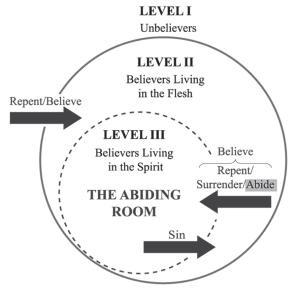
The diagram above is the primary Abiding Room diagram, with one small addition—the word “Abide” is shaded. As we continue to revisit this diagram, the subject of the discussion will be shaded for additional focus.
What does it mean to abide? First, let’s look at what Jesus said about the significance of abiding in Him.
“I am the true vine, and my Father is the vinedresser. Every branch in me that does not bear fruit he takes away, and every branch that does bear fruit he prunes, that it may bear more fruit. Already you are clean because of the word that I have spoken to you. Abide in me, and I in you. As the branch cannot bear fruit by itself, unless it abides in the vine, neither can you, unless you abide in me. I am the vine; you are the branches. Whoever abides in me and I in him, he it is that bears much fruit, for apart from me you can do nothing. If anyone does not abide in me he is thrown away like a branch and withers; and the branches are gathered, thrown into the fire, and burned. If you abide in me, and my words abide in you, ask whatever you wish, and it will be done for you. By this my Father is glorified, that you bear much fruit and so prove to be my disciples” (John 15:1–8 NIV).
Overview of Abiding
In John 15, Jesus introduces the metaphor of the vine and the branches. His description consists of only seventeen verses, and this word picture of abiding in Jesus is found only in the Gospel of John. Jesus gave it at the very end of His ministry, just before He went to the cross.
Although this passage is relatively short, numerous people have credited Jesus’ brief teaching revolving around the simple words, “Abide in me,” as the source of the joy in their lives and the power to impact the lives of others. So don’t think less of these seventeen verses because of their brevity or simplicity. It’s exciting that so much treasure is found in such a small package! It takes only a minute or two to open, but it takes a lifetime to unpack.
We will divide Jesus’ lesson on abiding into two parts. In this lesson, we’ll look at verses 1–8, where He describes the metaphor of the vine and branches. In the next lesson, we’ll delve into verses 9–17 where He explains the abiding friendship.
If you live most of each day in a close, abiding relationship with Jesus, you know the serenity of having the King of kings, who calls you friend, walking by your side through the uncertainty and challenges of each day. You know the excitement of being an instrument God uses to impact the lives of others in significant ways.
Let’s explore Jesus’ intimate words to His disciples and us and learn how we can have a deeper friendship with Him.
Roles—Verses 1 and 5
The first few verses of John 15 record how Jesus laid out the roles involved in our abiding relationship with Him. Notice four key words continue to show up throughout the passage: “abide,” “vine,” “branches,” and “fruit.”
“I am the true vine, and my Father is the vinedresser” (John 15:1 NIV).
“I am the vine; you are the branches. Whoever abides in me and I in him, he it is that bears much fruit, for apart from me you can do nothing” (John 15:5 NIV).
In verse 1, Jesus tells us He is the vine, God the Father is the gardener or the vinedresser, and we are the branches.
The Father is the caretaker. He cares for those whom He has chosen—you and me. Jesus is the vine. He is the source of life. His life is flowing into us. We are the branches. The branch itself has no life. The vine has the life, and when the branch is attached to the vine, the life of the vine flows into and through the branch, and grapes are produced from the connection.
Note that Jesus did not choose a large tree with strong branches that can grow tall and impressive, independent of a caretaker. To describe our relationship with Him, He chose a vine whose branches are scrawny and feeble. The branches of a vine need a great deal of care to reach their peak fruitfulness. When cared for properly, a vineyard can be both beautiful and productive.
Napa Valley in California is a production facility for wine. But one distinction that makes this wine region stand out from so many other production facilities in the world is that the vineyards are peaceful, calm, and restful.
In the midst of the peaceful environment, under the watchful eyes of their caretakers, the vines are going about their moment-by-moment purpose of flowing their life into the branches and producing a staggering amount of some of the best grapes in the world. As the vinedressers go about their work, no grunting and groaning is going on among the vines and branches. They are quietly and peacefully bearing much fruit.
While Jesus names the Father, the Son, and us (the branches), He doesn’t specifically name the Holy Spirit. But just as the hidden, life-giving sap flows from the vine into the branches, so does the Holy Spirit flow into us as we remain connected to (abide in) Jesus, the vine. The result in both the vineyard and our spiritual lives is bearing fruit.
As the fruit in the vineyard bears witness to the connection of the vine to the branch, so does the fruit in our lives bear witness to Jesus’ life flowing into us in the person of the Holy Spirit. The fruit of the vine is the evidence that the life of the vine is flowing through the branch. As you abide in Jesus and receive the flow of the Spirit into your life, the fruit you bear gives evidence to the life of Jesus in you.
Relationship—Verses 4 and 5
“Abide in me, and I in you. As the branch cannot bear fruit by itself, unless it abides in the vine, neither can you, unless you abide in me. I am the vine; you are the branches. Whoever abides in me and I in him, he it is that bears much fruit, for apart from me you can do nothing” (John 15:4–5 NIV).
Another word for abide is “remain.” In this context, abide means to remain in constant relationship with Jesus. Abiding describes an ongoing, intimate fellowship with Jesus. As the branches, we are to remain in continuous fellowship with our friend, Savior, and source of life—Jesus the vine.
It’s interesting to note the word “nothing” at the end of verse 5. In many Bible passages, it is not uncommon for English-language versions of the Bible to translate or interpret words differently. But when you look at John 15:5 in some of the more commonly used versions of the Bible, here’s what you find:
New American Standard version: “apart from me, you can do nothing.”
New International Version: “apart from me, you can do nothing.”
English Standard Version: “apart from me, you can do nothing.”
New King James Version: “for without Me you can do nothing.”
Different scholars looked at the meaning of this verse, and in each case chose the word “nothing” to describe what Jesus said we could do on our own. In other words, there’s consensus among these scholars that “nothing” is how Jesus described what we can accomplish without Him.
As we are about to see, however, even our non-abiding moments can be fruitful. Jesus is making it clear: even when we are not fully engaged with Him, the fruit we see in our lives is still a result of His life flowing through us, not a result of our own fleshly efforts.
Level II—Modest Fruit Bearing
“Every branch in me that does not bear fruit he takes away, and every branch that does bear fruit he prunes, that it may bear more fruit” (John 15:2 NIV).
Our lives display different degrees of fruit bearing, based on our relationship with Jesus. In John 15:2, Jesus describes the fruit we bear when we are abiding in Him in three ways: no fruit, fruit, and more fruit. We are not completely useless to God if we are operating in the flesh. He is able to work through anyone at any time if He chooses. It is still possible to be used by God when we are operating in our no-good flesh and living in Level II.
There’s no need to become discouraged when your obedience is less than perfect. Thankfully, by His grace, God can use us even when we are not abiding in Jesus! However, God’s plan for you is greater than these modest results described in verse 2. God’s plan is for your abiding life to bear much fruit!
Level III—Abundant Fruit Bearing
“I am the vine; you are the branches. Whoever abides in me and I in him, he it is that bears much fruit, for apart from me you can do nothing” (John 15:5 NIV).
In verse 5, Jesus lays out a new level of fruit bearing. He says, “Whoever abides in me and I in him … bears much fruit.” Previously, in verse 2, which describes non-abiding living, Jesus described the lesser fruit bearing as either no fruit, fruit, or more fruit. Now, in this new way of living, as you are abiding in Jesus, He says you will become a bearer of much fruit.
As you abide in Jesus, your fruitfulness increases dramatically. You bring greater glory to God by the impact your life has on your world. A different level of relationship results in a greater magnitude of fruit bearing.
When you abide in Jesus, you will bear much fruit. You cannot abide in Jesus and not bear much fruit. This is another of one of Jesus’ exciting conditional promises. He didn’t say, “If you abide in me, you might bear fruit.” He said, “You will bear much fruit.”
When describing abiding in Him, Jesus explains that this is a new and more fruitful way of living, and it’s only experienced by staying connected to Him. Only by having intimate fellowship with Jesus do you experience the fullness of Him living His life in and through yours. Abiding means intimate fellowship with Jesus. When you’re abiding, you’re dwelling in a rich relationship with Jesus.
The Great 2 for 1
As we explained previously, “The Great 2 for 1” means that as you abide in Jesus, you’re being filled with the Holy Spirit. We can now see the evidence of the abiding, Spirit-filled life is seen in its fruit. The sign you are filled with the Spirit is internal fruit—love, joy, peace, patience, kindness, goodness, faithfulness, gentleness, and self-control. The sign you are abiding in Jesus is the external fruit—bearing much fruit. As you abide, you experience both the internal fruit of the Spirit and the external impact through your life. To summarize: one obedience (abide), two blessings (internal and external fruit).
As you abide in Jesus, you also get to know Him better. And since abiding in Jesus fills you with the Holy Spirit, abiding results in you getting to know the person of the Holy Spirit better as well. Staying connected to Jesus moment-by-moment throughout the day will better acquaint you with the ways of both Jesus and the Holy Spirit.
Experiencing the Desires of Your Heart
“Delight yourself in the Lord, and he will give you the desires of your heart” (Psalm 37:4 NIV).
When we abide, we are in the Abiding Room. We experience all the blessings of Level III living. This is the abundant life Jesus promised. The answer to the desires of our hearts is to abide in Jesus.
Jesus tells us another blessing of abiding in Him is answered prayer. “If you abide in me, and my words abide in you, ask whatever you wish, and it will be done for you” (John 15:7 NIV).
Jesus said, “For truly, I say to you, if you have faith like a grain of mustard seed, you will say to this mountain, ‘Move from here to there,’ and it will move, and nothing will be impossible for you” (Matthew 17:20 NIV).
What is the desire of your heart to see God do? Jesus says first to abide in Him, and then to pray.
Your Purpose on Earth
“By this my Father is glorified, that you bear much fruit and so prove to be my disciples” (John 15:8 NIV).
Did you notice when you got saved, you didn’t immediately get promoted to heaven? Why is that? If God is love and wants the best for you, why didn’t you go directly to heaven when you were first saved? As a loving Father, why didn’t He remove you from this troubled, fallen world?
The reason is He still has work for you to do! Work that will bring Him glory. In His sovereign wisdom, God has chosen to use ordinary people like us to glorify Himself as we live out our lives here on earth. The glory isn’t for us, it’s for God. When Jesus uses the phrase “bear fruit,” He is saying He wants our lives to bless others wherever He places us.
Whatever kind of work He might have you doing right now is intended to bless others for His glory. When people see you living the abiding, Spirit-filled life, God will draw others to you and to Jesus because of what you are doing by His power.
Like the actual physical vineyards, the spiritual work of the branches is done by the vinedresser and the vine. The branches are effortlessly filled with the life of the vine, and the harvest of fruit appears as the result for all to see. Observers look at the feeble branches and know they couldn’t have possibly done it on their own, so it must have been the work of the vinedresser and the vine. When others are impacted, they don’t admire the scrawny branch; they admire the Vinedresser—God.
The apostle Paul described it this way: “For we are his workmanship, created in Christ Jesus for good works, which God prepared beforehand, that we should walk in them” (Ephesians 2:10 NIV).
God saved you for a relationship with Him, but He kept you on earth for good works. Your one-on-one relationship with Jesus is not just so you can have joy and peace internally but so you’ll have a great impact externally as well. The abiding branch is connected to Jesus on one end, but bearing much fruit on the other—fruit that is for the benefit of others.
Fruit bearing is not meant to be a solo act. The vine has many branches. Two thousand years ago, when Jesus said “you,” He wasn’t just talking to the apostle John, whose writing we read in John 15. He meant “you” as in “all you guys”—all eleven disciples who were in the room. And when we read it today, it is still plural. Jesus is speaking to all of us collectively in the church. Jesus, the vine, intends for us all, as His branches, to be big-time fruit bearers together in our own vineyards—the local church.
Imagine the dynamic impact of a local church filled with people abiding in Jesus and continuously filled with the Holy Spirit. This is what turned the world upside down 2,000 years ago, and it can turn the world upside down again!
When you abide in Jesus and are filled with the Holy Spirit, God will use your life in exciting and substantial ways you could never have imagined. You’ll gain a greater understanding that the way God made you divinely fits into the way He uses you. Perhaps for the first time, you will have confidence in knowing why you exist!
ABIDING TRUTH: When you abide in Jesus, you will bear much fruit.
Reflection Question
When you consider the idea of abiding in Jesus, what does that look like? (Think about others you know who have a great relationship with Jesus. What are they doing?)
Write down your answer to the box below (“Your Response or Question”) and send it to us. It will appear in Messages.
This Bible study lesson is based on Chapter 12 of The Abiding Room, a book by Kevin Seacat.
* * * * * * *
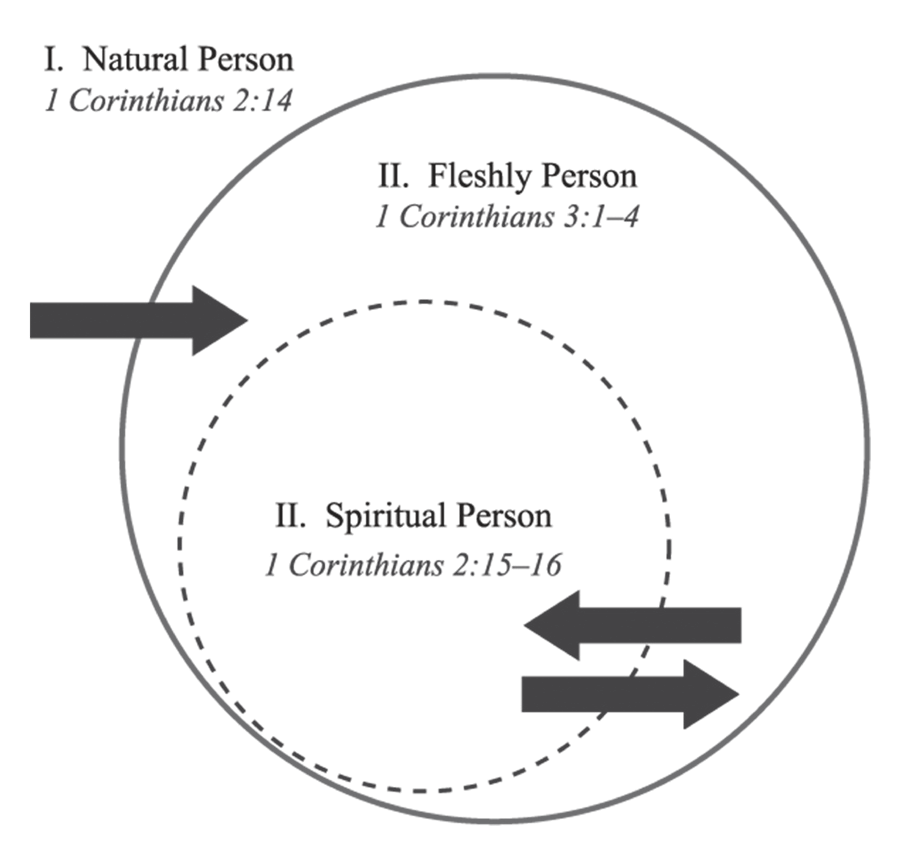
You may remember the Bible passage below from the three types of people described in chapter 2. This passage is used to describe the worldly person living in the flesh in Level II. The NIV translation uses the word “worldly,” while the ESV translation uses the word “flesh.” That’s because the words “worldly” and “flesh” are interchangeable in describing our hearts, as shown in the ESV version below.
“Brothers and sisters, I could not address you as people who live by the Spirit but as people who are still worldly—mere infants in Christ. I gave you milk, not solid food, for you were not yet ready for it. Indeed, you are still not ready. You are still worldly. For since there is jealousy and quarreling among you, are you not worldly? Are you not acting like mere humans?” (1 Corinthians 3:1–4 NIV).
“But I, brothers, could not address you as spiritual people, but as people of the flesh, as infants in Christ. I fed you with milk, not solid food, for you were not ready for it. And even now you are not yet ready, for you are still of the flesh. For while there is jealousy and strife among you, are you not of the flesh and behaving only in a human way?” (1 Corinthians 3:1–4 ESV).
When we’re living in our no-good flesh, the behavior that flows out of our hearts is worldly. When we’re living fleshly, worldly lives, we’re choosing to live in Level II. We are wandering in the wilderness rather than thriving in the Spirit in the Abiding Room.
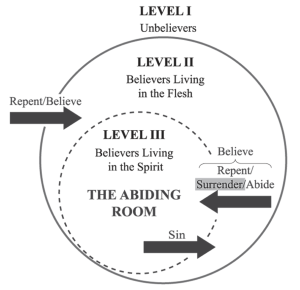
Here’s the Abiding Room diagram illustrating these verses again:
The apostle Paul laments he couldn’t even talk to the Corinthian church in spiritual terms because he was too busy addressing the problems of jealousy and quarreling arising from their operating in the flesh. It seems safe to assume Paul would much rather be celebrating the spiritual victories that would have been occurring in their lives if they had been living in the Spirit.
I wonder how many pastors in churches today can relate to Paul’s disappointment. They long to teach us the deeper things of Christ, but they are too occupied solving the problems caused by our fleshly, worldly hearts. If it’s true that few of us are consistently living in the Spirit, then unfortunately, it is quite likely many pastors can empathize with Paul.
How do we expect to hear from the Holy Spirit when we are choosing to live in a worldly fashion in the flesh? Just as Paul was sad that he couldn’t address the deeper spiritual things to the members of this church, today the Holy Spirit is often grieved that He cannot speak to us in a deeper spiritual language because we’re living in the flesh.
How, then, do we begin to get out of the rut of worldly, fleshly living? The answer once again lies in the word “surrender.”
Surrendering Worldliness
In just two verses, Romans 12:1–2 packs a great deal of instruction regarding surrendering our worldliness. This includes the exciting promise that the blessing of this surrender is to know God’s will:
“Therefore, I urge you, brothers and sisters, in view of God’s mercy, to offer your bodies as a living sacrifice, holy and pleasing to God—this is your true and proper worship. Do not conform to the pattern of this world but be transformed by the renewing of your mind. Then you will be able to test and approve what God’s will is—his good, pleasing and perfect will” (Romans 12:1–2 NIV).
This passage instructs us to surrender our whole selves. When the apostle Paul says to offer your body as a sacrifice, he means to give God all of you—your heart, mind, and soul. But also give Him your calendar, your checkbook, your ambition, your relationships—everything. Give God your complete, absolute surrender. Surrender precedes the outpouring of the blessings of the abiding, Spirit-filled life God the Father has planned for you.
Surrendering your worldliness is an ongoing, lifelong process. It involves developing an attitude of wholehearted release of your life to God every moment of each day. Expect God to lovingly and repeatedly reveal worldly attitudes of your heart you hadn’t noticed. Embrace these new moments of awareness as growth opportunities to yield your heart and your life to Jesus.
These verses instruct you to not be of the world but to be encouraged that by surrendering your life to God, you will be able to discern God’s will. Note the word “then.” “Then you will be able to test and approve what God’s will is.” The word “then” connects your surrender to the promise you will receive a greater capacity to know God’s will.
This passage explains there is a prerequisite to clearly knowing the will of God. This requirement is that you do not align your priorities with what this world says is important. The beginning of the blessing of knowing God’s will is the surrender of your worldliness.
The Message paraphrase of Romans 12:1–2 says this for us in everyday language: “So here’s what I want you to do, God helping you: Take your everyday, ordinary life—your sleeping, eating, going-to-work, and walking-around life—and place it before God as an offering. Embracing what God does for you is the best thing you can do for him. Don’t become so well-adjusted to your culture that you fit into it without even thinking. Instead, fix your attention on God. You’ll be changed from the inside out. Readily recognize what he wants from you, and quickly respond to it. Unlike the culture around you, always dragging you down to its level of immaturity, God brings the best out of you, develops well-formed maturity in you.”
When we let go of our desires and passions for the things of this world, we can fix our minds on the things of God. This is part of the gradual process of being “transformed” to be more like Jesus. We change from the Level II fleshly person who craves what this world has to offer to the Level III Spirit-led person whose thinking is guided by the mind of Jesus as described in 1 Corinthians 2:15–16: “The person with the Spirit makes judgments about all things, but such a person is not subject to merely human judgments, for, ‘Who has known the mind of the Lord so as to instruct him?’ But we have the mind of Christ” (NIV).
Surrendering Your Worldliness—a Recurring Biblical Theme
It’s up to us whether we live Level II lives, conformed to the world and living by the flesh, or Level III lives, transformed by God and living by the power of the Holy Spirit. At its heart, worldliness is having any worldly god rather than the one true God. Those worldly gods are idols.
God has always been serious about our choosing Him above worldly idols. In the Old Testament, God gave the Israelites the Ten Commandments before they entered the Holy Land, telling them He was to be their first priority.
Here are the first two commandments: “You shall have no other gods before me” (Exodus 20:3 NIV).
“You shall not make for yourself a carved image, or any likeness of anything that is in heaven above, or that is in the earth beneath, or that is in the water under the earth. You shall not bow down to them or serve them, for I the Lord your God am a jealous God, visiting the iniquity of the fathers on the children to the third and the fourth generation of those who hate me, but showing steadfast love to thousands of those who love me and keep my commandments” (Exodus 20:4–6 NIV).
Surrender calls on us to align our priorities with those God has for us. One of my favorite verses is a rather obscure one in the Old Testament. The prophet Jonah spoke it while inside the big fish, and it speaks of the enormous cost of loving the things of this world: “Those who cling to worthless idols forfeit the grace that could be theirs” (Jonah 2:8 NIV 1984).
God’s grace lavishes us with many, undeserved blessings. However, when our ambition is to love, pursue, and cling to the things of this world, such as recognition, money, and power, we miss out on many of the blessings God intends for us. But when we abandon these temporary worldly trinkets that distract us from God, He pours out His grace on us.
The apostle John describes surrendering our worldliness in the New Testament: “Do not love the world or the things in the world. If anyone loves the world, the love of the Father is not in him. For all that is in the world—the desires of the flesh and the desires of the eyes and pride of life—is not from the Father but is from the world. And the world is passing away along with its desires, but whoever does the will of God abides forever” (1 John 2:15–17 NIV).
Surrender is the remedy to worldliness. To leave behind the wilderness, you must leave behind your worldliness.
Surrender Your Worldliness—Time
Our resources of time, talent, and treasure are truly from God, and we’re blessed when we devote them to His plans and purposes. As has been said plenty of times: look at your calendar and your checkbook and you’ll know your priorities.
Let’s look at those two areas of surrender—time and money.
When you surrender your worldliness, your desire will shift from serving yourself to serving others. You will become a radiant blessing to your community. The needs of those around you are endless. Through community service, you can establish new friendships and learn to better understand the needs of others.
Serving others will broaden your perspective and contribute to your spiritual maturity. You can trust the Holy Spirit to guide you into opportunities to be the hands and feet of Jesus to those who don’t yet know Him. If you attend church but are still not feeling connected to others, I have a simple, one-word recommendation for you—serve!
Surrendering your worldliness includes ignoring the world’s message to be independent, and instead choosing to be engaged in a local church. The world tells us to live for self and make our own way, but God has chosen and gifted us to be part of a local church body.
The Bible puts it this way: “And let us consider how we may spur one another on toward love and good deeds, not giving up meeting together, as some are in the habit of doing, but encouraging one another” (Hebrews 10:24–25 NIV).
In today’s world of technology, there are plenty of opportunities to fool ourselves into thinking we can be part of a church solely through online worship. But God intends us to be interrelated. When we gather together, we’re able to encourage each other, sharpen each other spiritually, and join together in fellowship and service to bless others using our gifts within and outside of the church.
A wonderful part of being connected to Jesus and living the abiding, Spirit-filled life is enjoying all the blessings that arise from fellowship in Jesus’ body, the local church. Colossians 1:18 tells us Jesus is the head of the church: “And he is the head of the body, the church” (NIV).
Some of the most significant experiences of seeing the Holy Spirit at work are when He empowers you in your service within the church. When we’re operating in the flesh, we think like the world, asking, What’s in it for me? On the other hand, when we’re living lives surrendered to the Lord, we’re looking for ways to serve others, which is what Jesus modeled for us in His earthly ministry.
When our children were young, the temptation for Juli and I was to attend church to be served. After a long week, it can be a challenge just to get everyone fed, dressed, and out the door. But as we relinquished our rights for a leisurely Sunday and began serving, we were blessed in ways we couldn’t have predicted. There is no end to how God will bless you in your involvement in serving in small groups, in children’s ministries, and other areas within your church. A surrendered heart is a selfless, serving heart, and a prerequisite for experiencing the fullness of the abiding, Spirit-filled life.
Spirit-filled, Level III followers of Christ are fully engaged in their local church. Regardless of your age, the number of years you’ve been following Jesus, or your biblical knowledge, God’s plan is to utilize the gifts He has given you to bless others. How has God gifted you? Ask your local church leaders how you can identify and utilize your gifts to serve others in your church.
Now, having said all of that, it’s entirely possible to serve others in the flesh. The real evidence of being filled, led, and empowered by the Holy Spirit is when your life displays the fruit of the Spirit. It isn’t so much that service to others is evidence you are experiencing the abiding, Spirit-filled life, but an unwillingness to serve may be a sign that you’re not.
Surrender Your Worldliness—Finances
“Bring the whole tithe into the storehouse, that there may be food in my house. Test me in this,” says the Lord Almighty, “and see if I will not throw open the floodgates of heaven and pour out so much blessing that there will not be room enough to store it” (Malachi 3:10 NIV).
It has been said this verse is the only time in the Bible that God says we should test Him. God challenges you to relinquish control of your finances to Him, and then watch Him keep His promises as He blesses you.
Is this a guarantee against job loss or that the investments in your retirement plan will soar in value? Not at all. It is a statement intended to encourage you to trust God and release your finances to Him so you can experience Him and the blessings He gives you with your finances.
Everything you have is God’s: “The earth is the Lord’s, and everything in it, the world, and all who live in it” (Psalm 24:1 NIV). But He has entrusted His resources to you to manage faithfully. And the point is clear—what you do with your finances reveals your priorities. How you use or invest your finances is an accurate picture of what you truly treasure.
The Bible gives this guidance as to the attitude of your heart concerning giving when it says: “Each of you should give what you have decided in your heart to give, not reluctantly or under compulsion, for God loves a cheerful giver. And God is able to bless you abundantly, so that in all things at all times, having all that you need, you will abound in every good work” (2 Corinthians 9:7–8 NIV).
Jim Elliot was a young man when he and four other missionaries were killed while taking the gospel to a remote village in Ecuador.
After his death, an entry was found in his journal, written several years earlier. It presented a crystal-clear picture of what surrendering our worldliness for eternal purposes looks like. It read: He is no fool who gives what he cannot keep, to gain that which he cannot lose. Jim’s life illustrated this principle and serves as a dependable reminder that we are wise to invest our temporary resources of time and money in what is eternal.
When it comes to wisely utilizing the resources God has entrusted to us for kingdom purposes, the term “investing” rather than “giving” is perferrable. The funds you invest in your church and in ministries are stored for eternity in heaven. As a follower of Jesus, it is healthy and appropriate to have an Eternal Kingdom Portfolio mindset. That is, just as you may have (or plan on having) personal investments such as a 401k or IRA for earthly purposes, you can set your mind on investing for eternal purposes. God invites you to join Him in His kingdom work so you can experience the joy of participating in activities that will last for eternity.
When you support your church financially, you are part of everything God is doing there. What you do with your finances matters. God wants you to both be blessed and be a blessing. “Give, and it will be given to you. Good measure, pressed down, shaken together, running over, will be put into your lap. For with the measure you use it will be measured back to you” (Luke 6:38 NIV).
Let’s be clear, however, we can be generous givers while still in the flesh. It’s possible to do the right thing for the wrong reasons. The real evidence of the abiding, Spirit-filled life is, once again, when your life exhibits the fruit of the Spirit. It isn’t so much that generous giving is evidence you are experiencing the abiding, Spirit-filled life, but an unwillingness to fully release your finances to God is a pretty good sign that you’re not.
Surrender, Not Checklists
As we finish these three lessons on surrender, it’s possible you are beginning to think this sounds like a checklist of requirements to experience Level III living. There is a fine line between making sure our relationship with Jesus is where it should be and falling into the trap of turning our walk with Him into trying to keep a list of dos and don’ts. Following a list of rules is just legalism and religion.
Abiding in Jesus is not about checklists; it’s about the condition of your heart. Your heart’s condition, as revealed by your attitudes and actions, is of utmost importance so you can experience the abiding, Spirit-filled life in all its fullness. When your heart is fully surrendered to Jesus, the actions we’ve mentioned flow naturally from it. Moreover, you experience joy and peace from being wholly yielded to God.
ABIDING TRUTH: To experience the fullest blessings of the Spirit-filled life, surrender your worldliness.
Reflection Question
Reread Romans 12:1–2. What stands out to you?
Write down your answer to the box below (“Your Response or Question”) and send it to us. It will appear in Messages.
This Bible study lesson is based on Chapter 9 of The Abiding Room, a book by Kevin Seacat.
* * * * * * *
“As the Father has loved me, so have I loved you. Abide in my love. If you keep my commandments, you will abide in my love, just as I have kept my Father’s commandments and abide in his love. These things I have spoken to you, that my joy may be in you, and that your joy may be full. This is my commandment, that you love one another as I have loved you. Greater love has no one than this, that someone lay down his life for his friends. You are my friends if you do what I command you. No longer do I call you servants, for the servant does not know what his master is doing; but I have called you friends, for all that I have heard from my Father I have made known to you. You did not choose me, but I chose you and appointed you that you should go and bear fruit and that your fruit should abide, so that whatever you ask the Father in my name, he may give it to you. These things I command you, so that you will love one another” (John 15:9–17 NIV).
In the last lesson, we studied the first eight verses of John 15 in which Jesus illustrated that the bearing of much fruit is fulfilled by our abiding relationship with Him. Now in verses 9–17, He describes this relationship in very personal and relational terms. In these verses, Jesus applies the vine and branch metaphor to His abiding friendship with His disciples, which includes us.
Hopefully the term “friendship” describes your existing relationship with Jesus. But regardless of how you may currently describe your relationship with Jesus, in this chapter we’ll learn how you can deepen that relationship.
Your Friendship with Jesus
In John 15:15, Jesus describes to His disciples (and us) what the abiding friendship looks like: “No longer do I call you servants, for the servant does not know what his master is doing; but I have called you friends, for all that I have heard from my Father I have made known to you” (John 15:15 NIV).
When you think of the people you call your close friends, what comes to mind? What do you do with a good friend? You spend time with them. You enjoy each other’s company. You laugh. You tell each other your hopes, dreams, and fears. You enjoy and trust them.
Well, that’s exactly how Jesus thinks of you—as His friend! Jesus doesn’t just love you—He likes you! That’s why these are the same things Jesus wants to do with you on a daily basis. He not only loves you enough to save you, He enjoys you and longs to be with you every minute of every day.
The Joy of Abiding
On His last night before the cross, after telling His disciples about abiding for the first time, Jesus said, “I have told you this so that my joy may be in you and that your joy may be complete” (John 15:11 NIV). He was telling them they would be joyful regardless of their circumstances if they remained in relationship with Him.
The same is true for you today. The good news is Jesus has given you the key to your own joy! Even in times of turmoil—health problems, financial issues, a job loss, others’ antagonism toward your faith—we can still have joy. Joy is spiritual because it comes from God. God and His Holy Spirit never change, so you can be joyful regardless of your situation. Unlike happiness, which is dependent on the unpredictable circumstances of the world, joy is available at any time to you when you’re abiding in Jesus.
What Does Abiding Look Like in Your Life?
“Christ in you, the hope of glory” (Colossians 1:27 NIV).
What is abiding? Abiding is a restful, obedient activity. It’s not lazy or inactive. It is peace in the midst of obediently carrying out your work. Abiding in Jesus is letting Christ live out His life in and through you by the power of the Holy Spirit.
Abiding means you’re in tune with the amazing reality that Jesus is right beside you. Regardless of the circumstances, you are with Jesus. He’s always with you in all things. He’s right here, right now. Having Jesus alongside you in an abiding relationship makes any of life’s experiences better.
Abiding means staying in harmony, in fellowship, and in union with Jesus. As you walk through your day with Him, the truths you read in the Bible about Him are no longer just words on a page; they come alive through your life. For instance, the patience of Jesus you read about becomes reality in your life as Jesus lives out His patience through you. The peace of Jesus is lived out in your heart and mind, even in the surprises and setbacks of the day. Just as Jesus was never truly alone because He and the Father were one, you, too, are never alone because you are one with Him.
It’s often easy to turn our faith into an expectation of performance. But practicing the presence of Jesus as we go through our day turns what can become religion into a loving relationship with Him. It’s not a checklist to constrain you or a restrictive set of rules to follow, but rather a restful relationship that actually frees you from slavery to them.
You can confidently rest on Jesus’ promises in each area of your life as you acknowledge and understand He is always available to you, and you make yourself available to Him. When you mess up or drift away from Him, don’t ignore it or agonize over it. Quickly acknowledge it (that is called confession), ask Him for help, then simply and confidently move on.
Acknowledging our mistakes with Jesus is much easier than addressing our mistakes with other people. Since we often have trouble getting over our mistakes, we incorrectly assume it’s the same with Him. But Jesus is loving, caring, kind, and gentle. He loves you and is eager to forgive, instruct, reconnect, and move forward with you.
Be reassured by this promise God made to Israel, which is also a promise to us: “For I will be merciful toward their iniquities, and I will remember their sins no more” (Hebrews 8:12 NIV). Should you stumble, Jesus’ grace, mercy, love, kindness, and gentleness that you experienced when you first began a relationship with Him is always available to you. Go to Him quickly and be refreshed. Jesus loves you.
And let’s say it again—Jesus likes you! He calls you friend! There is nothing He wants more than to hang out with you. That’s why He made you His—to walk alongside you all day, every day. He wants to talk about what you are going through today and guide you through it.
We should not approach Jesus just to receive something from Him. Instead, we are to go to Jesus to just enjoy Jesus. Just resting in Jesus. Just Jesus. Take heart in knowing there is nothing better than simply resting in Him. Nothing we accomplish in our feeble strength compares to simply enjoying staying connected to Him.
God wants us to become receivers, not achievers. The trying and the striving in our limited strength, even if the intentions are good, is not God’s way. He wants us to be fruit bearers, not fruit producers or achievers. Jesus didn’t say, “I want you to go out and produce fruit.” He said, “Bear much fruit.”
As we discussed in the previously, bearing much fruit is a certainty as we abide in Jesus. Remaining connected to Him is the first and foremost thing. Abiding not only takes priority ahead of even doing the ministry God has called us to, but is actually how Jesus intends for ministry itself to be done. By our staying joined to Him, Jesus actually does the ministry in and through us, rather than our attempting to do it through our own self-effort.
Obedience Maintains the Abiding Connection
Once begun, how do you keep abiding? Jesus explained it to His disciples this way: “If you keep my commandments, you will abide in my love, just as I have kept my Father’s commandments and abide in his love” (John 15:10 NIV). And earlier in the evening He had said similarly, “If you love me, you will keep my commandments” (John 14:15 NIV).
In these verses, Jesus says the way you continue to abide is by obeying what God instructs you to do through His Word and His Spirit. These words are firm instruction regarding your friendship with Jesus, describing how to maintain the special, intimate, abiding friendship with Him. Jesus is explaining that you can continue enjoying the fullness of your moment-by-moment abiding relationship with Him through moment-by-moment obedience.
How do you know if you are abiding in Jesus? Since abiding in Jesus causes you to be filled with the Holy Spirit, the confirmation that you are abiding is the same as the confirmation that you are filled with the Spirit—do a fruit inspection. If you sense the fruit of the Spirit at work in you—love, joy, peace, patience, kindness, goodness, faithfulness, gentleness, and self-control—then you know you are abiding in Jesus. At any moment, a fruit inspection can reveal whether you are a part of the vine, or apart from the vine.
But regardless of where you are at any given moment, remember Jesus is always waiting and available to regain full connection and fellowship with you. He loves you, enjoys being with you, and is always lovingly waiting to be asked to guide you.
“Here I am! I stand at the door and knock. If anyone hears my voice and opens the door, I will come in and eat with that person, and they with me” (Revelation 3:20 NIV).
A Biblical Example: Mary the Abider of Bethany
The Bible has an encouraging story for all of us ordinary people. Some people might say, “Well, you know, I’ve never had lots of blessings, I’m not sure I’m that kind of person.” Let’s look at someone in the Bible who was an ordinary, common person who had a wonderful, intimate friendship with Jesus and was commended by Him for it. Her name was Mary of Bethany. I like to call her, Mary the Abider of Bethany.
Mary of Bethany was the sister of Lazarus and Martha, and perhaps as much as anyone in the Bible, Mary understood what it meant to abide in Jesus. Luke 10:38–42 tells the story:
“As Jesus and his disciples were on their way, he came to a village where a woman named Martha opened her home to him. She had a sister called Mary, who sat at the Lord’s feet listening to what he said. But Martha was distracted by all the preparations that had to be made. She came to him and asked, ‘Lord, don’t you care that my sister has left me to do the work by myself? Tell her to help me!’ ‘Martha, Martha,’ the Lord answered, ‘you are worried and upset about many things, but few things are needed—or indeed only one. Mary has chosen what is better, and it will not be taken away from her’” (Luke 10:38–42 NIV).
In the last part of His response to Martha, Jesus makes three statements that contain significant truths for us to embrace today:
Only one thing is needed. Though there was much to do, Mary did only one thing—stay near Jesus and listen to Him.
Doing the one thing is a choice. Mary made a choice—to remain and rest in Jesus’ presence. She chose to be with Him over all the other things she could have chosen.
It will not be taken away. Mary’s experience of being close to Jesus and learning from Him would always be available to her. Similarly, its impact on her would be permanent. The same is true for you today. That’s so reassuring, isn’t it? In a world where friends, family, finances, health, etc., can be taken away, this one thing (the better thing) cannot be taken away—your abiding relationship with Jesus.
Jesus’ Comforting Presence During Difficulties
Though the abiding, Spirit-filled life comes with the promise of the love, joy, and peace of Jesus, and the bearing of much fruit, it does not come with the promise of a life without difficulty. Jesus’ promise and provision is that He will be right next to you as you go through hardship. As others have said, Jesus doesn’t keep you from the fire; He’s with you in the fire. Jesus doesn’t keep you from the valley; He’s with you in the valley. Your problems aren’t extinguished, but they stay in proper perspective.
In fact, God may allow hardships in your life in order to put your faith in Him on display to others. What is better evidence of Jesus’ life being lived in and through you than when you handle trials and difficulties with joy and peace?
When you are filled with the Holy Spirit despite hardships, others—even those who may have never set foot in a church—may begin to ask themselves or ask you directly how you’re able to cope with these challenges. They may begin to wonder how you’re able to approach each day with such calmness when others are anxious or angry. Often, that’s the beginning of God using your abiding life to bear much fruit!
When you’re living the abiding, Spirit-filled life, your life will impact those around you as they see you living above your circumstances. Your spouse, family, friends, co-workers, and neighbors cannot help being attracted to your joy and peace in the midst of life’s uncertainties. Godly character itself bears fruit that remains.
Here are some encouraging words from the Bible reminding us that God is with us during trials:
God will guide you in the midst of your trial.
“Whether you turn to the right or to the left, your ears will hear a voice behind you, saying, ‘This is the way; walk in it’” (Isaiah 30:21 NIV).
“I will lead the blind by ways they have not known, along unfamiliar paths I will guide them; I will turn the darkness into light before them and make the rough places smooth. These are the things I will do; I will not forsake them” (Isaiah 42:16 NIV).
God will comfort you in the midst of your trial.
“The Lord is good, a refuge in times of trouble. He cares for those who trust in him” (Nahum 1:7 NIV).
“Cast your cares on the Lord and he will sustain you; he will never let the righteous be shaken” (Psalm 55:22 NIV).
God will help you in the midst of your trial.
“Though he may stumble, he will not fall, for the Lord upholds him with his hand” (Psalm 37:24 NIV).
“The Lord is a refuge for the oppressed, a stronghold in times of trouble” (Psalm 9:9 NIV).
“God is our refuge and strength, an ever-present help in trouble. Therefore we will not fear, though the earth give way and the mountains fall into the heart of the sea, though its waters roar and foam and the mountains quake with their surging” (Psalm 46:1–3 NIV).
God will restore you after the trial.
“And after you have suffered a little while, the God of all grace, who has called you to his eternal glory in Christ, will himself restore, confirm, strengthen, and establish you” (1 Peter 5:10 NIV).
Journaling
Consider journaling. Journaling will allow you to capture what is going on in your life and what God seems to be saying to you, and will connect the two. Use any type of journal. It doesn’t need to be fancy. It can be inexpensive spiral-bound notebooks. Keep your journal beside you when you do any type of Bible study. If something is impressed on your heart, jot it down. You could even start by using one of the verses listed above and thank God for how He was with you in the midst of a trial.
Don’t be concerned about the quality of your writing. Just get it on paper. Write the private thoughts of your heart to Jesus, not to others. Every few days, go back and see what’s been happening and ask God to reveal to you what He’s showing you from the events and thoughts of your life.
Your entries do not need to be profound. Some days nothing is written, some days a little is written, and some days a lot is written. Each day start a new page, even if the previous entry was very short. There’s no particular pattern, other than perhaps start with Lord, you are showing me … or Lord, thank you for … But strung together, they will show the blessings of God’s leading in your life.
You can journal in any style that fits you. The important point is you’re in consistent communication with God and are creating a record of His work in your life. As you look back, you can thank Him and praise Him for His loving provision.
Abide in Jesus and Be Filled with the Holy Spirit
Jesus instructs you to abide in Him and promises He will abide in you. Rest in Him, and He will rest in you. He’s always there for you. He’s always waiting for you. He won’t turn you down. But it’s your choice. Abiding in Jesus is choosing Level III living in the Abiding Room.
Spend a few minutes in prayer, resting in Jesus’ presence and sensing what the Holy Spirit is saying to you.
ABIDING TRUTH: Jesus calls you friend and enjoys spending time with you.
Reflection Question
As you start each day in the coming week, ask yourself, “What is one blessing of being friends with Jesus?” Write each one down in your journal and review it each morning before adding to this list.
This Bible study lesson is based on Chapter 10 of The Abiding Room, a book by Kevin Seacat.
* * * * * * *
“Not my will, but yours, be done” (Luke 22:42 NIV).
As we begin the chapters on surrender, the word “Surrender” is shaded in the diagram:
We now know the key to being filled with the Holy Spirit is abiding in Jesus. This means the reason so few Christians are consistently experiencing the abiding, Spirit-filled life is because they aren’t abiding in Jesus. Why is that? I believe the primary reason is simply very few are aware abiding exists and what it entails. Hopefully, the information presented on these pages will help enlighten and inspire many in that regard.
First, it’s important to explore what prevents us from abiding. I think two primary barriers exist for most of us: (1) living for ourselves in the flesh, and (2) sin. Before we can truly abide in Jesus, we must address the effect the flesh and sin have on our lives. The remedy for living in the flesh is surrender. After that, we’ll consider the remedy for sin, which is repentance.
Before we proceed, let’s briefly look at the words we’ll be using. While most things in our spiritual lives exist in varying degrees, in the next few lessons we’ll use absolute and direct terms to make the point about the importance of the abiding, Spirit-filled life. The assumption is that experiencing the full, consistent blessings of the abiding, Spirit-filled life explained previously is only possible if we are obedient to the instruction on surrender and repentance in the upcoming lessons.
In some cases, we’ll be speaking as if the area being addressed is either all or nothing. We will say things along the lines of, “If you want to receive the full benefits, you must pay the full cost.” The hope is that, in our making direct and absolute statements, you will experience an increase in the quality of your life and, ultimately, greater eternal rewards.
Therefore, keep in mind we are using emphatic words for only one purpose: to experience more of the abiding, Spirit-filled life now, and in anticipation of the day when Jesus says to you, “Well done, good and faithful servant” (see Matthew 25:23 NIV).
In addition, it’s worth noting we’ll use the term “surrender” to refer to the surrender of our will to God’s will after our salvation. Surrender is the ongoing, repeated, daily act of surrendering our will to the Father’s will. Surrender may be known by other names, such as abandon, release, relinquish, or yield. All these terms imply the giving up of ourselves and our rights to Jesus and trusting in His indwelling Holy Spirit to bring about the desires of our hearts in His time and His way.
What might the absolute surrender of your whole heart look like? Let’s explore the possibilities.
The Ultimate Surrendered Life
The ultimate example of a surrendered life, of course, is Jesus. Perhaps as amazing as the fact that Jesus lived a perfect life, is that He left a perfect life. He surrendered His rights and left His perfect life in heaven to be nailed to a cross for us on earth. He did not consider Himself first. In fact, He did not consider Himself at all.
The Bible describes Jesus’ surrender to God the Father this way: “Do nothing from selfish ambition or conceit, but in humility count others more significant than yourselves. Let each of you look not only to his own interests, but also to the interests of others. Have this mind among yourselves, which is yours in Christ Jesus, who, though he was in the form of God, did not count equality with God a thing to be grasped, but emptied himself, by taking the form of a servant, being born in the likeness of men. And being found in human form, he humbled himself by becoming obedient to the point of death, even death on a cross. Therefore God has highly exalted him and bestowed on him the name that is above every name, so that at the name of Jesus every knee should bow, in heaven and on earth and under the earth, and every tongue confess that Jesus Christ is Lord, to the glory of God the Father” (Philippians 2:3–11 NIV).
As we humble ourselves and surrender our will to the Father’s will as Jesus did, our hearts come into alignment with His plans for our lives. Then we can fully know the joy of living out the purpose for which God created us.
Remember, God wants you to experience Him in fullness even in the seemingly minor moments of the day. These minor moments are the pathway to the major plan He laid out for you since the time He chose to create you!
“For we are his workmanship, created in Christ Jesus for good works, which God prepared beforehand, that we should walk in them” (Ephesians 2:10 NIV).
God’s Way or Your Way?
Too often my plans, strategies, and tactics take me off course and bear little fruit. This occurs because of my independence from God rather than the perfect will of God playing out as a result of my surrender and dependence on Jesus.
In many ways, our ongoing spiritual battle is the opposite of a physical battle. In physical battles, you throw all your effort into pummeling the enemy into submission until they surrender and the battle ends. In contrast, to win the spiritual struggle between our flesh and the Spirit, we must begin with surrender. Victory in the spiritual battle within us is assured when we surrender at the outset.
As you follow the example of surrender Jesus modeled, and surrender your rights to self, you can trust the indwelling Holy Spirit to do the work in and through you. Giving up your independent ways sets you on the path leading to victory over your flesh.
Surrender Your Comfort
The fullest blessings of God follow the person living in wholehearted surrender. God sees our hearts as surrendered when they are emptied of our self-centered plans and in a state of ready obedience to His will. Surrender often means leaving the comfortable present circumstances we know for the unknown future God has planned for us.
Let’s look at two biblical examples of people whose surrender meant leaving the life they knew to follow God wherever He led them. The first example is Abraham in the Old Testament, and the second is Peter and the disciples in the New Testament.
The earthly blessing Abraham and the disciples received was the result of abandoning their agendas and accepting God’s invitation to follow His plan for their lives. While we don’t know exactly what they gave up, we do know they couldn’t have experienced the blessings God had in store for them if they had clung tightly to the safety of their present circumstances. These principles of the blessing of surrender are still true in your life today.
We might not even know Abraham’s name (which was Abram at the time of God’s invitation) if he hadn’t left behind the life he knew for the unknown life God invited him into. Because Abraham trusted God, he became the father of the Jewish nation:
“The Lord had said to Abram, ‘Go from your country, your people and your father’s household to the land I will show you. I will make you into a great nation, and I will bless you; I will make your name great, and you will be a blessing’” (Genesis 12:1–2 NIV).
“By faith Abraham obeyed when he was called to go out to a place that he was to receive as an inheritance. And he went out, not knowing where he was going” (Hebrews 11:8 NIV).
It’s also unlikely we would know the disciples’ names if they hadn’t left behind the lives they knew for the unknown plans God had for them. In a dialogue found in the Gospels of Matthew, Mark, and Luke, the apostle Peter expressed the disciples’ surrender to Jesus in this way: “And Peter said, ‘See, we have left our homes and followed you’” (Luke 18:28 NIV).
Jesus responded to Peter with this affirmation of their surrender and the blessings that follow it: “And he said to them, ‘Truly, I say to you, there is no one who has left house or wife or brothers or parents or children, for the sake of the kingdom of God, who will not receive many times more in this time, and in the age to come eternal life’” (Luke 18:29–30 NIV).
Surrender Daily
What might surrender look like in your life? Is it possible Jesus is the Lord of your life but not the Lord of your today? Is it possible you turn to Him for the big, insurmountable obstacles that occur occasionally in your life but don’t give Him all the little things that are occurring every moment of the day?
Surrender can look as simple as beginning each day with heartfelt attitudes and prayers, such as:
Lord, this day is yours. I’m going to trust you for everything today.
Lord, not my will, but your will be done today.
Lord, I have no idea what this day looks like, but you do, so I’m giving it to you and trusting you for it.
Lord, I surrender control of this day to you. Take it and use me for your glory.
Lord, show me how to be your hands and feet today.
An attitude of surrender sets your heart and mind on trusting God to guide you through the upcoming day. A surrendered heart keeps your chocolate milk stirred up. What a wonderful blessing it is to live with a heart fully surrendered to and trusting in Jesus!
Fasting from Self
When we’re in the flesh, we’re very likely motivated by our desire to be esteemed, noticed, admired, and respected by others. Sometimes we long to be the center of attention. With the immense influence of social media today, many sources encourage us to put the focus on ourselves in an attempt to portray ourselves in a positive light. This can become habitual.
As you may know, when the Bible speaks of fasting, it means going without something for a period of time in order to focus on God, to pray about something in particular, and to listen to and hear from God. Try “Fasting from Self.” For three days, try to fast from self by doing as little as possible to draw attention to yourself in both writing and conversation.
Here’s what it involves:
Don’t tell anyone you’re taking the challenge.
For three days—if possible, including the weekend when you’re more likely to be around friends and family—don’t talk about yourself.
Participate in conversations, but don’t express your own opinions.
If the conversation turns to you, respond briefly, and, without being too obvious, turn it back to others.
If someone expresses an opinion that’s the opposite of yours, hold back from expressing yours.
Humble yourself and be genuinely interested in anyone and any topic. Don’t redirect the conversation to something that interests you, even if you are bored and you completely disagree with what’s being discussed.
If you find yourself in a discussion that seems to have no end in sight, or participating in something that is completely disinteresting to you, stay engaged and enjoy it.
Last, take a break from posting anything on social media.
If you feel led to try this, you may be surprised at how many times you want to express an opinion or draw attention to yourself. It can be a challenge to yield yourself to such a seemingly easy task, but it may reveal something that will bless your obedience in practicing surrender.
Surrender to God’s Plan for You
“For I know the plans I have for you,” declares the Lord, “plans to prosper you and not to harm you, plans to give you hope and a future” (Jeremiah 29:11 NIV).
Although this beloved message from God is directed to the Israelites as a people group, Jeremiah 29:11 describes God’s heart for all His children. God has a unique plan for you too. And if you look in the rearview mirror of your life, you can probably see how God has blessed you when you listened to His directions in the past. You celebrate when you think about these times of trusting Him.
But you may also remember choices you’ve made to go your own way that brought regret. Everyone can look back and see both types of experiences. Take a moment to recall some choices in your past, both good and bad.
You undoubtedly also remember times when the Holy Spirit gave you whispers, hints, and nudges, telling you which way to go. Sometimes you chose to listen to them, and sometimes you chose to ignore them. These experiences remind you of the value of listening to the Spirit’s guidance.
When you completely yield your life to God and abide in Jesus, you can hear the Holy Spirit more clearly as He guides you in the next direction you should go. The view out the front window is not always clear. That’s the point. You have to trust God for where He is taking you and listen to instructions for the next turn. As a follower of Jesus, when you come to a decision point in your life, you can have confidence that the Holy Spirit living within you will guide you in the right direction and help you make the right choice. In those moments, it’s reassuring to know other names for the Holy Spirit are Helper and Comforter!
God created you to live a surrendered life so you can enjoy intimacy with Him. As you increasingly surrender your life to God, you’ll experience the plan He has intended for you from the beginning. It’s a life filled with joy, peace, and the power to live for His glory.
ABIDING TRUTH: To experience the fullest blessings of the Spirit-filled life, surrender your will to God’s will.
Reflection Question
What did Abraham need to surrender to God? What did the disciples need to surrender to God? How can you move forward with this concept of surrendering? What would it look like to daily surrender to his will?
Write down your answer to the box below (“Your Response or Question”) and send it to us. It will appear in Messages.
This Bible study lesson is based on Chapter 11 of The Abiding Room, a book by Kevin Seacat.
* * * * * * *
“Come to me, all you who are weary and burdened, and I will give you rest” (Matthew 11:28 NIV).
Do you ever find yourself working to the point of exhaustion? Does it feel like you often check two things off your to-do list, only to find three more have been added, which leaves you feeling overwhelmed? Do you often feel hurried and worried? Do you feel the frustration of doing it well, but knowing it could have been done better? Do you have trouble saying no to the many good things you could do, and as a result, you don’t have the energy to do the best thing? Do you find yourself irritated at others who, in your mind, aren’t giving 100 percent to the cause?
You’re not alone! Many well-intentioned followers of Jesus feel exhausted. We all need to continue to learn to put into practice the reality that following Jesus also means resting in Jesus.
If we know only striving, we are missing out on the abiding life. And if we aren’t abiding in Jesus, sadly, we’re very likely too familiar with exhaustion. Serving in our own strength will not only wear us out, it will also result in not bearing “much fruit” (John 15:5, 8 NIV). Thankfully, when we fully surrender our striving and self-effort, and our hearts are fully connected to Jesus, we can experience rest and the bearing of much fruit!
Doesn’t that sound contradictory—less effort leading to more fruit? That’s because, in many ways, the surrendered life is the opposite of what today’s world teaches—if we want better results, we must try harder. This counterintuitive nature of the abiding, Spirit-filled life likely helps explain why a minority of Christians today are experiencing it.
When, however, by faith, we give Jesus our absolute surrender, He graciously reaches out, inviting us to abide in Him and receive the fullness of His life and Spirit! We discover Jesus is the way, the truth, and the life to not only eternal salvation, but to contentment in this life as well!
Martha the Tireless Worker
An excellent example of the contrast between abiding in Jesus and relying on self-effort is found in the story of Jesus with Mary and Martha. This is the same Mary we referred to as Mary the Abider of Bethany in chapter 7. Both Mary and her sister Martha were devoted followers of Jesus, but they demonstrated their loyalty in different ways. Let’s look again at how Martha put her faith into action.
“As Jesus and his disciples were on their way, he came to a village where a woman named Martha opened her home to him. She had a sister called Mary, who sat at the Lord’s feet listening to what he said. But Martha was distracted by all the preparations that had to be made. She came to him and asked, ‘Lord, don’t you care that my sister has left me to do the work by myself? Tell her to help me!’ ‘Martha, Martha,’ the Lord answered, ‘you are worried and upset about many things, but few things are needed—or indeed only one. Mary has chosen what is better, and it will not be taken away from her’” (Luke 10:38–42 NIV).
As we read this story, we need to understand Jesus wasn’t condemning Martha. He was fully aware she was working hard out of her desire to serve Him in the best way she knew. Yet He was gently instructing her that there was a better way.
Martha was giving it her all. She was fully invested, all in, sold out. She fully recognized Jesus was the Son of God, and she was serving Him with all her heart. Because of how she was living out her faith, however, she was missing out on the very best of Jesus in her life. In spite of her passion, she was operating in the flesh and floundering in frustration in Level II. Her focus on the task was distracting her from being teachable.
Martha needed to embrace the rest found in abiding in Jesus by surrendering her self-effort. Jesus was telling her there was rest available in Him, and she could put aside all the world’s ways of working in her own strength by instead choosing to simply abide in Him. Jesus was pointing Martha to abiding in Him rather than striving for Him.
Nothing on Our Own
“So Jesus said to them, ‘Truly, truly, I say to you, the Son can do nothing of his own accord, but only what he sees the Father doing. For whatever the Father does, that the Son does likewise … I can do nothing on my own’” (John 5:19, 30 NIV).
“Do you not believe that I am in the Father and the Father is in me? The words that I say to you I do not speak on my own authority, but the Father who dwells in me does his works” (John 14:10 NIV).
Jesus described His life as letting God the Father live in and through Him. He was not only describing how He lived, but foreshadowing how we are to live—by letting the life of Jesus and the power of the Holy Spirit do in and through us what we cannot do ourselves.
Realizing we are operating in our own strength is not always easy. Similar to Martha, we may have good intentions, but our method is misplaced. While the deeds of the flesh (such as fits of rage, jealousy, and envy) may not describe your typical daily attitude, the fruit of the Holy Spirit (such as joy and peace) may not seem to describe your daily experience either. You may find yourself caught somewhere in the middle.
That middle is the wilderness of Level II living. Do contentment and restful satisfaction seem to elude you as you follow Jesus? Instead of experiencing the freshness of the fruit of the Spirit, do you find yourself fatigued, disillusioned, and, at times, even hopeless? Jesus, who knows your heart, compassionately lets you know He understands. He tenderly instructs you that, regardless of how hard you strive, feeble branches like you and me cannot bear fruit all alone. He says, “The branch cannot bear fruit by itself” (John 15:4 NIV). Even our best efforts cannot produce the authentic spiritual fruit such as joy and peace that come only from the life of Jesus flowing through us.
Thankfully, it does not have to be this way! Just like Martha, the solution is right next to you—Jesus. He invites you to surrender your reliance on your own strength and instead, rest, trust, and abide in Him. He will accept even your smallest act of faith in turning to Him, lovingly take your burden upon Himself, and walk alongside you.
Three Key Verses Regarding Self-Effort
Three verses taken from three letters written to three churches nicely fit together to encourage us to live by the Holy Spirit and guard against self-effort.
“So then, just as you received Christ Jesus as Lord, continue to live your lives in him” (Colossians 2:6 NIV). You’re instructed to continue to live your life in Christ Jesus just as you started. How did you start your life with Jesus? You received Jesus as Lord. You did not achieve salvation; you received it.
“For by grace you have been saved through faith. And this is not your own doing; it is the gift of God, not a result of works, so that no one may boast” (Ephesians 2:8–9 NIV). How did you receive Jesus and were saved? It was by God’s grace, through faith, not by your works, that you received Jesus as your Lord and Savior. So, referring back to Colossians 2:6, you are to continue to live just as you started—by God’s grace, through faith in Jesus, not by your own self-effort (or works).
“Are you so foolish? Having begun by the Spirit, are you now being perfected by the flesh?” (Galatians 3:3 NIV). The phrase “not by works” means not by your own self-effort. Nevertheless, it is extremely easy for us to slip into doing works by self-effort. Remember, we said self and flesh are essentially the same. While it may not be intentional, it’s very common to try doing good works in the flesh. Self-effort is doomed to failure because your no-good flesh cannot bear much fruit. Apart from Jesus, we cannot bear as “much fruit” as we can when we are resting, or abiding, in Him.
Just as you received, not achieved, the gift of salvation, so do you continue to bear fruit, not produce fruit. The bearing of much fruit is not accomplished through your well-intentioned reliance on yourself. Bearing fruit is accomplished by trusting God, surrendering your self-effort, and letting the Holy Spirit do His work in and through you as you abide in Jesus.
As we connect these three sets of instructions from Paul, we see they give us guidance for how we’re to restfully follow Jesus.
Living in the Spirit vs. the Self-Effort of the Flesh
Too often in our desire to carry out good works, we do so while forgetting the One who inspired us to do them in the first place—Jesus. If we begin with the abiding relationship with Jesus, we can trust the Holy Spirit to guide, direct, and empower us to complete our work.
God created us for a life of purpose that flows from our relationship with Him. If our priority becomes more focused on obedience rather than on the relationship, we end up getting less of both. But as we abide in our relationship with Jesus, the Holy Spirit fills us (The Great 2 for 1), and we discover that, not only does the will of God become clearer to us, but the work of God becomes easier for us too.
It’s as C.S. Lewis wrote: “Put first things first and we get second things thrown in; put second things first and we lose both first and second things.” Meaning, if we make our relationship with Jesus our top priority, the good works flow naturally from that relationship. However, if we get things out of order, and thrust forward into attempting to carry out the work in our own strength, we’ll experience less of both Jesus and fruit.
Let’s compare the difference between attempting to exhibit the fruit of the Spirit through our self-effort and watching it appear naturally as we trust in the power of the Holy Spirit.
First, what does it look like to attempt to live out the fruit of the Spirit in the flesh of self-effort? If you get up in the morning and effectively say to yourself, Today I’m going to do all I can to be loving and joyful and peaceful and patient and kind and good and faithful and gentle and self-controlled, you may find (1) at some point you’ll stumble, and (2) at some point you’ll be exhausted. Why? Because you can’t produce those things in the flesh.
The tree of the flesh can produce some meager levels of fruit for a while through self-effort, but eventually a storm will arise that washes away the topsoil and reveals the root of these things is the flesh. You may discover the fruit vanishes, and the deeds of the flesh such as anger, frustration, harsh criticism, and their accompanying fatigue and discouragement appear.
On the other hand, if you get up in the morning and acknowledge, Lord, I surrender this day to you. You know what is ahead, and I know I can’t exhibit the fruit of the Spirit in my own strength, so I am trusting you to do it, then you can likely count on three things: (1) that the fruit of the Spirit that appears is genuine, (2) at some point you may still stumble, and (3) if at the point of stumbling you quickly acknowledge to Jesus that you messed up and simply start over by surrendering again, you can trust you’re back on track, abiding in Jesus.
We will mess up, and Jesus will not be surprised because He knows we’re in constant training. The Holy Spirit will let us know when we’re off-track, but Jesus is not waiting to condemn us. Rather, He’s eager to encourage and guide us. At this point, our faithful friend Jesus will gently say to us what He said to the apostle Paul: “My grace is sufficient for you, for my power is made perfect in weakness” (2 Corinthians 12:9 NIV).
As you begin each day, isn’t it comforting to know that Jesus’ grace is constant? His grace is present at the start, the middle, and the end of the day. His grace is present during both your successes and failures. We can rest during the events of the day, knowing it’s no longer us attempting to do things for God in our own strength, but Jesus living out His life through us by the Holy Spirit. The secret is to remain connected to Jesus, not to chase perfection.
Life in the Spirit doesn’t eliminate the problems and difficulties the fallen world brings into our lives, but if somebody else is doing the work, we won’t become nearly as exhausted. By consistently living by the power of the indwelling Holy Spirit, we have Jesus’ assurance of bearing much fruit. That’s because it’s not us striving to produce the fruit; it’s Jesus living in us who is doing the work.
Surrendering our self-effort doesn’t mean we spend all day napping and expecting things to get done. God didn’t save us for leisure and laziness but for kingdom purposes. As we live by the power of the Spirit, we can know what to do and can enthusiastically embrace God’s plan for us, experiencing the Spirit’s presence and power throughout the day.
Here’s how Paul described the transforming work of the gospel in and through him: “But by the grace of God I am what I am, and his grace toward me was not in vain. On the contrary, I worked harder than any of them, though it was not I, but the grace of God that is with me” (1 Corinthians 15:10 NIV).
Abide during the process, obey at decision points, and trust God for the results. Over time, you will have fewer and shorter detours in the flesh. And what is even more exciting is that as you increasingly walk in the Spirit, you can be confident that, step-by-step, you are becoming more like Jesus!
The Love You Had at First
“I know your deeds, your hard work and your perseverance. I know that you cannot tolerate wicked people, that you have tested those who claim to be apostles but are not, and have found them false. You have persevered and have endured hardships for my name, and have not grown weary. Yet I hold this against you: You have forsaken the love you had at first. Consider how far you have fallen! Repent and do the things you did at first” (Revelation 2:2–5 NIV).
Jesus gives us an invitation, saying, “Come to me, all you who are weary” (Matthew 11:28 NIV). Does this describe you? If so, He invites you to surrender your self-effort and rest in Him.
Do you remember the freshness of your faith when you first came to Jesus? You knew so little; yet you knew all you needed to know because you knew Jesus. You knew your childlike faith alone was enough. Jesus says everyone, no matter their gifts or experiences, must come to Him as a child.
When Jesus calls you friend, He gently invites you to leave behind your self-effort and enjoy His company. Friends don’t require our performance; they just enjoy our presence. When you’re with your best friend, you’re relaxed, rested, smiling, laughing, and enjoying their company. Your friend Jesus is inviting you to throw away your attempts at pleasing Him with your self-effort and simply come alongside Him and abide.
ABIDING TRUTH: To experience the fullest blessings of the Spirit-filled life, surrender your self-effort and rest in Jesus.
Reflection Question
How did Jesus describe the contrast in how Martha and Mary lived out their faith?
Write down your answer to the box below (“Your Response or Question”) and send it to us. It will appear in Messages.
This Bible study lesson is based on Chapters 13 – 15 of The Abiding Room, a book by Kevin Seacat.
* * * * * * *
God Is Holy
“Be holy, for I am holy” (Leviticus 11:44 NIV).
In this final lesson, we’ll look at another Biblical illustration of the reality of the Abiding Room—the temple of God. We’ll see how the Abiding Room is actually the holy place of God where we dwell in His presence.
The Definition of Holiness
God describes Himself as holy. Holy means to be set apart. It means absolutely pure, perfect, or sacred.
Holiness is the essence of who God is, and because He is holy, He cannot be pleased with anything impure. And since there is nothing good in our flesh (Romans 7:18 NIV), God cannot be pleased with His children when we are living in the flesh. But our actions are always pleasing to Him when we are filled, led, and empowered by His Holy Spirit. Even in our imperfect, human state, as a loving Father, God is pleased with His children when we’re living in the Spirit.
Encountering God’s Holy Presence
Throughout the Bible, God repeatedly emphasizes His holiness. When people encounter God’s holiness, it is overwhelming and can be terrifying.
In the Old Testament book of Leviticus, as God gave Moses and Aaron His regulations for living lives of cleanliness and presenting acceptable offerings to Him, He said: “For I am the Lord your God. Consecrate yourselves therefore, and be holy, for I am holy. You shall not defile yourselves with any swarming thing that crawls on the ground. For I am the Lord who brought you up out of the land of Egypt to be your God. You shall therefore be holy, for I am holy” (Leviticus 11:44–45 NIV).
When God was about to save the Israelites from their captivity in Egypt, He appeared to Moses in a burning bush. The voice of God didn’t proclaim His love to Moses, but rather God’s own holiness. When Moses encountered God, it wasn’t a comfortable experience. It was a frightening one, a momentous event that was recounted in the early church more than 1,000 years later in the book of Acts: “Now when forty years had passed, an angel appeared to him in the wilderness of Mount Sinai, in a flame of fire in a bush. When Moses saw it, he was amazed at the sight, and as he drew near to look, there came the voice of the Lord: ‘I am the God of your fathers, the God of Abraham and of Isaac and of Jacob.’ And Moses trembled and did not dare to look. Then the Lord said to him, ‘Take off the sandals from your feet, for the place where you are standing is holy ground. I have surely seen the affliction of my people who are in Egypt, and have heard their groaning, and I have come down to deliver them. And now come, I will send you to Egypt’” (Acts 7:30–34 NIV).
Later, Moses asked God to show him His ways so he might know how to find favor in God’s sight. God responded by saying His face of unfathomable goodness and holiness could not be looked upon even by Moses, the man of God: “And the Lord said to Moses, ‘This very thing that you have spoken I will do, for you have found favor in my sight, and I know you by name.’ Moses said, ‘Please show me your glory.’ And he said, ‘I will make all my goodness pass before you and will proclaim before you my name “The Lord.” And I will be gracious to whom I will be gracious, and will show mercy on whom I will show mercy. But,’ he said, ‘you cannot see my face, for man shall not see me and live.’ And the Lord said, ‘Behold, there is a place by me where you shall stand on the rock, and while my glory passes by I will put you in a cleft of the rock, and I will cover you with my hand until I have passed by. Then I will take away my hand, and you shall see my back, but my face shall not be seen’” (Exodus 33:17–23 NIV).
At the end of the Bible, in the book of Revelation, the apostle John gets a glimpse of Jesus seated on His throne in heaven, and the overwhelming spectacle of heavenly creatures worshiping Him day and night without ceasing. They never stop praising God and His holiness: “Holy, holy, holy is the Lord God Almighty, who was, and is, and is to come” (Revelation 4:8 NIV).
Ignoring or underestimating the importance of the holiness of God leads to a diminished relationship with God. The insightful author and thinker of the previous century, A.W. Tozer, writing on God’s holiness in his classic book on the nature of God, The Knowledge of the Holy, wrote, “Because he [God] is holy, his attributes are holy; that is, whatever we think of as belonging to God must be thought of as holy.”
The Tabernacle and Temple of God
The reality that God’s holiness sets Him apart from sinful mankind is clearly illustrated in physical terms in the architecture of His temple. There, God is distinctly separated from man.
As the Israelites wandered in the desert in the early chapters of the Old Testament, God was with them in the first temple called the tabernacle. The tabernacle could be disassembled and moved when God instructed them.
Many years after the Israelites had entered the Holy Land, Solomon built an extraordinary temple for God in Jerusalem. Solomon’s temple was destroyed around 586 BC. Later, the prophet Ezekiel received a vision of another magnificent temple that, to date, has not yet been built. Centuries after Ezekiel’s vision, King Herod had another temple built. It was less magnificent than Solomon’s temple, and, in AD 70, it was also destroyed.
While people may look at the architecture and marvel at one temple more than others or compare the temple of God with other man-made structures, the true magnificence of any temple is due to God’s presence.
Physically, one of the commonalities is that each temple consisted of essentially three parts—the outer court, the inner court, and the holy places. God resided in the innermost part of each temple—the holy places. In the Old Testament, only the priests had access to the holy places, and they entered for the purpose of making sacrifices for the sins of the people.
The holy places consisted of both the Holy Place and the Most Holy Place. We will refer to them together as the holy places, which is the term the book of Hebrews uses, as we will see shortly. The Abiding Room is the holy place of God. We can depict the holy places as Level III, as shown in the next diagram:
The Glory of God Fills the Temple
In the Old Testament, there are descriptions of special events where the glory of God fills the temple. Each is an overwhelming occasion.
Moses experienced this with the first temple, which was referred to as the tabernacle: “Then the cloud covered the tent of meeting, and the glory of the Lord filled the tabernacle. And Moses was not able to enter the tent of meeting because the cloud settled on it, and the glory of the Lord filled the tabernacle” (Exodus 40:34–35 NIV).
When Solomon prayed at the dedication of the temple, whose construction he oversaw, the glory of the Lord again overwhelmed the people as it filled the temple: “As soon as Solomon finished his prayer, fire came down from heaven and consumed the burnt offering and the sacrifices, and the glory of the Lord filled the temple. And the priests could not enter the house of the Lord, because the glory of the Lord filled the Lord’s house. When all the people of Israel saw the fire come down and the glory of the Lord on the temple, they bowed down with their faces to the ground on the pavement and worshiped and gave thanks to the Lord, saying, ‘For he is good, for his steadfast love endures forever’” (2 Chronicles 7:1–3 NIV).
The prophet Ezekiel describes a truly awesome experience as the glory of the Lord fills the temple: “And behold, the glory of the God of Israel was coming from the east. And the sound of his coming was like the sound of many waters, and the earth shone with his glory. And the vision I saw was just like the vision that I had seen when he came to destroy the city, and just like the vision that I had seen by the Chebar canal. And I fell on my face. As the glory of the Lord entered the temple by the gate facing east, the Spirit lifted me up and brought me into the inner court; and behold, the glory of the Lord filled the temple” (Ezekiel 43:2–5 NIV).
God’s presence, power, majesty, and holiness are in His temple and are apparent to all who encounter Him. Throughout history, God’s glory filling the temple was a staggering revelation of God to man.
Jesus Made a Way into the Holy Places
Much as God dramatically revealed the salvation of mankind through the parting of the Red Sea, He revealed a new relationship with mankind through the profound tearing of the temple veil that separated us from the holy places: “From noon until three in the afternoon darkness came over all the land … And when Jesus had cried out again in a loud voice, he gave up his spirit. At that moment the curtain of the temple was torn in two from top to bottom. The earth shook, the rocks split and the tombs broke open” (Matthew 27:45, 50–52 NIV).
God tore the veil in a way only He could—from top to bottom—at the exact moment Jesus died for mankind’s sins. The tearing of the veil symbolized the death of Jesus made a way we could enter into the presence of God. By Jesus’ blood, a new covenant (agreement) with mankind had begun, and we can now have a wonderful abiding fellowship with God through Jesus.
In the Old Testament, the priests entered the holy places to repeatedly make sacrifices on behalf of the people for their sin. But now, because of Jesus’ perfect sacrifice on the cross for your sin, He has made a way for you to enter into fellowship with your Holy God.
“But when Christ appeared as a high priest of the good things that have come, then through the greater and more perfect tent (not made with hands, that is, not of this creation) he entered once for all into the holy places, not by means of the blood of goats and calves but by means of his own blood, thus securing an eternal redemption. For if the blood of goats and bulls, and the sprinkling of defiled persons with the ashes of a heifer, sanctify for the purification of the flesh, how much more will the blood of Christ, who through the eternal Spirit offered himself without blemish to God, purify our conscience from dead works to serve the living God” (Hebrews 9:11–14 NIV).
There is no more need for a physical temple where priests make sacrifices for your sins. Jesus’ death means you can experience intimate fellowship with God without the need for a physical temple: “For Christ has entered, not into holy places made with hands, which are copies of the true things, but into heaven itself, now to appear in the presence of God on our behalf. Nor was it to offer himself repeatedly, as the high priest enters the holy places every year with blood not his own, for then he would have had to suffer repeatedly since the foundation of the world. But as it is, he has appeared once for all at the end of the ages to put away sin by the sacrifice of himself” (Hebrews 9:24–26 NIV).
Jesus made a way for you to enter into the holy places that were once off-limits to ordinary people like us. He made a way for you to enter that no longer requires the blood of animals. You can walk through this door that is made possible by His blood.
Because God is holy, however, the presence of any sin must be addressed. The wondrous reality of entering the holy places of precious intimacy with Jesus exists by God’s grace but requires your humble submission. You may approach the throne of Jesus having first responded in faith by confession and repentance of any sin the Holy Spirit reveals to you. The writer of Hebrews describes your confident entry into God’s presence this way: “Therefore, brothers, since we have confidence to enter the holy places by the blood of Jesus, by the new and living way that he opened for us through the curtain, that is, through his flesh, and since we have a great priest over the house of God, let us draw near with a true heart in full assurance of faith, with our hearts sprinkled clean from an evil conscience and our bodies washed with pure water” (Hebrews 10:19–22 NIV).
Fear Has Been Replaced by Joy
The Abiding Room is the holy places. Jesus has made the holy rooms once reserved exclusively for priests the new Abiding Room for ordinary people like you and me! Jesus has made a way so that the holy places even priests once entered with fear can now be entered by all God’s children with joy. Fear has been replaced by joy!
The reality of this new privilege gets even better. Jesus sets no time limit on how long you can remain in His holy presence. It is up to you. As long as you abide and obey, you can remain in the joy of the Lord: “If you keep my commandments, you will abide in my love, just as I have kept my Father’s commandments and abide in his love. These things I have spoken to you, that my joy may be in you, and that your joy may be full” (John 15:10–11 NIV).
Praise to the name of Jesus, who made a way for you to both enter into and remain in the joy of His presence and the presence of His joy!
You Are the Temple of the Holy Spirit
“Do you not know that you are God’s temple and that God’s Spirit dwells in you?” (1 Corinthians 3:16 NIV).
“Do you not know that your bodies are temples of the Holy Spirit, who is in you, whom you have received from God? You are not your own; you were bought at a price. Therefore honor God with your bodies” (1 Corinthians 6:19–20 NIV).
Beginning with Pentecost in the New Testament, God’s Holy Spirit took up residence in a new temple without walls—the hearts of Jesus’ followers. Once again, it’s not the externals of God’s temple that matter, but to what extent the occupant of the house—the indwelling, almighty God—is put on display.
In the verses above, twice Paul teaches the Corinthian church that they are the temples of God. In each case, Paul is reminding them of their great privilege of being indwelt by the Spirit of God and of the accompanying high calling it entails. The Spirit of God is holy, and as a result, the church at Corinth, as well as you and me today, are called to lives that are pure and devoted to God.
When you were first saved and the Holy Spirit made your heart His permanent home, He didn’t move into an immaculate residence. He moved in with the mandate from God to gently and intentionally begin a cleaning project that will last your entire lifetime. It’s up to you as to when you are obedient to actively carry out the Holy Spirit’s instructions. You get to choose when to start and how deep you’re willing to clean. You can procrastinate, or you can quickly initiate changes to begin experiencing the joy and peace that accompanies the filling of the Holy Spirit.
Know for certain that, even when you are living in the flesh, the Holy Spirit is still living in you. And be encouraged that the entire time you are taking actions of obedience, Jesus is smiling. He is watching in delight as you are becoming the person He’s always known you will be and as your heart continually becomes a more beautiful palace for the Holy Spirit to reside in.
“If the Spirit of him who raised Jesus from the dead dwells in you, he who raised Christ Jesus from the dead will also give life to your mortal bodies through his Spirit who dwells in you” (Romans 8:11 NIV).
Today, God is still glorified when His temple is filled with the Holy Spirit, but now that temple is you! Every follower of Jesus is the temple of God and indwelt with the person of the Holy Spirit. It is God’s desire that you, your body, and your life put His glory on display. This is accomplished when you are filled with the Holy Spirit. As you abide in Jesus, God’s temple is being continuously filled with the Holy Spirit.
Pursue Holiness
“Pursue peace with all people, and the holiness without which no one will see the Lord” (Hebrews 12:14 NASB).
Think about how, so many years ago, great men of God such as Moses, Solomon, and Ezekiel were overwhelmed by the glory of God filling the temple in the Old Testament. Isn’t it almost incomprehensible that as a follower of Jesus you have the same Holy Spirit residing in your heart? Isn’t it astounding you have access to the very same power every minute of every day through the indwelling Holy Spirit? What an immense gift the gracious God of the universe has given you as His child in the person of the Holy Spirit!
No one in this lifetime becomes and remains entirely holy, but God tells us to pursue holiness. Since God alone is holy, when we desire to be holy as God is holy, our only option is to pursue God Himself. This is a lifelong pursuit. But just as a loving, earthly father takes joy in running with his small child and letting himself be caught, so, too, does your heavenly Father. In His love and grace, when you wholeheartedly pursue Him, God takes joy in letting you “catch” Him—and then filling you with His Holy Spirit!
Repentance
Now we will discuss repentance for followers of Jesus after salvation. Repentance relates to God’s holiness and your ongoing choice to live in the flesh or in the Spirit at any given moment.
“Or do you presume on the riches of his kindness and forbearance and patience, not knowing that God’s kindness is meant to lead you to repentance?” (Romans 2:4 NIV).
The word “Repent” is now shaded in the diagram:
What is repentance? Repentance means having a change of heart and mind that causes us to turn from going our own way and instead go God’s way. It means turning from our sin to God.
Restoration Not Condemnation
“There is therefore now no condemnation for those who are in Christ Jesus. For the law of the Spirit of life has set you free in Christ Jesus from the law of sin and death” (Romans 8:1–2 NIV).
While God’s unconditional love means we will never lose our relationship with Him, repentance brings us back into the fullness of that relationship. It’s part of God’s plan for our continual, full, relational restoration with Him. It does not lead to punishment or condemnation, but rather to restoration!
Repentance, like surrender, is another condition required for believers to experience the deeper, abiding fellowship with Jesus. Our sin is a barrier that keeps us from abiding. Repentance is the remedy to this barrier. Having repented of known sin, we can abide in Jesus and thus be filled with the Spirit.
“And I pray that you, being rooted and established in love, may have power, together with all the Lord’s holy people, to grasp how wide and long and high and deep is the love of Christ, and to know this love that surpasses knowledge—that you may be filled to the measure of all the fullness of God” (Ephesians 3:17–19 NIV).
As followers of Jesus, we need to continually renew our minds. Repentance is part of the transformational thinking that brings transformational living. God lovingly accepts our repentance when we acknowledge our sin. When sin is present, God is always eagerly awaiting our repentance. It is certain that when you repent, God will forgive you!
God Is Holy
Let’s briefly review the diagram that shows God is both love and holy:
Once more, it is important to understand God is holy. And again, the word “holy” means set apart or sacred. God is without any trace of sin or evil.
As we learned, when Adam and Eve sinned, they could no longer live in the Garden of Eden. A barrier was placed between God and all humankind. Why? Because God is holy, and as a result, there were consequences for man’s sin.
Because God is holy and because you are His beloved child, He cannot be pleased when you sin. When we sin, it negatively impacts our relationship with Him. While God’s love is unconditional, His pleasure is conditional, because He is holy: “For I am the Lord your God. Consecrate yourselves therefore, and be holy for I am holy … For I am the Lord who brought you up out of the land of Egypt to be your God. You shall therefore be holy, for I am holy” (Leviticus 11:44–45 NIV).
God’s Holiness Reveals Our Sin
Isaiah 6 tells of the prophet Isaiah’s dramatic encounter with God’s holiness: “In the year that King Uzziah died I saw the Lord sitting upon a throne, high and lifted up; and the train of his robe filled the temple. Above him stood the seraphim. Each had six wings: with two he covered his face, and with two he covered his feet, and with two he flew. And one called to another and said: ‘Holy, holy, holy is the Lord of hosts; the whole earth is full of his glory!’” (Isaiah 6:1–3 NIV).
There is no hiding our sin from our all-knowing God. When we seek God, His character and His holiness are revealed to us. His holiness reveals to us any sin that is present. This is when we see ourselves as God sees us.
Isaiah experienced the conviction of sin in his encounter with God’s holy presence: “And the foundations of the thresholds shook at the voice of him who called, and the house was filled with smoke. And I said: ‘Woe is me! For I am lost; for I am a man of unclean lips, and I dwell in the midst of a people of unclean lips; for my eyes have seen the King, the Lord of hosts!’” (Isaiah 6:4–5 NIV).
When the presence and work of the Holy Spirit convicts us of the presence of sin in our lives, our correct response is repentance. We repent because of who God is. He is holy. God desires the best for us, and that means He leads us to repentance.
Even in repentance, our depraved hearts will always fall short of God’s holiness. Thankfully, His grace bridges the gap from our repentance to His holy presence. Isaiah experienced this firsthand when God reached out and restored him: “Then one of the seraphim flew to me, having in his hand a burning coal that he had taken with tongs from the altar. And he touched my mouth and said: ‘Behold, this has touched your lips; your guilt is taken away, and your sin atoned for’” (Isaiah 6:6–7 NIV).
God’s Best for You Leads You to Repentance
“Your sorrow led you to repentance. For you became sorrowful as God intended and so were not harmed in any way by us. Godly sorrow brings repentance that leads to salvation and leaves no regret, but worldly sorrow brings death” (2 Corinthians 7:9–10 NIV).
Note how this passage distinguishes godly sorrow from worldly sorrow. Worldly sorrow does not lead to repentance. We can be sorry we got caught in sin or that we are experiencing the consequences of sin, without repenting.
Godly sorrow brings repentance, not merely regret. Godly sorrow leads us to genuine repentance not merely because it will relieve or reduce our pain but because we see our sin as God sees it. Godly sorrow produces a deep conviction and a sincere hatred toward sin because it is a detestable offense toward our Holy God.
Disconnecting by Disobedience
“So whoever knows the right thing to do and fails to do it, for him it is sin” (James 4:17 NIV).
In the next diagram, the word “Sin” is highlighted on the out arrow:
Sin impacts our abiding relationship with God. When you sin, God still loves you because He is love, and you are His beloved child. But God cannot be pleased with your sin because He is holy. When you receive instruction from the Lord through His Word or His Spirit’s promptings, and you know what to do but choose to disobey, that is sin. A stubborn refusal to repent leads to the loss of the fullness of the blessing of abiding in Jesus and being filled with the Holy Spirit.
“Everyone who makes a practice of sinning also practices lawlessness; sin is lawlessness. You know that he appeared in order to take away sins, and in him there is no sin. No one who abides in him keeps on sinning” (1 John 3:4–6 NIV).
As we saw earlier, sin grieves the person of the Holy Spirit and quenches His power, as described in Ephesians 4:30 and 1 Thessalonians 5:19. And though the Holy Spirit has come to dwell in you forever, sin creates uncleanliness that diminishes the fullness of your intimacy with Jesus.
There’s more at stake than simply whether or not you will repent. It’s a choice of whether or not you will abide in Jesus and be filled with the Spirit. All the wonderful blessings of the abiding, Spirit-filled life we have examined in previous chapters are available when we acknowledge our sin and repent. The decision to repent carries with it the choice to either be part of the minority who generally reside within the Abiding Room or among the majority of Christians living primarily outside of the Abiding Room.
“Make every effort to live in peace with everyone and to be holy; without holiness no one will see the Lord” (Hebrews 12:14 NIV).
Stated in absolute terms, if you won’t repent, it displeases God. If you refuse to repent, you cannot expect to fully abide and thus be filled with the Holy Spirit. Our refusal to repent is a personal choice to not be filled with the Holy Spirit. It’s a choice to live a Level II life rather than experience the full abundance of a harmonious relationship with God in Level III, Spirit-filled living. Yes, God’s love, mercy, and grace remain, but so does His holiness.
Is it worth the loss of God’s full favor and blessing to stubbornly refuse to repent of known sin?
The “Continual” Way of Living
Just as with any other relationship, our relationship with Jesus is constantly changing. In John 15:5, when Jesus said, “Abide in me,” He was in essence saying, “Remain in continual fellowship with me.” Ephesians 5:18 essentially says, “being continually filled with the Spirit.” Similarly, Colossians 2:6 says, “So then, just as you received Christ Jesus as Lord, continue to live your lives in him” (NIV).
This principle of continuity applies to repentance as well. Walking in the Spirit is a life of ongoing repentance. Repentance is not only how you were saved initially; it’s also how you are renewed continually.
As he prepared the way for Jesus’ ministry, John the Baptist said, “Bear fruit in keeping with repentance” (Matthew 3:8 NIV). You began your walk with Jesus by repenting. The good work God started in you carries on within you as His grace continues to lead you to repentance.
In his book, Repentance, The First Word of the Gospel, Richard Owen Roberts says, “When a Christian grows careless about repentance, sin and self begin to crowd back into the life, and moral and spiritual decline set in as God demonstrates His displeasure by withdrawing more and more of His manifest presence. When true repentance occurs, a moral and spiritual recovery is made as God returns in refreshing power. If one lives in perpetual repentance as one ought, neither the decline nor the renewal occurs, but rather a steady upward movement is discernable. But alas, few live in consistent repentance, and thus an erratic lifestyle characterizes most professed Christians.”
Confession and Repentance Together
“If we say we have no sin, we deceive ourselves, and the truth is not in us. If we confess our sins, he is faithful and just to forgive us our sins and to cleanse us from all unrighteousness” (1 John 1:8–9 NIV).
Confessing means agreeing with God about your sin. Confession precedes repentance. It’s easy to get caught up in the cycle of “sin, confess, sin, confess” but never come to repentance. If you keep repeating the same sins in your life, perhaps it’s because you’re going the same way and haven’t turned around. It’s quite possible to agree with God that you’re going the wrong way (confession) without turning around (repentance).
To experience the abiding, Spirit-filled life, when you sin, the only thing that will get you going back in God’s direction is the life-changing, heartfelt turnaround of repentance. When the Holy Spirit reveals your sin, you need to agree with God that what He says is true, and turn back to Him by repenting.
Jesus Welcomes Repentance
Jesus is always giving you an open invitation to repent when sin is present so you can experience the fullness of His presence and blessings. It is His desire for you to become more like Him, so He gave you the Holy Spirit to reveal your sin so you will turn from it.
Let’s look back at the Last Supper when Jesus was with His disciples and described the abiding relationship. First, He described the people in the relationship—the Father as the Vinedresser, Jesus as the true Vine, and His followers as the branches. Then He told the disciples they were already clean. Next, He said, “Abide in me,” and began describing the blessings of bearing much fruit, answered prayer, etc., that flow from the abiding relationship with Him. The disciples were attentive listeners and learners as Jesus spoke.
What if instead of being submissive, obedient, teachable, and attentive, the disciples were constantly debating Jesus on what He was teaching them? What if each time He taught them something, they were saying things such as, “No, I disagree. I think you’re wrong. Here’s what I think”? Do you think Jesus, the Son of God, would have ignored their resistance and continued to share with them the intimacy of the abiding life if they were exhibiting those types of attitudes toward His teaching?
Or, what if while Jesus was speaking, they were all sitting around the table looking at pornographic drawings? What if they were sexually involved with women who weren’t their wives? Do you think Jesus would have ignored these sinful behaviors? It’s more likely He would have spoken to them as He often spoke to the crowds following Him—speaking direct truths so they might understand and make important adjustments in their lives. It’s much more likely He would have dealt with their sin before He invited them to abide in Him.
Rest assured that when you mess up, Jesus is never looking to harshly say “Gotcha!” Far from it. Instead, He is always there to catch you and gently say “Don’t worry. I gotcha.” He stands there with open arms, ready to embrace you with His love, grace, mercy, and forgiveness.
The Restoration of Joy Arising from Repentance
“Restore to me the joy of your salvation and grant me a willing spirit, to sustain me” (Psalm 51:12 NIV).
Can you wholeheartedly say you’re experiencing the joy of the Lord? The beginning of the restoration of the joy of your salvation, as King David asked for in Psalm 51, is one U-turn away. Repentance triggers an outpouring of God’s grace and mercy that brings the joy of the restoration of a right relationship with God.
It is worth noting that while repentance is turning to go in the right direction, typically it won’t immediately bring you to your destination. Any journey begins by taking a first step in the right direction, and you will need others to accompany and help you.
Long-term ingrained sin patterns and addictions take time to overcome. You may need to talk to a pastor, seek counseling, or enroll in a program specifically designed to assist you in your commitment to change.
As you consider the truths of repentance, which can be an uncomfortable process, don’t get discouraged. Don’t stop! Keep going—this is the process that leads to blessing! This leads to God’s best for you and all that He has in store for you.
God’s Word reminds you of this: “God disciplines us for our good, in order that we may share in his holiness. No discipline seems pleasant at the time, but painful. Later on, however, it produces a harvest of righteousness and peace for those who have been trained by it” (Hebrews 12:10–11 NIV).
“The Lord your God is with you, the Mighty Warrior who saves. He will take great delight in you in his love he will no longer rebuke you, but will rejoice over you with singing” (Zephaniah 3:17 NIV).
Search Me, O God
Do you long to have the blessings of intimacy with Jesus poured out on you richly as the previous verses remind us? Do you long for the regeneration and daily renewal of the fullness of the Holy Spirit? The awareness of any sin in your life is merely a short prayer away. It simply involves asking your merciful heavenly Father to search your heart and open your eyes, mind, and heart to any sin that exists.
Meditate and pray Psalm 139:23–24 below with sincerity right now. Go before God and genuinely ask Him to search your heart: “Search me, God, and know my heart; test me and know my anxious thoughts. See if there is any offensive way in me, and lead me in the way everlasting” (Psalm 139:23–24 NIV).
God sees your heart as clearly as you see the words on this page. What is the Holy Spirit saying to you at this moment? Did He bring to mind something you need to do? Did He bring to mind someone you need to go to?
Right now, you might be squirming as you think about what it might cost you to fully follow Jesus and repent of your sin. If I were sitting across from you, I’d do everything to keep you from squirming out of this. There’s too much at stake. You have too much to gain! Don’t let your pride stand in the way of you making a spiritual U-turn. Take action.
Turn around now so you are heading in the right direction. Repentance restores, refreshes, and revives.
Listen to what God is saying to you and obey. The rewards await! “To him who is able to keep you from stumbling and to present you before his glorious presence without fault and with great joy—to the only God our Savior be glory, majesty, power and authority, through Jesus Christ our Lord, before all ages, now and forevermore! Amen” (Jude 24–25 NIV).
ABIDING TRUTH: Because God is holy, to experience the fullest blessings of the Spirit-filled life, repent of all known sin.
Forgiveness
“And do not grieve the Holy Spirit of God, with whom you were sealed for the day of redemption. Get rid of all bitterness, rage and anger, brawling and slander, along with every form of malice. Be kind and compassionate to one another, forgiving each other, just as in Christ God forgave you” (Ephesians 4:30–32 NIV).
Perhaps you’ve had the experience of receiving a notice of a gathering, reunion, wedding, or some other event you would like to attend, but your mind quickly jumped to the thought, “Oh no! THAT PERSON who did THAT THING to me will be there!” Instead of being excited about attending the event and seeing family and friends, you begin fretting about having to be in the same room with THAT PERSON. Have you ever felt like that? I know I have.
We Are Commanded to Forgive
We have looked at many aspects of how we can experience the abiding, Spirit-filled life. Now let’s look at an important, common hindrance to experiencing the fullest blessings of Level III living—unforgiveness. It falls within the category of repentance, but it’s addressed separately and saved for last because it merits special attention.
Jesus commands us to forgive each other. In Matthew 6:14–15, he said,
“For if you forgive other people when they sin against you, your heavenly Father will also forgive you. But if you do not forgive others their sins, your Father will not forgive your sins” (NIV).
Unforgiveness is a difficult issue that comes in many forms and often lingers for years. It digs deep into our hearts and is tough to get out permanently, often reappearing suddenly as a major barrier to Spirit-filled living. Is anyone immune to its impact?
We have all had people do things to us that hurt deeply. Perhaps you’ve had some things done to you that are horrendous. But the Word of God is consistent—the path to freedom and the overflowing blessing of Jesus is forgiveness in your heart.
Ephesians 4:30–32 at the beginning of the chapter shows us the connection between unforgiveness and grieving the Holy Spirit. When we have unforgiveness in our hearts, it grieves the person of the Holy Spirit. When in our flesh we choose to not forgive, we are also choosing to forfeit the fullness of the blessings of abiding in Jesus. The lack of love in our hearts brings with it a loss of joy and peace not just toward the unforgiven person, but across our entire lives.
Jesus instructs us to love each other as He loves us. Therefore, if we choose not to forgive another person, it is direct disobedience to His command. Even partial disobedience is disobedience, and disobedience is sin. As we’ve seen, going all the way back to Adam in the garden of Eden, sin separates us from the abiding relationship with God. It was that way in the garden, and it is that way today.
Experiencing the fullest measure of fruit bearing Jesus described when we are abiding in Him is negated when the poison of unforgiveness resides in us. God, however, will bless your obedience to repent of unforgiveness with the power to live in freedom that cannot be experienced otherwise.
Forgiveness, then, is the obedience that comes about after we confess (agree with God about our sin) and repent (turn from our sin to God). Obedience to forgive others can take us from Level II to Level III living. Be assured, God still loves you unconditionally and can choose to bless you even if you don’t forgive. It’s not that God will abandon you if you are unrepentant, but He longs to pour out even greater blessings to those whose hearts have been made clean by repenting of their unforgiveness.
Unforgiveness in Our Lives
The reasons for unforgiveness are extensive and may include when someone:
ignored you
continually disappointed you
continually criticized you
snubbed you
failed to appreciate your efforts
claimed your work as theirs
cheated you
excluded you from their group
used you and then dumped you
fired you
lied to you or about you
gossiped about you
harmed you financially
harmed you verbally
harmed you physically
harmed you sexually
Of course, this is not a complete list. Someone may have done some other awful thing to you. But whatever the offense, our unforgiveness can often reveal itself in a desire to see the offender punished. We may fear they’ll get away with it and even think of ways to get even with them. This may manifest itself in actions such as ignoring them, being rude to them, telling others about their offenses, or other forms of revenge.
God, however, is clear that He is in charge of repaying them for their sin:
“Repay no one evil for evil, but give thought to do what is honorable in the sight of all. If possible, so far as it depends on you, live peaceably with all. Beloved, never avenge yourselves, but leave it to the wrath of God, for it is written, ‘Vengeance is mine, I will repay, says the Lord.’ To the contrary, ‘if your enemy is hungry, feed him; if he is thirsty, give him something to drink; for by so doing you will heap burning coals on his head.’ Do not be overcome by evil, but overcome evil with good” (Romans 12:17–21).
Doesn’t knowing that God is aware of their sin, of how it hurt you, and that He promises to deal with them in His way and timing give you greater freedom to forgive them?
It’s possible THAT PERSON may be unaware they’ve harmed you. You may have even discussed the situation with them, and they downplayed or refused to acknowledge their offense. But your forgiveness cannot be dependent upon their viewpoint and actions, because those are out of your control. What is within your control is your ability to choose to give up your devotion to your unforgiveness and allow the Spirit of God to empower you to forgive them.
Forgiveness doesn’t mean forgetting what was done to you. It doesn’t necessarily result in reconciliation. It may or may not result in trust being restored in the person who harmed you. It is possible to forgive and still wrestle with the emotions of having been hurt. The process of forgiving may very naturally lead to feelings of anger, mourning, and sorrow.
Jesus understands the heartache you feel from the wrongs done to you. While Jesus forgave everyone who sinned against Him, He still felt pain as a result of the hurtful actions of others:
“He was despised and rejected by men; a man of sorrows, and acquainted with grief” (Isaiah 53:3).
God recognizes you will feel pain from the unkind or hostile actions of others and is always available to let you unload your burdens on Him. He promises to be with you and comfort you in the midst of your pain:
“Blessed are those who mourn, for they shall be comforted” (Matthew 5:4).
Again, it’s possible—and reasonable—to mourn, grieve, and feel anger as you process your unforgiveness. Ultimately, what you choose to do with those emotions is what matters to God.
In the never-ending spiritual battle going on in your heart between your flesh and the Holy Spirit, your flesh may continue to remind you of the unjust actions of THAT PERSON. Do not be discouraged—this is a battle you can win by the power of the Spirit within you.
The Holy Spirit, whom Jesus sent as a Counselor to indwell your heart, continues His work to bring you to full spiritual maturity as you become more like Jesus. The Holy Spirit will minister to you as you take steps to forgive. He will guide you in the same way as Jesus always has—in love. Freedom from the burden of unforgiveness is available to you if you choose to be obedient to His leading.
Love and Forgiveness Go Together
On His last night before the cross, as He introduced and connected the abiding life with the upcoming arrival of the Holy Spirit, Jesus also tied love and obedience together. Jesus knew unforgiveness would be a problem. And He knew we can’t be both unforgiving and loving toward someone at the same time. So just before He began laying out the abiding, Spirit-filled life at the Last Supper in John 14–16, He spoke about loving each other:
“A new command I give you: Love one another. As I have loved you, so you must love one another. By this, everyone will know that you are my disciples, if you love one another” (John 13:34–35 NIV).
“If you love me, you will keep my commandments” (John 14:15).
“If you keep my commandments, you will abide in my love, just as I have kept my Father’s commandments and abide in his love. These things I have spoken to you, that my joy may be in you, and that your joy may be full. This is my commandment, that you love one another as I have loved you” (John 15:10–12).
Jesus connected abiding in Him with loving others. He didn’t say, “Love and forgive if …” or “Love and forgive except …” or “Love and forgive when …” Jesus never said to love and forgive others if they acknowledge they are wrong, or if they say they are sorry, or if they make things right. He simply said, “Love one another.”
Love and unforgiveness cannot co-exist. If we won’t forgive someone, we’re unable to love them as Jesus loves us. When we choose to not forgive, we’re also choosing to disobey Jesus’ instructions regarding loving others. He said:
“We love because he first loved us. If anyone says, ‘I love God,’ and hates his brother, he is a liar; for he who does not love his brother whom he has seen cannot love God whom he has not seen. And this commandment we have from him: whoever loves God must also love his brother” (1 John 4:19–21).
Without question, forgiving others is easier said than done. You may need to talk to a pastor or leader in your church, a good friend, or a biblical counselor. It may be a process that takes weeks, months, or years. It may pop up again in your heart and need to be revisited. But regardless of the challenges, pursue whatever actions are necessary to rid yourself of unforgiveness.
“Strive for peace with everyone, and for the holiness without which no one will see the Lord. See to it that no one fails to obtain the grace of God; that no ‘root of bitterness’ springs up and causes trouble, and by it many become defiled” (Hebrews 12:14–15).
The Blessing of Forgiveness
Is it possible your unforgiveness is robbing you of the joy and peace of Jesus?
“So Jesus said to the Jews who had believed him, ‘If you abide in my word, you are truly my disciples, and you will know the truth, and the truth will set you free.’ They answered him, ‘We are offspring of Abraham and have never been enslaved to anyone. How is it that you say, “You will become free”?’ Jesus answered them, ‘Truly, truly, I say to you, everyone who practices sin is a slave to sin. The slave does not remain in the house forever; the son remains forever. So if the Son sets you free, you will be free indeed’” (John 8:31–36).
Jesus’ heartfelt desire is for you to have the full measure of His joy flowing through you. He longs for you to experience an abundance of His presence. But consistently experiencing the fullness of the blessing of the abiding, Spirit-filled life is conditioned upon repenting of the sin of unforgiveness.
Think of the relief it will be to let go of your grudge toward THAT PERSON. You’ll be freed up in your mind and your heart to fully enjoy resting in the presence of your friend, Jesus. Think of the contentment you will have, knowing you have been obedient and are no longer bound by the grip of unforgiveness. Rather than repeatedly replaying the offense in your mind, you will be free to embrace this peaceful, life-changing, biblical thinking. Think of the peace you will experience when you choose love over bitterness.
While Jesus was on the cross being crucified despite being sinless, He looked on the men crucifying Him and said, “Father, forgive them, for they do not know what they are doing” (Luke 23:34 NIV). The same power and grace that Jesus had to forgive them (and to forgive us), He will give you to help you forgive your offender. Why settle for a few drops of God’s blessing and mercy when you are promised an outpouring of God’s blessing if you’re obedient to forgive?
Don’t Wait to Forgive
How many hours, days, or even years have you wasted agonizing over your initial hurt and bitterness toward THAT PERSON or THOSE PEOPLE? Aren’t you tired of lugging your unforgiveness with you everywhere you go?
Imagine how much more God would do through your life if you were released from those thoughts and filled with His peace and the power of the Holy Spirit instead. Again, it may require you going to a pastor or counselor for guidance and help, meeting with the other person, perhaps apologizing and asking for forgiveness for your actions, or other steps. But whatever steps are needed, don’t wait.
All the promises of blessings of Level III living will be yours when you forgive. Don’t wait another minute to get started. Go to Jesus now and ask Him to give you the strength to forgive. Jesus will accompany and guide you through it, and it will change your life in ways you never imagined.
Dear friend, my hope for you is that you will experience freedom from unforgiveness as expressed in the apostle Paul’s words to the believers in the Corinthian church:
“Even if I caused you sorrow by my letter, I do not regret it. Though I did regret it—I see that my letter hurt you, but only for a little while—yet now I am happy, not because you were made sorry, but because your sorrow led you to repentance. For you became sorrowful as God intended and so were not harmed in any way by us. Godly sorrow brings repentance that leads to salvation and leaves no regret, but worldly sorrow brings death. See what this godly sorrow has produced in you: what earnestness, what eagerness to clear yourselves, what indignation, what alarm, what longing, what concern, what readiness to see justice done. At every point you have proved yourselves to be innocent in this matter. So even though I wrote to you, it was neither on account of the one who did the wrong nor on account of the injured party, but rather that before God you could see for yourselves how devoted to us you are. By all this we are encouraged” (2 Corinthians 7:8–13 NIV).
ABIDING TRUTH: Because God is holy, to experience the fullest blessings of the abiding, Spirit-filled life, forgive THAT PERSON who did THAT THING to you.
Reflection Question
What are some ways you could pursue the holiness God asks for? How are repentance and forgiveness related to holiness?
Write down your answer to the box below (“Your Response or Question”) and send it to us. It will appear in Messages.