God offers an incredible gift. There are five keys to unlock the Gift of Heaven.
The Gift of Heaven tract is available in the following languages and formats. They are free downloadable PDF files.
Telugu: Letter
But it is even harder when you don’t know how to work through the difficulties
and challenges that come your way. You can benefit from the valuable biblical
lessons and principles Dr. Brandt has learned during more than six decades of
counseling tens of thousands of people with similar problems.
Dr. Brandt was a popular teacher at conferences, in churches and on radio
programs. Many of his messages have been transcribed and made available
on this website to help you deal with your life situations. Explore the following
categories and discover the answers you need.
The following links will take you to BiblicalCounselingInsights.com.
This Bible study lesson is based on Chapters 1 and 2 of The Abiding Room, a book by Kevin Seacat.
* * * * * * *
Unfortunately, too few Christians are experiencing the abundant, Spirit-filled life that Christ offers. It is estimated that only about 5 percent of believers are living in the power of the Holy Spirit. While the exact figure may be difficult to determine, it is clear that only a small minority of Christians are enjoying the fullness of life that God has planned for us. This is both unfortunate and unnecessary.
God intends for every follower of Jesus to experience the fruits of the Holy Spirit outlined in Galatians 5: love, joy, peace, patience, kindness, goodness, faithfulness, gentleness, and self-control. These are the incredible blessings of Spirit-filled living that we are about to explore. As you experience the presence of Jesus and the power of the Holy Spirit, you will also come to know God’s will for your life more clearly.
Throughout the Bible, God provides stories and instructions illustrating that, at any given moment, our relationship with Him exists at one of three levels. Only in Level III, the Abiding Room, do we experience God in the fullness He intends for us.
The 3 Levels of Life first became evident in the Garden of Eden. Initially, mankind—Adam and Eve—was sinless, walking in a harmonious relationship with God. God provided everything they needed, and there was no death or separation because there was no sin. At this stage, there was only one level of life, as depicted in this diagram:
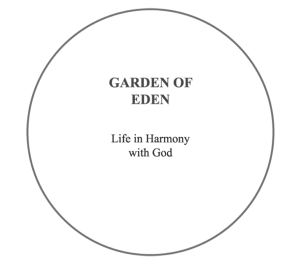
Life with God was as He intended, but He gave Adam a command and warning: “You may surely eat of every tree of the garden, but of the tree of the knowledge of good and evil you shall not eat, for in the day that you eat of it you shall surely die” (Genesis 2:16–17 NIV). Satan deceived Adam and Eve, leading them to disobey God by eating from the forbidden tree.
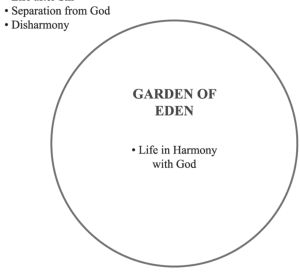
This broke the perfect, harmonious relationship between a holy God and now-sinful mankind. Because God is holy, He imposed consequences for sin. One consequence was banishment from the Garden: “So, the Lord God banished him from the Garden of Eden to work the ground from which he had been taken. After he drove the man out, he placed on the east side of the Garden of Eden Cherubim and a flaming sword slashing back and forth to guard the way to the tree of life” (Genesis 3:23–24 NIV). This introduced two levels of life, as shown in the next diagram:
Ultimately, their sin led to another consequence: death for all. “The man has now become like one of us, knowing good and evil. He must not be allowed to reach out his hand and take also from the tree of life and eat, and live forever” (Genesis 3:22 NIV). “Altogether, Adam lived a total of 930 years, and then he died” (Genesis 5:5 NIV). Thus, the 3 Levels of Life emerged, as illustrated below:
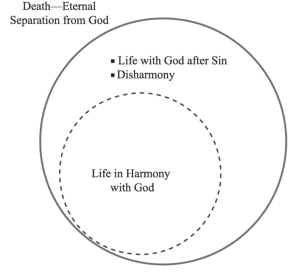
The Bible teaches that sin continues to impact all humankind: “Therefore, just as sin came into the world through one man, and death through sin, and so death spread to all men because all sinned” (Romans 5:12 NIV). The entire Bible demonstrates that our relationship with God exists at one of these three levels. Only one level—living in harmony with God—is truly pleasing to Him, yet few consistently live this way.
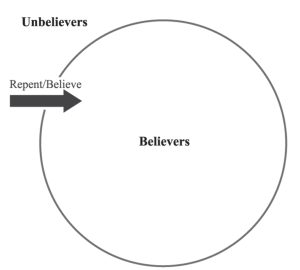
Becoming a Christian involves repentance and belief: “Jesus came into Galilee, proclaiming the gospel of God and saying, ‘The time is fulfilled, and the kingdom of God is at hand; repent and believe in the gospel’” (Mark 1:14–15 NIV). From an unbeliever, one accepts Jesus’ invitation to become a believer.
Salvation is a one-way journey, secure and irrevocable. Jesus assures eternal security: “I give them eternal life, and they shall never perish; no one will snatch them out of my hand. My Father, who has given them to me, is greater than all; no one can snatch them out of my Father’s hand” (John 10:28–29 NIV).
The Bible confirms this certainty through the Holy Spirit, received at conversion to indwell forever: “When you believed, you were marked in him with a seal, the promised Holy Spirit, who is a deposit guaranteeing our inheritance until the redemption of those who are God’s possession—to the praise of his glory” (Ephesians 1:13–14 NIV). This assurance is depicted in the following diagram:
Living in the Flesh
With confidence in salvation, believers choose moment-by-moment to live in either the flesh or the Spirit. In Romans 7, Paul describes the struggle of living in the flesh: “For I do not understand my own actions. For I do not do what I want, but I do the very thing I hate” (Romans 7:15 NIV).
“For I know that nothing good dwells in me, that is, in my flesh. For I have the desire to do what is right, but not the ability to carry it out. For I do not do the good I want, but the evil I do not want is what I keep on doing” (Romans 7:18–19 NIV). He cries out in desperation: “Wretched man that I am! Who will deliver me from this body of death?” (Romans 7:24 NIV).
Living in the Spirit
In Romans 8, Paul describes the freedom and victory of living by the Holy Spirit’s power, enabling a life free of sin and filled with peace: “There is therefore now no condemnation for those who are in Christ Jesus. For the law of the Spirit of life has set you free in Christ Jesus from the law of sin and death” (Romans 8:1–2 NIV).
“For those who live according to the flesh set their minds on the things of flesh, but those who live according to the Spirit set their minds on the things of the Spirit. For to set the mind on the flesh is death, but to set the mind on the Spirit is life and peace” (Romans 8:5–6 NIV). This illustrates the 3 Levels of Life, as shown in the diagram:
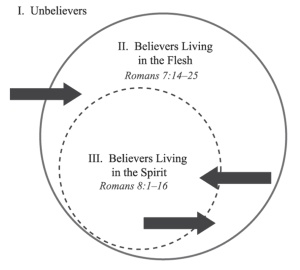
Can you know what God desires you to do? Yes! In the Abiding Room, God’s instructions become clear. In 1 Corinthians, Paul describes three types of people, illustrating the 3 Levels of Life.
Level I—The Natural Person
“The natural person does not accept the things of the Spirit of God, for they are folly to him, and he is not able to understand them because they are spiritually discerned” (1 Corinthians 2:14 NIV).
Level II—The Fleshly Person
“But I, brothers, could not address you as spiritual people, but as people of the flesh, as infants in Christ. I fed you with milk, not solid food, for you were not ready for it. And even now you are not yet ready, for you are still of the flesh. For while there is jealousy and strife among you, are you not of the flesh and behaving only in a human way?” (1 Corinthians 3:1–4 NIV).
Level III—The Spiritual Person
“The spiritual person judges all things, but is himself to be judged by no one. ‘For who has understood the mind of the Lord so as to instruct him?’ But we have the mind of Christ” (1 Corinthians 2:15–16 NIV).
Paul’s words to the Corinthian church clarify three spiritual states, relevant today. In 1 Corinthians 2, he contrasts the natural person (Level I), who cannot understand God’s things without the Holy Spirit, with the spiritual person (Level III), who discerns God’s truths through the Spirit.
In chapter 3, he places the Corinthians at Level II—saved but fleshly, acting like infants, unable to grasp deeper truths due to jealousy and strife. Their actions cause church conflict, requiring Paul to address their behavior rather than deeper spiritual truths. He implies this is a choice, not a permanent state: not ready and still of the flesh.
Believers can move to Level III, living spiritually, in harmony with God, led by the Holy Spirit, with a clearer understanding of their purpose, as shown in the diagram
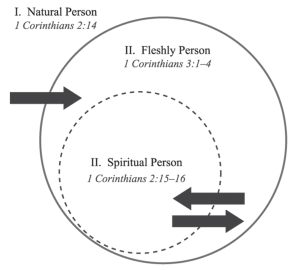
The Corinthians’ failure to utilize the Holy Spirit’s power reflects a choice. Believers today face the same choice: live in the flesh (Level II) or the Spirit (Level III), the Abiding Room, where harmony with God and others is possible.
These diagrams illustrate the three levels of life, showing the contrast between living by the Holy Spirit versus the flesh. The outer circle’s solid line represents a spiritual boundary crossed only by God’s act, while the inner circle’s dashed line signifies a boundary believers can cross through choice.
However, these diagrams present spiritual conditions as absolutes—fully in Level I, II, or III—while reality is less clear, often shaded in gray. The Bible uses absolute terms like filled with the Spirit, never partially filled.
Yet, these illustrations, though biblically based, cannot fully capture the complexities of our spiritual walk in a fallen world. They are tools to guide us toward a fuller relationship with God, acknowledging their limitations in explaining spiritual truths. Now, let’s explore the Holy Spirit’s truths.
ABIDING TRUTH: The New Testament confirms and illustrates The 3 Levels of Life.
What are some of the ways you have found to regularly impact your development toward spiritual maturity?
Write down your answer to the box below (“Your Response or Question”) and send it to us. It will appear in Messages.
This Bible study lesson is based on Chapter 3 of The Abiding Room, a book by Kevin Seacat.
* * * * * * *
“But I say, walk by the Spirit, and you will not gratify the desires of the flesh. For the desires of the flesh are against the Spirit, and the desires of the Spirit are against the flesh, for these are opposed to each other, to keep you from doing the things you want to do” (Galatians 5:16–17 NIV).
Did you know you’re in an ongoing, daily, spiritual battle? As Galatians 5:16–17 tells us, not only are the Spirit and the flesh opposites, but they’re also opponents, engaged in a battle for our hearts. Essentially, there is a spiritual civil war raging inside of us—a major battle for everything God wants you to become.
As followers of Jesus, moment by moment, we are all choosing to either have our chocolate syrup “stirred up” and be empowered by the Spirit or be impaired by the flesh. When our hearts are led by the Spirit, our lives exhibit the fruit of the Spirit, and we look like Jesus to others. But when we are living in our flesh, we look a lot like the world. Is it any wonder Satan will do everything he can to keep us from walking in the Spirit?
This internal battle between the indwelling Holy Spirit and your flesh is going on every minute of every day. Although the battle never ends in this life, you can consistently win the daily fight. It helps to know the enemy and understand what is at stake. In this chapter, we’ll examine this internal conflict to set the stage for the upcoming chapters that describe the many blessings available to you when you win this fight.
“Now the works of the flesh are evident: sexual immorality, impurity, sensuality, idolatry, sorcery, enmity, strife, jealousy, fits of anger, rivalries, dissensions, divisions, envy, drunkenness, orgies, and things like these. I warn you, as I warned you before, that those who do such things will not inherit the kingdom of God” (Galatians 5:19–21 NIV).
When you read some of the terms used by the apostle Paul describing the flesh in his letter to the Galatian church, perhaps you can say they don’t describe your experience. But look again at the bolded words in the middle of the verses. Do some of those actions describe your life? Your family? Have you heard of churches experiencing strife (conflict or bitter disagreement) over fundamental issues? How about jealousy, fits of anger, rivalries, dissensions, divisions, or envy in the church?
The flesh is destructive to relationships of all kinds. Unfortunately, works of the flesh are far too common among followers of Jesus. They existed in Paul’s day, 2,000 years ago, and they still exist today. Notice how Paul describes the reality of living in the flesh—it is highly visible to others. He says, “the works of the flesh are evident” (verse 19). If it’s true that a large majority of believers today spend the bulk of each day living in the flesh rather than living in the Spirit, it not only creates difficulties in our lives, but it is “evident” to the outside, watching world too.
“But the fruit of the Spirit is love, joy, peace, patience, kindness, goodness, faithfulness, gentleness, [and] self-control” (Galatians 5:22–23 NIV).
After explaining the works of the flesh, Paul contrasts them with the fruit of the Spirit. The evidence that you are living in the Spirit is that the fruit of the Spirit is exhibited in your life. Before you received Jesus as your Savior, you always operated in your flesh—never in the Spirit. Because you didn’t have the indwelling Holy Spirit, you had no choice to live otherwise. But when you received Jesus as your Savior, you also received the Holy Spirit. And that means you no longer must live by your flesh. You can choose to live every moment by the power of the Holy Spirit.
In contrasting the Spirit and the flesh, Jesus says, “It is the Spirit who gives life; the flesh counts for nothing; the words that I have spoken to you are spirit and are life” (John 6:63 NIV). Again, the apostle Paul said, “For I know that nothing good dwells in me, that is, in my flesh. For I have the desire to do what is right, but not the ability to carry it out” (Romans 7:18 NIV).
In both verses, we see a link between the two words “flesh” and “nothing.” These verses do not say there are “some things wrong with the flesh” or there are “some things good in the flesh.” They do not say the flesh is “imperfect” (that could imply there is something of merit or value that can be coaxed out of the flesh). Rather, the Bible clearly says there is nothing good in our flesh. Nothing. Our flesh is not 90 percent good; it’s not 50 percent good; it’s not even 20 percent good. It is 0 percent good.
Our flesh is completely flawed and depraved. It is what Jesus paid the price for on the cross by his death. Our flesh cannot be improved into something good because there is nothing good in our flesh in the first place. When we’re living in the flesh, we want to get our way. But when we’re walking in union with the Holy Spirit, we are servant-hearted. Maybe it’s no coincidence that “flesh” spelled backward with the ‘h’ removed is “self.” Our flesh wants what it wants when it wants it. It operates to please self, or what has been called the unholy trinity—Me, Myself, and I.
How do you know if you’re being led by the Spirit at any given moment? Well, let me ask you this: How do you know an orange tree is an orange tree? By its fruit, of course. And that’s how you know if you are living in the Spirit or the flesh. If a personal spiritual examination reveals the fruit of the Spirit—love, joy, peace, patience, kindness, gentleness, and self-control—you can be confident you are living in the Spirit. But if the examination reveals the deeds of the flesh, you’re living in the flesh.
Jesus described it this way: “Make a tree good and its fruit will be good, or make a tree bad and its fruit will be bad, for a tree is recognized by its fruit” (Matthew 12:33 NIV). And He said it’s impossible for us to bear good fruit when we’re operating in the bad tree of the flesh: “Likewise, every good tree bears good fruit, but a bad tree bears bad fruit. A good tree cannot bear bad fruit, and a bad tree cannot bear good fruit” (Matthew 7:17–18 NIV).
If we’re producing bad fruit, we need to get to the root of the problem—we’re operating in the flesh. Trying and striving to produce good spiritual fruit from a bad, fleshly root simply will not work. Why? Because there’s nothing good in the flesh, so nothing good can come out of the flesh. Self-effort cannot rectify the situation because self cannot overcome the flesh.
The bad fruit produced by the flesh is not merely bad behavior that needs correction; it’s the external evidence of an internal heart problem. It’s not the behavior that needs to be addressed; it’s the heart itself. That’s the cause of the problem. The heart operating in the flesh rather than by the power of the Holy Spirit does not need a topical salve. It needs internal heart surgery. By God’s grace, however, when we are letting Jesus live out His life in and through us by the power of the Holy Spirit, we can resemble good trees bearing good fruit.
Living in the flesh leads to sin, and sin has consequences. This impacts our lives in the following three areas:
The Holy Spirit is a person, and since He is God, He is holy. Sin grieves the person of the Holy Spirit and hinders us from experiencing the fullness of our relationship with God. When we sin and feel an ache in our hearts, that is the Holy Spirit convicting us of sin. When the Holy Spirit is grieved by our sin, He then notifies us so we can correct our course. He lovingly directs us to confess, repent, and quickly turn back to and connect with Jesus.
Our quick obedience to His prompting lessens the chance of a lengthy, internal agony as a result of the sin and its consequences. When we choose to live in our flesh and not in the Spirit, we wander in the spiritual desert. We live fleshly, Level II lives, rather than Spirit-filled, Level III lives. It is important, however, to remember and have confidence in our eternal security as depicted by the one-way Repent/Believe arrow that shows us moving out of Level I living into Level II. That way, when we sin and experience the grieving of the Holy Spirit in our hearts, we know it is the Spirit convicting us. He is giving us a godly sorrow meant to lead us to repentance and restore the fullness of our relationship with Jesus.
If it is true, and I believe it is, that today a minority of Christians are walking in the Spirit at any given time, then most followers of Jesus are operating in the flesh most of the time. As a result, too much time is spent on conflict resolution within churches instead of focusing on impacting people outside of the church. The consequences are extremely detrimental within churches, and they lessen the positive impact they should be having upon a needy, hurting, and lost world. Christians living fleshly lives was a significant problem in the church in Paul’s day and continues to be a problem today.
When we operate in the flesh, it does not mean God can’t use us for His purposes. Thankfully, God is gracious and patient with us, and He can work through us even when we are not being led by the Holy Spirit at any moment.
God is able to work through us even when we are living in the flesh. It’s not that we’re useless to God when we’re in the flesh; it’s that we’re less useful to Him.
“And all who believed were together and had all things in common. And they were selling their possessions and belongings and distributing the proceeds to all, as any had need. And day by day, attending the temple together and breaking bread in their homes, they received their food with glad and generous hearts, praising God and having favor with all the people. And the Lord added to their number day by day those who were being saved” (Acts 2:44–47 NIV).
This description of the church just after Pentecost paints a desirable picture of what a church led by the Holy Spirit looks like. The people were harmoniously meeting together in both the temple and each other’s homes and showing great generosity toward each other. Many unbelievers were taking notice of the church as they saw the unity of its people and as the Holy Spirit opened their eyes to the good news of salvation through Jesus.
As a follower of Jesus, you are God’s masterpiece. You are His best creation because He made you in His very image. You are His child whom He loves unconditionally. And as your heavenly Father, He wants the best for you. That means He wants to teach you to consistently walk in His Spirit.
Regardless of whether you are led by the Spirit or the flesh at any particular moment, it has absolutely no impact on God’s infinite and eternal love for you. Even when you live in the flesh, He loves you just the same as when you’re living in the Spirit. No amount of fleshly living will ever separate you from God’s infinite love for you, His beloved child. But when you learn to consistently live by the power of the Holy Spirit, God can do things through you you’ve never imagined! “I have loved you with an everlasting love; therefore I have continued my faithfulness to you” (Jeremiah 31:3 NIV).
Take some time to ask God for help in knowing your heart. Pray this timeless and heartfelt prayer from King David’s heart: “Search me, O God, and know my heart; test me and know my anxious thoughts. See if there is any offensive way in me, and lead me in the way everlasting” (Psalm 139:23–24 NIV).
Every word of this passage has a piercing insight. God knows your heart no matter where you are physically, emotionally, or spiritually, and He rejoices when you come to Him with this request. He longs to answer this prayer in order to draw you nearer to Him.
ABIDING TRUTH: An internal battle between the indwelling Holy Spirit and your flesh goes on every minute of every day, but you can consistently win the daily fight as you choose to walk in the Spirit.
Ask yourself how you could change one thing in your life you feel causes you to live in the flesh. This could be a habit, a relationship, or even a specific situation that stands outside of God’s will for you. Once identified, make a plan for combating it, and then share this plan with someone you trust, asking them to pray for you.