37106 Abundant Life in God’s Love

In their book, The Rest of the Gospel, Dan Stone and David Gregory begin by writing:

“Most people’s Christianity is like an old iron bed: firm at both ends and sagging in the middle. On the one end you trust Christ as Savior and get your sins forgiven. On the other end, one day you will die and go to heaven. In between, it gets pretty desperate. You have lots of questions that all boil down to one: Where is the abundant life Jesus promised?”

I like that quote—including the compelling question at the end. Where is the abundant life Jesus promised?

We begin our life as a Christian by believing that Jesus died for our sin and accepting Him into our life. Receiving Christ and experiencing His forgiveness is wonderful. We know we will go to heaven when we die. Then, after a period of initial joy and freedom in our newfound relationship, we set to work to live the life we see painted in Scripture. We try to keep the commandments, stay in communion with God and love God and neighbor.

But after a while we find this new life tiring and frustrating. Even with God’s help, we do not have what it takes to live it. We cannot do what we know we should. So, how does God intend for us to live our Christian lives on earth? How do we come to live as God created us to? What does the abundant life look like in everyday reality?

God’s love is the foundation for living the life Jesus promised.

God is love.

1 John 4:8 and 16 proclaim: “God is love.” God doesn’t just give love; He is love. God has always been love and He will always be love. Unconditional, self-giving, other-centered love is the essence of God’s nature. All God’s other attributes are varied expressions of His love. Forgiveness, mercy and kindness are expressions of His love as are jealousy and anger. God is jealous for us because He knows it is in our best interest to desire Him above all others. God’s anger is poured out on sin because sin destroys the people He cherishes.

Father, Son and Holy Spirit are One in love.

We see God’s love in the bond between Father, Son and Holy Spirit. Our loving, relational God is Three in One. Each member of the Trinity has a unique role, yet each is love. Mutual adoration and self-giving bind the Trinity together in unbroken unity. We get a glimpse of this bond when the Father introduces His Son, “This is My beloved Son” (Matthew 3:17) and when Jesus is praying to His Father just before the cross, and says, “You loved Me before the foundation of the world” (John 17:24).

God loves us.

Because “God is love,” He shares Himself. Love needs to be expressed; it desires to give itself away. God created human beings in His image—so that we could know Him and be in a love-relationship with Him and with each other.

All human beings have a God-given need to be in kind, caring relationships. It is as if we were born with a hole in our heart that can only be filled with God’s love. At the core of our being, each of us needs to know that we are accepted and valued. Life literally depends on it. Children raised in institutions or with extreme emotional deprivation often die in infancy or suffer debilitating psychological problems throughout life. We were made to be loved.

However, what the world calls “love” contaminates our understanding of God’s love. Culture tells us we must measure up to some elusive standard (performance in school, athletic competence, promotions at work, body image …) to earn recognition and value. Even as Christians our tendency is to view God like Santa Clause. We think he is watching to see if we have been “naughty or nice” so he can reward or punish us accordingly. In this way, Life becomes a constant struggle to be “good” enough to earn the love our heart so desperately needs.

God desires to fill the hole in your heart with His unconditional love. He values you, not because of what you do or don’t do. His love for you is not based on your merits. No sin, past, present or future, can stop God from loving you. Romans 5:8 says, “God demonstrates His own love toward us, in that while we were still sinners, Christ died for us.” God doesn’t love you because you are good; He loves you because love is who He is. His love isn’t dependent on you; it is inherent in Him

God loves you intimately and personally. He knows you better than you know yourself. All your strengths and weaknesses (even those you can’t admit to yourself), all your victories and sins (even those you don’t see), are known by God. He cherishes you to the depths of your being. God thinks towards you like a father who cradles, sings to and wishes the best for his baby. You are precious to Him. He treasures and adores you as his child.

God proved His love by giving us His son who died for us. Jesus said, “Greater love has no one than this, than to lay down one’s life for his friends” (John 15:13). Then He went to the cross.

In Romans 8:35, Paul asks a question: “Who shall separate us from the love of Christ? Shall tribulation, or distress, or persecution, or famine, or nakedness, or peril, or sword?” Then in Romans 8:38–39, he answers his own question with bold clarity: “I am persuaded that neither death nor life, nor angels nor principalities nor powers, nor things present nor things to come, nor height nor depth, nor any other created thing, shall be able to separate us from the love of God which is in Christ Jesus our Lord.”

Nothing—absolutely nothing—can separate us from God’s love; it constantly surrounds us. But that does not mean that we recognize and embrace it. We can choose to see God’s love for us in a golden sunset, in the taste of warm bread, in the hand of a friend pressed into ours. But we can also fail to recognize these as expressions of God’s love.

God wants us to know and believe His love.

God longs for us to receive His love; that is how He planned for us to live the abundant life.

Love, by definition, can only be accepted willingly; it is a free choice. Think about your own life. If you really love someone, you want them to receive your love and love you in return. Yet, you can’t make them do that. Love doesn’t work that way. God won’t force anyone to believe or accept His love nor will He force them to be in a relationship with Him.

Infants are naturally wired to illicit and receive love from a parent or caregiver. But sometimes babies who spend their first months or years in an orphanage or dysfunctional family system remain emotionally and socially stunted throughout life. One of my friends adopted a child who resisted her care and affection. Her son would turn his face away and cry when she offered milk or changed a diaper. When my friend greeted the little boy in the morning the child would show no reaction. Rather, he seemed to look straight through his mother as if she wasn’t there. My friend cried as she recalled the pain. Not only was she being rejected, but in refusing to accept her, she knew the child was hurting himself.

Imagine yourself as a parent, being rejected day after day and witnessing the devastating consequences on your child of their refusing to accept your love. Imagine the pain and hurt God experiences when we refuse Him.

God longs for us to receive His love. Just before He went to the cross, Jesus prayed to His Father asking that we would know His love: “… that the world may know that You have sent Me, and have loved them as You have loved Me … that the love with which You loved Me may be in them, and I in them” (John 17:23, 26).

Paul echoed this desire when he prayed for the Ephesians to know the vastness of God’s love. “For this reason I bow my knees to the Father of our Lord Jesus Christ … that you, being rooted and grounded in love, may be able to comprehend with all the saints what is the width and length and depth and height—to know the love of Christ which passes knowledge ”(Ephesians 3:14–19)

Jesus gives us the love by which we love others.

Since Adam’s sin in the Garden, God’s desire had always been to restore the love-relationship with and between His people. The Old Covenant law commanded that we love God and neighbor.

A Pharisee came to Jesus with a question, “Teacher, which is the greatest commandment in the law?” And Jesus replied, ‘You shall love the LORD your God with all your heart, with all your soul, and with all your mind.’ This is the first and greatest commandment. And the second is like it: ‘You shall love your neighbor as yourself.’ On these two commands hang all the Law and the Prophets” (Matthew 22:36–40).

But just as with the rest of the Old Covenant law, people were not capable of obeying these two commands. The law couldn’t make people love. Demanding love from someone doesn’t cause them to love you; giving love to them does.

The Ten Commandments described what people should do, but they did not provide the ability to do what was required. Following rules and regulations (whether they be the Ten Commandments or other modern-day, biblically-based suggestions), can only produce a religious, outward appearance such as had by the Pharisees.

However, the Law succeeded in its purpose. It showed that in our own strength, apart from God, we are incapable of living life as God intends. It showed our desperate need for a Savior. Sin, as highlighted by the Law, set the stage for God to demonstrate His sacrificial love for us.

Jesus, the perfect, unblemished Son of God, came to earth as a man to accomplish what we human beings could not. As a sinless man, He took the place of death we deserved and died on the cross in our place. In so doing Jesus established the New Covenant—in which God fulfilled both our side and His side of the agreement. The New Covenant is not based on the will of man and his failing obedience; it is based on the will of God and His unfailing love.

On the night of the last supper, just after He washed the disciples’ feet, Jesus said, “A new commandment I give to you, that you love one another; as I have loved you, that you also love one another” (John 13:34).

As I have loved you: it makes all the difference. The New Covenant is based on God’s love for us—not on our self-generated love for God or neighbor. In the New Covenant, God offers us a new heart so that we can live—not through obedience to external rules—but through love-relationship with Him.

In the New Covenant, God is the source of the love. “We love Him because He first loved us” (1 John 4:19). We love others with the love Jesus first gave to us.

We surrender and let God’s love transform and define us.

All that I have written above is true. But God doesn’t just give us love like a parent gives a gift to a child. Love is not something He shares apart from Himself. God is love. We know love by knowing Him. Love rules in our heart when we let Him rule in our heart. As we surrender and die to our old natures, Jesus’ nature—His life of love—becomes ours.

Romans 6:3–8 says, “Do you not know that as many of us as were baptized into Christ Jesus were baptized into His death? Therefore we were buried with Him through baptism into death, that just as Christ was raised from the dead by the glory of the Father, even so we also should walk in newness of life. For if we have been united together in the likeness of His death, certainly we also shall be in the likeness of His resurrection… Now if we died with Christ, we believe that we shall also live with Him.”

The abundant life is not about improving the old nature; it is about replacing it with Jesus’ new nature. Jesus provides for us to love others with His love. We take hold of that provision by taking hold of Jesus—by letting Him rule in our hearts. We die to ourselves and let Christ live His life of love in us.

Paul writes of his own life: “I have been crucified with Christ; it is no longer I who live, but Christ lives in me; and the life which I now live in the flesh I live by faith in the Son of God, who loved me and gave Himself for me” (Galatians 2:20).

Knowing the Son of God who loved and gave enables us also to live by faith, surrender our lives and let Jesus live His life in and through us.

Because God is self-giving love, we know He has our best eternal interests at heart. This gives us the confidence to embrace the cross of Christ and die to our old sin nature. We give up the wants and desires of our soul and let the Spirit lead. The life we live is not our own; it is Christ’s.

This new life is deeply right; we are filled with God’s righteousness. Now we obey the Law, not because of self-improvement efforts, but because of the One who lives and has His way in us. Our spirit, soul and body are in alignment with the perfect will of God. In this way, the Old Covenant law is fulfilled. “Love does no harm to a neighbor; therefore love is the fulfillment of the law” (Romans 13:10).

Our transformed life looks like Jesus’ life. He is the example of how we were designed to live. Jesus said, “I can of Myself do nothing…. I do not seek My own will but the will of the Father who sent Me” (John 5:30). “The words that I speak to you I do not speak on My own authority; but the Father who dwells in Me does the works” (John 14:10). “He who has seen Me has seen the Father” (John 14:9). The world saw God’s love in Jesus because in all things the firstborn Son surrendered His will to the Father. Similarly, God planned for the world to see Him in us—His later born sons/daughters.

We are meant to radiate the Father’s love just as Jesus did. 1 John 4:16–17 says, “And we have known and believed the love that God has for us. God is love, and he who abides in love abides in God, and God in him. Love has been perfected among us … because as He is, so are we in this world.”

In this world we share God’s heavenly love in practical, earthly ways. You are His hands that give a cup of cold water to one who is thirsty. You are His feet that walk with a neighbor to the market. You are His voice that encourages others of their value and worth. In this sense, your occupation or station in life is not important. What matters is that you do what you do with love.

1 Corinthians 13:1–3 says. “Though I speak with the tongues of men and of angels, but have not love, I have become sounding brass or a clanging cymbal. And though I have the gift of prophecy, and understand all mysteries and all knowledge, and though I have all faith, so that I could remove mountains, but have not love, I am nothing. And though I bestow all my goods to feed the poor, and though I give my body to be burned, but have not love, it profits me nothing.” Doing miraculous things, even doing works that appear to be caring (like giving all one’s resources to feed the poor), gain us nothing.

The love of God in us, coming forth through us—to our brothers and sisters, our neighbors and enemies—defines us as followers of Jesus. John 13:35 says, “By this all will know that you are My disciples, if you have love for one another.” The abundant life Jesus promised is characterized by love

We abide in God’s love and let Him live His life through us.

We rest in unity with God and let Him live in us. In this way, God’s love flows from us bringing life wherever we go. Jesus said, “He who believes in Me, as the Scripture has said, out of his heart will flow rivers of living water” (John 7:38).

Galatians 5:22 tells us, “The fruit of the Spirit is love, joy, peace, long-suffering, kindness, goodness, faithfulness, gentleness, self-control.” The fruit of the Spirit is God’s love in all its varied expressions: joy that overflows, peace that calms and soothes, long-suffering that endures, kindness in action … These qualities are produced by the Holy Spirit living in us and expressing Himself through us. The Spirit in us produces the fruit. Nowhere does scripture say, “The fruit of a self-disciplined life is …” It does not say, “The fruit of our hard work and law-abiding life is …” It says, “The fruit of the Spirit is …”

As we abide in God’s love, the fruit comes naturally. Jesus said, “I am the vine, you are the branches. He who abides in Me, and I in him, bears much fruit; for without Me you can do nothing” (John 15:5). “As the Father loved Me, I also have loved you; abide in My love (John 15:9). We are willing, vibrant branches bearing the nature of God. The life we live—the works we do—don’t come from us. They flow through us in connection with the Vine. The abundant life is living as branches in seamless unity with the Vine.

In loving others, we are loving God.

People have different ways in which they like to be loved. Some like to receive gifts. Others feel loved when someone spends time with them. Still others may especially like being affirmed by another’s words. God too has a special way in which He likes to be loved. It warms God’s heart to see His children loving others.

Jesus told a parable in which a king commended those who treated others with kindness—who fed the hungry, gave drink to the thirsty, clothed the naked and visited the sick and imprisoned. Then He went on to say, “Assuredly, I say to you, inasmuch as you did it to one of the least of these My brethren, you did it to Me” (Matthew 25:40). God accepts our caring for others as our loving Him.

In Jesus’ last recorded interaction with His disciples, He took Peter—the disciple who had denied Him three times—aside and restored him to his original calling. Three times Jesus asked Peter, “Simon, son of Jonah, do you love Me?” (John 21: 15, 16 and 17). And each time, after Peter answered, “Yes,” Jesus responded, “Feed My lambs” (John 21:15), “Tend My sheep” (John 21:16), “Feed My sheep” (John 21:17). God wants us to love Him by loving His sheep—His children. He accepts our feeding, sheltering, teaching or comforting His people as us loving Him.

When we love others, we are loving God. In this way, the two greatest Old Covenant commands (to love God and neighbor) are fulfilled in Jesus’ one new command (to love one another as He loves us). In God’s amazing plan, when we care for a fellow human being, we are loving God. In this way, God’s love flows from Giver to receiver and back again so that the two become one.

What a joyful, free way to live. We surrender our will and let God direct our steps. We abide in Him and let His life of love flow out to those around us. He put us on this earth to love in our unique, God-ordained way, those in our unique God-ordained niche of the world. Your humanity is the earthly showcase for God’s perfect, heavenly love. God’s love finds expression, fulfillment and completion in you. Letting God live His life of love through you is the abundant life!

Using the headings from each of the sections in this article, the chart below serves as a reminder that God’s love is the foundation and source for living the abundant life Jesus promised.

God is Love

1 John 4:8

. . .

Father, Son and Holy Spirit are One in love.

Matthew 3:17; John 17:24

. . .

God loves us.

Romans 5:8; John 15:13; Romans 8:38–39

. . .

God wants us to know and believe His love.

John 17:23, 26; Ephesians 3:14–19

. . .

We surrender and let God’s love transform and define us.

Galatians 2:20; 1 John 4:16–17; 1 Corinthians 13:1–3; John 13:35

. . .

We abide in love and let Jesus live His life through us.

John 7:38; Galatians 5:22; John 15:5, 9

. . .

Jesus gives us the love by which we love others.

John 13:34; 1 John 4:19

. . .

In loving others, we are loving God.

Matthew 25:40; John 21:15–17
37107 Healing the Soul

Do you sometimes have thoughts you can’t control? Do you find yourself reacting to certain situations in self-punishing or hurtful ways? Do you sometimes feel stressed, anxious or depressed? Do you ever feel like nobody cares?

If your answer to any of these questions is “Yes,” you are like most Christians; you suffer from symptoms of an unhealed soul. These symptoms are the voice of your soul crying out for help—crying out for rightness—crying out for God’s love.

If we as Christians do not understand this, our lives can be frustrating, confusing and depressing. After all, we are Christians. We are born again. The Bible tells us that we are supposed to be joyful and loving. Jesus promised us life and life more abundant. Yet, sins and weights still pull us down. Our relationships with self, others and God are sabotaged.

But, take heart. There is hope!  Understanding (1) how God created you, (2) how Satan uses lies to mess with God’s plan and (3) how God made a way for His truth to replace the lies, will help you become an active participant in the healing journey.

How God Created Us

God is a triune being; He is Father Son and Holy Spirit. And God created us in His image. We are of three parts—spiritsoul and body. First Thessalonians 5:23 says, Now may the God of peace Himself sanctify you completely; and may your whole spiritsoul, and body be preserved blameless at the coming of our Lord Jesus Christ.

Your body is the physical part of yourself. It keeps you alive on earth and gives the hidden parts of yourself—your spirit and soul—a resting place in this world. First Corinthians 6:19 says, Your body is the temple of the Holy Spirit who is in you.

Just like your body connects you to earth, your spirit connects you to heaven. When you accept Jesus, the Holy Spirit comes in to live in your spirit and you are born again. Your spirit is now full of the truth of God’s love. Romans 8:16 says, The Spirit Himself bears witness with our spirit that we are children of God.

Your soul is the link between your body and your spirit. It is the house for your mind, will and emotions—your nature. When you accept Jesus in your spirit, your soul does not automatically change and take on God’s nature. Adam’s nature still fills your soul.

What is in your soul (not what is in your spirit) determines the way you think, the emotions you have and how you interact with the world. If you feel depressed, your body shows it. If you are full of joy, your body shows that. Our body shows the world the hidden contents of our soul. Proverbs 23:7 says, For as he thinks in his heart, so is he.

Clearly it is the soul part of us Christians that is messed up, but why?  What is the nature of the disease that afflicts the mind, will and emotions?

Lies Distort the Soul

Our mind, will and emotions are messed up because our souls are not filled with God. Our mind, will and emotions do not know and experience God as He really is—full of love for us.

God created you to be loved. Every soul has a deep desire and need to be loved. This basic fact has been proven over and over again in psychological research. Children deprived of loving relationships early in life—such as those raised in understaffed orphanages or by abusive caregivers—suffer emotional and relational problems throughout life. We humans were created for love.

God is love (1 John 4:16). If my spirit were filled with the God of love and my mind, will and emotions knew His love, then my body would radiate that to the world. Satan does not want that! The “enemy of our souls” does not want us looking like Jesus! That would spell his ultimate defeat. So the “father of lies” fills our soul with lies—lies about the God of love.

Especially when we are young and vulnerable—when our developing brains are most malleable—he infects us with lies. Because Satan begins planting the lies when we are preverbal children, they do not have words (by which we could more easily identify them as adults). Rather, they stay hidden beneath conscious awareness, in the framework of the mind.

The “father of lies” uses early experiences and traumatic events to shape our brains around one basic lie: “You are not loved.” Each individual carries a different derivative of that lie: “You are not loved because . . .” What comes after the “because” differs for each person: “because you did ______,” “because you didn’t try hard enough,” “because you are irreparably bad at the core.” Satan is creative in his evil scheming to keep us from the love of God.

All of us were raised by imperfect parents (who were raised by imperfect parents, who in turn were also raised by imperfect parents . . . clear back to Adam and Eve). In order to survive and make sense of the ways we were raised, our young minds formulated reasons for why we were treated in hurtful ways.

For example, a young girl may feel neglected and unloved . . .  because she feels unattractive . . . , because she feels she can’t do enough good things to earn recognition . . .  or because she feels she is inherently and shamefully unworthy. Any one of these “becauses” gives “rational” for her feeling neglected and unloved.

Patterns of thought developed in childhood persist in adulthood. In the above example, the girl who feels she is unloved because she is unattractive may grow into a young woman who is overly concerned with her looks or who believes she is so unattractive that she lets herself become grossly overweight. In either case, she lives out the lie she believes.

This is a simplified example, but it serves to illustrate the point. Early experience affects brain circuitry, which in turn affects thought/feeling/behavioral patterns. In this way the brain is wired by early experiences to reflect the lies. It is not like we were taught these lies; they were not hung, like facts, on existing brain structure. It is more like we caught the lies; they actually became part of the brain structure itself.

And tragically, the lie-based way our minds came to understand early caregivers and how they related to us, colors our understanding of God and how He relates to us. We see self, others and God through the darkened filter of the lies.

If the girl believed growing up, “My dad would love me if I were pretty,” she will attribute the same to her heavenly father and think “God would love me if I were attractive.” Then she might try and try to look nice—all the while unconsciously refusing God’s freely offered, unconditional love.

Psalm 51:5 gives a concise summary of the problem. Behold, I was brought forth in iniquity, and in sin my mother conceived me.

Lies are the problem, but what is the cure? How do we cooperate with God to let Him heal our soul?

Restoration of the Soul

Just as God had a cure for your spirit, He has a cure for your soul. When we accept Jesus by faith, our spirit is born again. When we come to know and believe God’s love for us, our soul is renewed. Getting Satan’s lies out and God’s love in is what healing of the soul is all about. Knowing how much God loves you gives you joy, peace, value and self-worth.

There is hope. Psalms 51:6-7 continues, Behold, You desire truth in the inward parts, and the hidden parts You will make me to know wisdom. Purge me with Hyssop, and I shall be whiter than snow. Make me to hear joy and gladness.

Romans 12:2 encourages us, Do not be conformed to this world, but be transformed by the renewing of your mind that you might prove what is the good and acceptable and perfect will of God. When our minds—our souls—are transformed so that we know the love of God, we will show His love to the world.

But transformation of the mind—changing brain circuitry—is not easy. Old brain programming has to be rewired with truth. Just because we can sing the words, Jesus loves me this I know . . . does not mean we know the God of love.

So how is it that transformation happens? Scripture gives a clear first step: Open your mind, will and emotions to God. Be completely honest with Him. Ask and trust Him for help. David prayed, Search me, O God, and know my heart: try me, and know my anxieties; And see if there is any wicked way in me, And lead me in the way everlasting (Psalm 139:23-24).

After this initial step, the Bible does not give us a step-by-step formula for healing. The same formula will not work for each person and the diverse array of hurtful lies they carry. But here are some ideas.

  • Just being aware that problems in your soul spring from lies crafted to keep you from the love of God, will give you knowledge, courage and strength to fight those lies.
  • As best you are able, surrender to the God of love. Tell Him you are powerless, but that He is all-powerful. Ask Him to show you the lies as you can handle them. He will not overwhelm you by revealing the lies all at once. Ask Him as your Counselor to replace the lies with the truth of His love for you.
  • Be aware that situations we face in everyday life may open old wounds. Something as small as a wrong look from a stranger or being late to an event can trigger a cascade of hurtful emotions. As a general rule, if the emotions last more than three minutes and are outside the range of what would normally be expected in the situation, a lie lurks in the subconscious. Hurtful thoughts, feelings and behaviors are the voice of the soul crying: “Help! Something is not right. I am not loved.”
  • When negative thoughts, feelings or behaviors give clue to a hidden lie, take some time with God and trace the emotions back as far as God lets you. He may led you to the initial event(s) that provided the hurtful environment for the lie to enter. If you get an image of an event, let God into that memory. He was there loving you despite whatever traumatic circumstances Satan used to perpetuate his lies. Let God show you how He is reaching back in time, healing that hurt and loving you.
  • Lies are like landing strips for enemy aircraft; they allow demons access. As a believer, demons do not have access to your spirit and they cannot possess your soul. But they can take up residence in areas of the soul darkened by lies. When the lies are removed and replaced with truth, the demons cannot return.
  • If a wrong thought comes into your head, fight it with God’s truth. Replace the hurtful thought with the exact opposite truth. Use the word of God. If the voice in your head says, “You are worthless,” say, “No, I am precious in the sight of God. Scripture says, I was redeemed with the precious blood of Christ (see 1 Peter 1:19); that makes me valuable! Continually thinking and feeling with truth—continually living in God’s love—will rewire the brain.
  • Be obedient to God’s leading in the healing process. If you think God is telling you to do something, and that something is backed by scripture, do it. Sometimes  memories will require that you forgive someone or ask someone for forgiveness.
  • Sometimes working these issues through with a counselor, pastor or trusted friends is helpful.
  • Meditate on God.  Let Him say to you, “I love you, (your name).” If you feel yourself resisting His words, voice your resistance honestly to Him. Let the “buts” come. “But Jesus, how could you love me? I did . . .” “But Jesus, how could you love me? I am . . .” And let Him answer each excuse with the truth of His love for you.
  • Healing will take time. But all the while you will be moving forward in God’s love. Gradually He will remove the “buts,” until every lie is gone and every nook and cranny of your soul is filled to overflowing with the love of God.

Don’t stop this process once enough of the lies and their hurts are gone so that you feel OK. God wants you to live continually in His love. He wants your soul to know and experience the truth of His unending love for you. God intends for His love in your spirit, to continually flow through and purify your soul, and pour out of your body to others. You were designed to be a spirit-soul-body channel for the love of God.

Go child of God! Give yourself to God and let Him replace the lies with truth. Only believe. Believe in God as He really is—full of love for you.

37108 Lies Out, Love In

Every single one of us has thoughts and feelings about God and ourselves that are not true. Perhaps you believe that because of a particular sin you have committed (or continue to commit) God couldn’t possibly love you. Maybe you feel rejected and alone—like God doesn’t care. Or you might think that you need to constantly work at being good to earn God’s love.

But these things are not true! God loves each one of us regardless of how we think or feel! His love for us is the foundational truth that breaks the lies distorting our thoughts and feelings. Through understanding and experiencing God’s love we actually become the people He created us to be; we grow in being filled with the fullness of God and loving others as Jesus loves us.

Paul prays for the believers in Ephesus to know the riches of God’s love. Hear his words as a prayer for you: “For this reason I bow my knees to the Father of our Lord Jesus Christ, from whom the whole family in heaven and earth is named, that He would grant you, according to the riches of His glory, to be strengthened with might through His Spirit in the inner man, that Christ may dwell in your hearts through faith; that you, being rooted and grounded in love, may be able to comprehend with all the saints what is the width and length and depth and height—to know the love of Christ which passes knowledge; that you may be filled with all the fullness of God. Now to Him who is able to do exceedingly abundantly above all that we ask or think, according to the power that works in us, to Him be glory in the church by Christ Jesus to all generations forever and ever. Amen” (Ephesians 3:14–21).

Wow! Paul describes God’s love as having width, length, depth and height. How can we know this love that “passes knowledge”? How can we “comprehend” it?

Let’s look again at these verses. Before Paul prays for us to know God’s love, he prays for us “to be strengthened with might through His Spirit in the inner man, that Christ may dwell in your hearts through faith.”

Our life in Christ begins by faith—by believing in Jesus, the Son of God, who died for our sins. John 3:16 tells us, “For God so loved the world that He gave His only begotten Son, that whoever believes in Him should not perish but have everlasting life.” Through faith in Jesus, our spirit is born again and we have eternal life.

But we as human beings were created by God with a soul and body as well. We have a spirit, a soul and a body. Salvation of the spirit isn’t all that God has planned for us. The soul and body are also in need of transformation. God’s intent is that our soul—our mind, will and emotions—comes to know the love of God. When this happens, our body will radiate that love to others so that we become living expressions of God’s will on earth.

After initial salvation by faith, God desire is that we abide in greater and greater knowledge and experience of His love. Paul’s prayer continues, “That you, being rooted and grounded in love, may be able to comprehend with all the saints what is the width and length and depth and height—to know the love of Christ which passes knowledge; that you may be filled with all the fullness of God.”

Paul is praying for us to know, in our soul—in our mind, will and emotions—the vast extent of God’s love. So, what is keeping us from comprehending and knowing?

Be assured, Satan cannot, in any way, stop God from loving us. But he can and does send lying thoughts and feelings to twist our ideas about God and ourselves in an effort to prevent us from fully receiving all that God has for us. Lies buried deep in our souls keep us from knowing, understanding and experiencing God’s love. Satan tries to deceive us into thinking that God’s love is like the limited, fickle, conditional “love” the world has to offer. All too often we wrongly believe that, for one reason or another, God couldn’t really, always and forever, love us.

And sadly, these deceptions are often supported by religion—including Christianity. Our distorted views of God and self can be reinforced by teachings we hear (or think we hear), by what we witness in the lives of other Christians or even by wrongly interpreted Bible verses. We may think we need to do something “good” or be “obedient” before God will love us. So, we try to pray more … do more “good” things … obey rules … all with the underlying misconception that doing such things will earn us God’s favor and affection.

But, in God’s design, we do not earn His love. Rather, we simply accept that we are loved. There is a huge difference!

“God is love” (1 John 4:8, 16). God is not just loving. Love is not merely one of His attributes. Love is God’s very nature. God is love. This means that God wants what is truly good for us. He has our best interests at heart. His love tells us that we are forgiven, not condemned; remembered, not forgotten; valued, not worthless. It is true that we have sinned. It is also true that God hates sin. He hates sin because it destroys the people He created and He wants us to be transformed. Nevertheless, your sins—past, present or future—do not stop God from loving you. You are His precious child. He values and adores you.

Yet, precisely because God is love, Satan tries to twist and contaminate our understanding of God’s love for us. In childhood, when we are young and vulnerable, the “father of lies” (see John 8:44) works his deceptions into the foundational structure of our souls. It isn’t that we were taught wrong ways of thinking and feeling; it is more like we caught them. We caught them from imperfect parents and caregivers … who caught them from imperfect parents …who caught them from imperfect parents … clear back to Adam and Eve.

After Adam and Eve sinned by disobeying God and eating of the forbidden fruit, they lost sight of God as He really is. Their distorted images have been transferred on down the generational line to this present day. We are born into this world with Adam’s sin nature. However, once we are born again in Christ, we have a new nature capable of seeing God as He really is. But the old, lie-riddled nature still tries to hold on.

Here are a couple of examples of how Satan’s lies foster false images of God and self, images that affect our ability to receive God’s love.

Example #1. John’s biological father wanted John’s mother to abort him. In his young life, uncaring stepfathers and unkind and selfish older brothers and sisters further reinforced John’s feelings of being rejected and unloved. As a result, he internalized the lie that he was unwanted, worthless and undeserving. Put yourself in John’s shoes and imagine trying to receive God’s love.

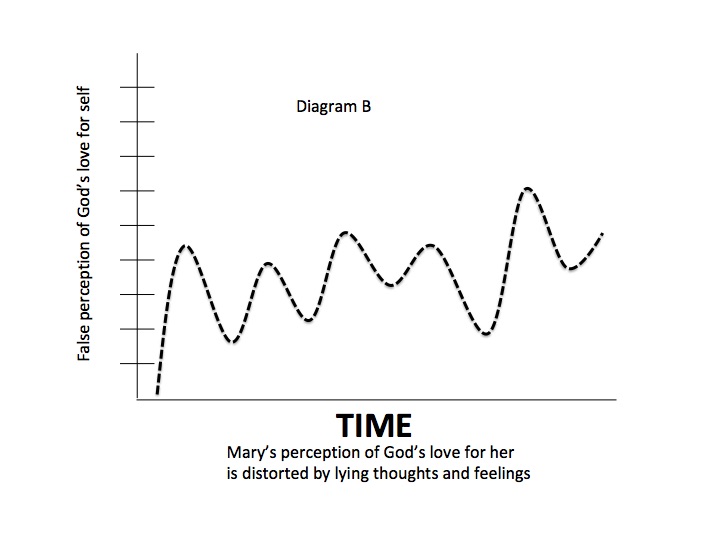
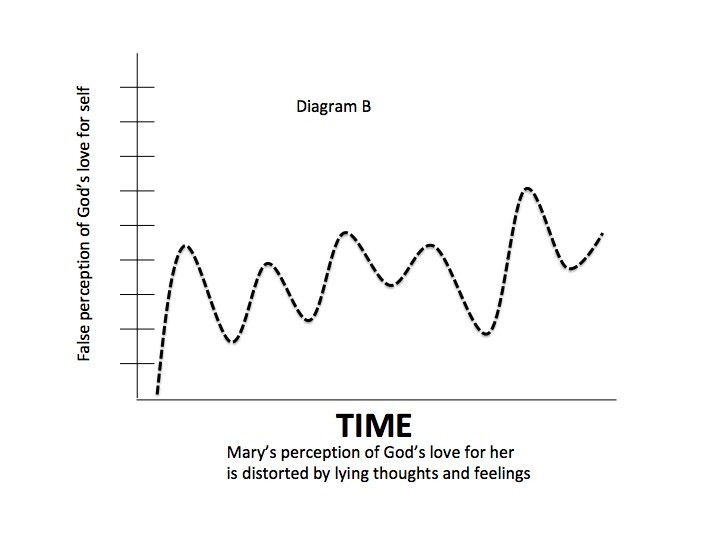
Example #2. Mary came from a hard-working, high-achieving, Christian family. She knew her parents loved her. But she also believed they loved her more when she did more good things. After all, if she performed well, they heaped on the praise. But if she did not live up to expectations, Mary’s father punished her. As a result, she grew up thinking that God loved her, but that He would love her more if she did good things and less if she did bad things. Put yourself in Mary’s shoes and imagine the stress of constantly trying to do more good things so that God would love you. Imagine the fear of sinning and somehow short-circuiting God’s love.

Now think about yourself for a moment. What might be a foundational lie you have believed about God’s love for you? How might lies imbedded in your early experiences have affected your ability to receive from God?

Each one of us has a “twisted love story.” I know; I am the Mary in the example above. That is how I was raised. Those were some of the lies I internalized.

Satan’s lies prevent us from accepting God’s care and compassion—from becoming who God created us to be. Our spirits are saved; we have eternal life. But accepting Christ does not automatically ensure that our souls—our mind, will and emotions—are in line with God and infused with His love. And because our souls are misguided, our bodies radiate that misconception to the world.

We break distorted images of God and self by opening ourselves to God and letting Him expose and replace the lies we have believed in our soul with truth. Then, out of that healing, God’s love will flow forth—through our body—as something we naturally share with others. It is a gradual process; the lies don’t get replaced all at once. Knowing God’s love allows us to trust Him in deeper ways … so He can wash away more of our deceptions … so we can know more of His love. In this way, the healing, love-growing cycle continues.

Even when our thoughts and feelings prevent us from accepting it, God surrounds us with His love. He wants our mind (thoughts), will and emotions (feelings) to be filled with truth. As we come to know and believe more of His constant, unconditional love, renewed thoughts and feelings will follow.

Let’s revisit John—the one who felt rejected. Distorted thoughts and feelings in his soul caused him to falsely believe, “You are unwanted.” “You are not valuable.” “You are unlovable.” And so, John came to think of God’s love for him as consistent with the lies about love already established in mind. John perceived God’s love for him as shown by the dotted line in Diagram A—as close to zero.

But in truth, God’s love for John is higher than the highest height. It is infinite in magnitude and stretches on into eternity.

In my case, distorted thoughts and feelings in my soul caused me to falsely believe, “God will love me if I obey Him. But when I sin, He won’t.” I perceived God’s love for me as shown by the dotted line in Diagram B—as bouncing wildly up and down depending on the good or bad I judged myself to have done.

But God’s love for us can’t be reduced to a graph. It is vast beyond all measure.

What does your dotted line look like? In what ways are the thoughts and feelings in your soul lying to you about God’s love for you? What is your “twisted love story”?

Contrast your dotted line with God’s actual love for you—constant and unchanging … stretching out infinitely in all directions into eternity.

Paul’s prayer assures us that God “is able to do exceedingly abundantly above all that we ask or think, according to the power that works in us.” With the understanding God is able to do more than we can even imagine, let’s take a look at “the width and length and depth and height” of His love for us.

Width—God’s love for us stretches out in infinite width. “As far as the east is from the west, so far has He removed our transgressions from us” (Psalm 103:12). Can you think of a better way to describe endless width? East and west never meet. The width of God’s love is seen in Jesus’ arms stretched out horizontally on the cross—one to the thief on the left and the other to the thief on His right. People of all religions as well as those of no particular religious persuasion, each and everyone, He longs to gather in His wide-open arms.

Length—God’s love stretches the length of our entire existence—from beginning on into eternal life. God didn’t start loving you on the day you accepted Christ. He didn’t start loving you on the day you were born or the day you were conceived. Ephesians 1:4 says, “He chose us in Him before the foundation of the world, that we should be holy and without blame before Him in love.” God loved you from the beginning and He will continue to love you on into eternity.

Depth—Jesus’ love reaches to the lowest hell. Isaiah 53:8–9 tells us, “He was cut off from the land of the living; for the transgressions of My people He was stricken. And they made His grave with the wicked.” The Psalmist says, “If I make my bed in hell, behold, You are there” (Psalm 139:8). On the cross, Jesus took our place as sinners deserving of eternal damnation; that is the depth of Jesus’ love for us. Nothing—absolutely nothing—you have ever done or can ever do will stop God from reaching to the lowest depths for you.

Height—Love carries us from the depth of hell to the height of heaven. On the cross an exchange took place … and it wasn’t a fair trade. Jesus took our sin upon Himself and gave us His righteousness. When God the Father looks upon us, He doesn’t see our sin; He sees the righteousness of Christ. Paul tells us, “But God, who is rich in mercy because of His great love with which He loved us … made us alive together with Christ … and raised us up together, and made us sit together in the heavenly places in Christ Jesus” (Ephesians 2:4–6). God delights in you. He has raised you up to the height of heaven to sit with Jesus.

God will always love us with His vast, personal love. He doesn’t change. But our belief in Him changes us.

Paul’s prayer reflects God’s desire for you. Jesus is longing that you—you who are reading or hearing these words—come to know that you are cherished with a love beyond measure.

Perhaps you have already processed in your mind a lot of this information. You’ve seen the graphs. You’ve heard the Scriptures. But maybe, if you are honest with yourself, something is keeping God’s love from being real in your life.

So … just sit quietly for a few minutes and let yourself receive. Meditate on the words “rooted and grounded in love.” Imagine yourself as a young tree. You are withered and dying because you have believed yourself unlovable in some way. But now you are being transplanted into the rich soil of God’s perfect love. Your roots stretch down into the cool, refreshing earth and drink deep of life-giving water and nourishment. Your branches spread wide as your leaves soak up life-supplying air and sun. You are being “filled with all the fullness of God.” You are receiving God’s love and flourishing in new life.

37109 Amazing God! Amazing Love!

The Bible tells us that “God is love” (1 John 4:8, 16). It does not just say that “God loves” or that “God is loving.” It says, “God is love.” Because God’s very essence is love, we can know God’s love for us only to the extent that we know God as he really is.

God is all His attributes expressed together in one glorious display. All God’s attributes are in perfect agreement and alignment with the others. When we see God as He really is, we see a true picture of His love.

Much as colors blend together and offset each other in natural beauty, God’s attributes mix together and highlight each other to give us a true and vivid display of who He is. In nature, we see the sparkling blue-gold of moving water, tinted with the golden-orange of the sunset as they highlight the reds and browns of the rocks in the stream bed. With God we see wrath and justice, offset with grace and mercy, balanced together with truth and holiness. And in seeing these attributes together, we see God as He really is—full of love for us.

If God’s nature could be summed up in one word it would be “Love.”

We often think that love is nice and kind. We may see it as even-tempered, not wanting to offend, accepting, and non-judgmental. But God’s love is not reduced to tolerant, mushy weakness. In God’s attributes, we see a vast, fierce, and uncompromising, personal, gentle, and unconditional love.

The All-Power of God

God possesses the power to do whatever He chooses. Jeremiah 32:17 says, “Ah, LORD God! Behold, You have made the heavens and the earth by Your great power and outstretched arm. There is nothing too hard for You.”

Because God is love, He uses His power to rule the earth with kindness and compassion. His power demonstrates His love. We see His power in the majesty of mountains, the vastness of seas … in the eternal life He freely gives. Second Peter 1:3 tells us, “His divine power has given to us all things that pertain to life and godliness.”

God is the only One who can limit His power. He limits His power by abiding by the laws He established to govern His kingdom in love. God limits His power by giving us free will. He could have made us like robots—beings who were obedient to His every command. But He chose instead to limit His power and give us free choice. Love, by definition, cannot be forced. You can’t force someone to love you, neither can God. God loves you, and He limits His power so you can of your own free will choose to Him in return.

The All-Knowing of God

God understands the intricate workings of creation as only the Creator can. Psalm 147:5 says, “Great is our Lord, and mighty in power; His understanding is infinite.” Job describes God as being “perfect in knowledge” (Job 37:16).

God knows you. He knows how you developed in your mother’s womb. He knows when you lie down and when you stand up. Every hair on your head is numbered. He knows your heart and your desires. In 1 John 3:20, we read, “God is greater than our heart, and knows all things.” Even though He knows your sins, anxieties, worries, and shortcomings, He loves you.

God is all-knowing, but at the same time, He gives us free will concerning how much we know Him and how much He, in turn, can share Himself with us. Despite His desire to know you, He will not force Himself upon you. Patiently, eagerly He waits for you to share yourself with Him. In Psalm 139:23 David invited God to know him by praying, “Search me, O God, and know my heart; Try me, and know my anxieties.”

The Sovereignty of God

God in His sovereignty is King of Kings and Lord of Lords. As the supreme authority, He is free to do as He pleases. Absolute right to govern His creation, according to His own good pleasure, belongs to Him. First Chronicles 29:11 says, “Yours, O LORD, is the greatness, the power and the glory, the victory and the majesty; for all that is in heaven and in earth is Yours; Yours is the kingdom, O LORD, and You are exalted as head over all.”

Because God is love, He expresses His sovereignty by ruling according to what is supremely good for His creation—according to what is supremely good for you. Although it may not seem to be what is best at the time, in His sovereignty God causes “all things [to] work together for good to those who love God” (Romans 8:28).

In any area of your life, you can choose to reject God’s sovereignty, but that does not make Him any less sovereign. Similarly, you can choose to reject His love, but that does not make Him love you any less. It only means that you have chosen to separate yourself from who He really is.

The Holiness and Righteousness of God

God in His holiness is perfect in purity. He is light without any darkness at all. His very essence is completely and wholly good. Around His throne in heaven creatures proclaim, “Holy, holy, holy, Lord God Almighty, who was and is and is to come!” (Revelation 4:8).

In His holiness, God is completely separated from sin. Yet, the Son of God put aside God’s holiness and became sin for us. As Jesus hung on the cross, tortured and despised by those He had become sin for, the holy Father turned His face away. He could not look upon the sin His Son had become. God separated from God. There could be no greater anguish. Oh, what sacrificial love holy God showed to us when He became sin for us.

Because of God’s holiness, He can only do what is right. God’s righteousness is His holiness expressed in action. Deuteronomy 32:4 says, “He is the Rock, His work is perfect … righteous and upright is He.” God expresses His holiness to us humans by dealing righteously with us. His thoughts and actions toward us are perfectly pure and holy. Everything He thinks toward us, does for us, or allows to happen to us is based on what is eternally best for us.

The Faithfulness and Truthfulness of God

God’s faithfulness means that He will always do what He says He will do. All His promises will come to pass. Psalm 119:90 says, “Your faithfulness endures to all generations.”

God is true to His word. He is honest and cannot lie. If God were not truthful, He could not be faithful. Faithfulness and truthfulness go together. In Revelation 19:11, God is called “Faithful and True.”

Without God’s faithfulness and truthfulness, it would be impossible to trust Him and know that He loves you. Without faithfulness and truthfulness, love could not exist.

The Justice and Wrath of God

God is a God of justice. He will judge between right and wrong. He will administer justice perfectly; He is completely unbiased and fair in all His judgments. Romans 11:33 tells us, “Oh, the depths of the riches both of the wisdom and knowledge of God! How unsearchable are His judgments and His ways past finding out.”

God’s wrath is His anger toward sin. Because God is love, He is fiercely protective of His children. Sin hurts us and will be judged and punished with the full fury of His wrath. In Romans 1:18 we read, “For the wrath of God is revealed from heaven against all ungodliness and unrighteousness of men, who suppress the truth in unrighteousness.”

God’s wrath is in perfect accord with His other attributes. Yet, He does not want us to experience it. When we accept Christ, we accept the sacrifice Jesus made on our behalf and God’s wrath passes over us. First Thessalonians 5:9 says, “For God did not appoint us to wrath, but to obtain salvation through our Lord Jesus Christ.”

The Mercy and Grace of God

God shows us mercy by not giving us what we deserve. When we become part of His family, He extends mercy to us by withholding the penalty for our sin. Ephesians 2:4–5 says, “But God, who is rich in mercy, because of His great love with which He loved us, even when we were dead in trespasses, made us alive together with Christ (by grace you have been saved).”

Grace is closely tied to mercy. God, in His mercy, withholds the judgment and wrath we deserve; God, in His grace, gives us good things that we do not deserve. In His grace, God freely gives us the air we breathe, the beauty of a sunset, the caring of family … eternal life. The story of the Lost Son in Luke Chapter 15 gives a beautiful picture of God’s mercy and grace.

It is easy to see how mercy and grace are components of God’s love. Because of His mercy, there is no condemnation for those who are in Christ. Instead, because of His grace, He gives us full life—in His love.

The Unity of God

God is a God of unity. He is perfectly One. There is no division or disagreement within or between Father, Son, and Holy Spirit. God is never at odds or conflicted with Himself; all His attributes agree and complement each other. Deuteronomy 6:4 says, “The LORD our God, the LORD is one!”

Unity and relationship are at the core of God’s nature. God made us to be one with Him so no separation exists between us. He shares Himself with us … so that we can be in unity with Him … so that we can live in His love. In John 17:23 Jesus prayed to His Father: “I in them, and You in Me; that they may be made perfect in one, and that the world may know that You have sent Me, and have loved them as You have loved Me.”

God’s love keeps us in unity with Him and binds us together with our brothers and sisters—making us one, united family of God. Colossians 3:14 says, “But above all these things put on love, which is the bond of perfection.”

The Unchanging of God

God does not change. His nature is absolutely fixed. The attributes He possessed before the foundation of the world are the same attributes He possesses today … and the same ones He will possess tomorrow. His essence cannot change. Malachi 3:6 reminds us, “For I am the LORD, I do not change.”

God’s nature does not change. However, the way He relates to His people can and does change. Under the Old Covenant, God could not express Himself fully to humanity because our sin stood in the way. But, in the New Covenant, Jesus took our sin and the wrath of God upon Himself. Jesus showed us God’s hands, not as clenched, angry fists, but as open, nail-pierced palms.

In the New Covenant, God revealed Himself as the God of Love.

Amazing God! Amazing Love!

37110 God’s Heavenly Love

As Described by those with Near Death Experiences

God fills heaven with His love. People with near-death experiences who have died and gone to heaven and then returned to life on earth report that heaven is radiant with love. Their stories lend powerful and consistent support to the truth of God’s love we know from Scripture.

Regardless of age, economic background or culture, people who have gone to heaven describe it as being filled with a pure and absolute love fuller and more complete than anything they have ever known on earth.

How does one share with others a love that defies earthly experience? How does one describe a love greater than words can tell?

In the following excerpts, six people with near-death experiences do their best to articulate a love that far surpasses human experience and vocabulary.

Richard Sigmund, a traveling evangelist, was involved in a traffic accident in Oklahoma. Eight hours after being declared dead, he returned to his body. In his book, My Time in Heaven, Richard says:

He [Jesus] was talking to some people gathered around Him, and He was telling them how much He loved them. I could do nothing but stand speechless. Until you have heard the Master speak and express His love for us, you cannot completely understand why I was unable to speak. The meaning that we humans give to love pales in comparison with the purity, the depth, and the true meaning of what His love is like….

Then, Jesus put His arm around my shoulders and hugged me to Himself, and I wept uncontrollably. I was engulfed in a torrent, a flood of the greatest love and most absolute acceptance that I have ever known.1

Howard Storm, a college art professor, was leading a tour with his students. While in Paris he developed a perforation in his stomach area and died before doctors where able to operate. Howard tells about his experience in My Descent into Death:

He was more loving than one can begin to imagine or describe…. This person of blinding glory loved me with overwhelming power. After what I had been through, to be completely known, accepted, and intensely loved by this beautiful God/man of light surpassed anything I had ever known or could possibly have imagined. I had cried out to Jesus and he came to rescue me…. He held me and caressed me like a mother with her baby, like a father with his long-lost prodigal son….

It is not possible to articulate what occurred. Simply, I knew that God loved me, that God loved creation, that God is love.2

Mary Neal, an orthopedic surgeon, drowned while kayaking in Chile. After being dragged from the river, she was resuscitated. Later Mary wrote about her experiences in a book entitled, To Heaven and Back:

My arrival was joyously celebrated and a feeling of absolute love was palpable as these spiritual beings and I hugged, danced, and greeted each other. The intensity, depth, and purity of these feelings and sensations were far greater than I could ever describe with words and far greater than anything I have experienced on earth…. It was a though I was experiencing an explosion of love and joy in their absolute, unadulterated essence….

I felt my soul being pulled toward the entry and, as I approached, I physically absorbed its radiance and felt the pure, complete, and utterly unconditional absolute love…. It was the most beautiful and alluring thing I had ever seen or experienced.3

Crystal McVea, a schoolteacher and mother of four young children, died in the hospital while recovering from surgery. Because of a difficult childhood, in which she was repeatedly abused beginning at age three, Crystal struggled with her belief in God’s love for her. In her book, Walking up in Heaven, she describes an experience she had there:

Every time she [a little, three-year-old girl] laughed, my spirit absolutely swelled with love and pride for her. I wanted to watch this little girl play for the rest of eternity. I wanted to run up to her and take her in my arms and tell her how much I loved her. The love just kept building, endless and radiating waves of love so deep and so intense and so unstopping…. I knew I couldn’t possibly contain all the love I felt for this child.

And then God lifted this feeling from me.

It was almost as if I had been wearing some kind of magic glasses that suddenly He took off of me … I looked back at the child and immediately understood … the little girl …  was me.

And then another understanding passed between God and me, and I knew this is what He’d been trying to show me all my life. He’d been trying to show me how very much He loved me.4

Eben Alexander, a neurosurgeon, became ill with bacterial meningitis. For seven days he was in a coma during which time his brain completely shut down. Eben tells his story in Proof of Heaven:

It was something higher, holding all those other kinds of love within itself while at the same time being more genuine and pure than all of them….

To take one more shot at putting it into words (because of course it was initially delivered wordlessly), it would run something like this:

You are loved and cherished.

You have nothing to fear.

There is nothing you can do wrong.

If I had to boil this entire message down to one sentence, it would run this way:

You are loved….

Love is, without a doubt, the basis of everything.5

Ian McComack, a 20-year-old, was stung five times by a school of deadly box jellyfish off an Island in the Indian Ocean. As recorded in Imagine Heaven, Ian shares his experience:

My first thought was that this light was going to cast me back into the pit, but to my amazement a wave of pure unconditional love flowed over me. It was the last thing I expected. Instead of judgment I was being washed with pure love. Pure, unadulterated, clean, uninhibited, undeserved love. It began to fill me up from the inside out …

I found myself beginning to weep uncontrollably as the love became stronger and stronger. It was so clean and pure, no strings attached…. This love was healing my heart and I began to understand that there is incredible hope for humankind in this love.6

God’s love is so absolute, fulfilling and complete that those who have been to heaven do not wish to return. But they do come back … to be with loved ones and to share with us. They return to tell us of their experiences so that we will more deeply know of God’s great love for us.

Through their words we hear God saying, “I love you!”

  • It is not possible to articulate what occurred. Simply, I knew that God loved me, that God loved creation, that God is love.2
  • The meaning that we humans give to love pales in comparison with the purity, the depth and the true meaning of what His love is like.1
  • He [Jesus] held me and caressed me like a mother with her baby, like a father with his long-lost prodigal son.2
  • I physically absorbed its radiance and felt pure, complete, and utterly unconditional absolute love.3
  • I was engulfed in a torrent, a flood of the greatest love and most absolute acceptance that I have ever known.1
  • The love just kept building, endlessly and radiating waves of love so deep and so intense and so unstopping.6
  • I was being washed with pure love. Pure, unadulterated, clean, uninhibited, undeserved love.6
  • This love was healing my heart and I began to understand there is incredible hope for humankind in this love.6
  • This is what He’d been trying to show me all my life. He’d been trying to show me how very much He loved me.4

Endnotes

37111 Suffering and God’s Love

None of us like suffering. When violence or famine strikes a country, when fires, hurricanes or drought threaten our communities, when a loved one is in a serious accident, when a child is born with a disability, when we are sick, something deep within us cries, “No!” And we may wonder, “God, if you really love us, why don’t you stop this suffering?”

The truth is, we all have trials and, in this life, we will continue to have more. Why is this? Let’s take a closer look at this common-to-all, uncomfortable subject of suffering.

The kingdom of God is not like the kingdom of this world; it is an upside-down kingdom. In the kingdom of heaven, the first shall be last and the last shall be first. The meek inherit the earth. Understanding is hidden from the wise and learned and revealed to little children. And suffering is valued because God works it for the eternal good of those who love Him.

Scripture tells us, “Rejoice that you participate in the sufferings of Christ” (1 Peter 4:13). “Count it all joy when you fall into various trials” (James 1:2). Great good is hidden in suffering; God weaves suffering, love and glory together in inseparable ways.

I understood none of this when personal suffering came my way years ago. I was 32 when, over a period of a few weeks, my eyes quit working together and I became dizzy and unable to walk in a straight line.

One memorable night, after a long day of seeing doctors, as I lay in an MRI machine confused and scared, Romans 8:28 kept going through my head: “All things work together for good to those who love God, to those who are called according to His purpose.”

“I am going to be okay,” I told myself. “God is going to work this out for good. I’ll be able to take care of our four children. I’ll continue working at the university helping malnourished kids around the world. And when our children are older our whole family will go overseas and start Christian orphanages just as we’ve planned.”

But my idea of “good” never happened. The next day I was diagnosed with multiple sclerosis—a disabling, progressive neurological disease that affects the central nervous system and often results in death.

I gave up my job at the university. My sister and her family moved from 2,000 miles away to help out. Depressed and so, so tired and weak, I spent my days on the couch unable even to take care of our children. Pain. Anguish. Confusion. “God, why am I suffering? You could stop this illness; I know You could. So, what are You doing? How is this supposed to work for good? God, I don’t understand; You are a loving and caring God, so why all this suffering?”

How we answer these types of questions tells a great deal about who God is to us. Who we let God be to us in difficult times—how we live out the answers to the why of suffering—determines the effect suffering has on our lives and becomes the testimony we pass on to others.

So, let’s look at a two of the most common questions asked about suffering.

Why is there suffering in the world?

The first answer to that question is, we suffer because we live in a fallen world. And we live in a fallen world because Satan works his evil through the free will God gave Adam.

In the Garden of Eden, God created man in His image. He said, “Let us make man in Our image, according to Our likeness” (Genesis 1:26). An essential, foundational part of being made in God’s image that we have the ability to give and receive love. And the ability to give and receive love requires that we inherently have free choice to offer or withhold that love.

God could have created us as robots to do exactly as He says and never make mistakes. But He didn’t do that. He didn’t do that because you can’t love a robot. And a robot can’t love you. You can’t make someone love you. Neither can someone make you love them. You get to choose who you want to love. If you don’t want to let someone (including God) love you, you have the freedom to reject their love. An intrinsic part of God’s love is free choice. And free choice really means free choice. God will work with us to help us make right choices; He wants our wills to be conformed to His desires for us. But He will not block us from making wrong choices—with widespread, hurtful, suffering-producing consequences.

Humans have made a horrible mess of the earth by choosing their own will over God’s. Satan works through the will of broken humanity to bring suffering, pain, death and destruction to earth. Adolph Hitler, Joseph Stalin and Edi Amine are names we associate with terrible suffering. Yet, even though God knew of the wars, genocides, famines—all the horrors and sufferings to follow—He took the risk and gave us free will.

Love is that valuable—that precious—to God. “God is love” (1 John 4:8, 16). He doesn’t just have love; He is love. God is a lover. Therefore, in order for us to know God and accept Him for who He is—full of love for us—He had to give us free choice.

What “good” purpose does suffering serve?

To answer this question let’s consider four separate, but interwoven threads.

Thread One: In a world without affliction, God would not have been able to demonstrate His love for us.

Love is measured by the sacrifice it willingly makes for another. Without suffering, there would be no sacrifice. All the persecutions, sufferings and trials that Satan poured out to defile Jesus, God used to show His perfect love.

Jesus did not come to earth riding in a diamond-studded chariot, blowing love-kisses to a cheering humanity. He left His perfect heavenly home and came as a helpless baby born in an animal shed. To escape Herod’s deadly rampage, His family fled to Egypt. Jesus was tempted by Satan, misunderstood and falsely accused. He was betrayed and abandoned, whipped and cursed and nailed to a cross between two thieves.

Jesus said, “Greater love has no one than this, than to lay down one’s life for his friends” (John 15:13). God’s “greater love” was demonstrated against the backdrop of pain, suffering and death. Without that backdrop, we can’t see the full, grand display of God’s love. The “greater love” of Jesus was manifest in His perfect obedience in suffering.

Thread Two: God uses trials to give us opportunities to grow in our dependence on Him.

Paul gives us a beautiful example of this principle when he writes, “A thorn in the flesh was given to me, a messenger of Satan to buffet me, lest I be exalted above measure. Concerning this thing I pleaded with the Lord three times that it might separate from me. And He said to me, ‘My grace is sufficient for you, for My strength is made perfect in weakness.’ Therefore most gladly I will rather boast in my infirmities, that the power of Christ may rest upon me. Therefore I take pleasure in infirmities, in reproaches, in needs, in persecutions, in distresses, for Christ’s sake. For when I am weak, then am I strong” (2 Corinthians 12:7-10).

Paul prayed fervently for his “thorn” to be removed. But when God did not answer as Paul requested, the Apostle did not become disheartened or bitter. Rather, he came to realize that the eternal good God intended far outweighed the fleeting, earthly affliction of the thorn itself. In his weakness Paul learned greater dependence upon God.

In my life, my multiple sclerosis gave me the push I needed to surrender to God and let His definition of “good” replace my own. As the months of suffering turned into years, I gradually came to desire God—not for healing so I could get back to my own version of “good”—but for who He really is.

I had been a Christian since I was 16, but as the disease lingered and intensified, a desperate longing to know God grew within me. I craved to know God like someone dying of thirst in the desert would crave a drink of water. The desire for God didn’t make sense to my rational mind. I thought I knew God. But I couldn’t deny my desperate longing.

One night I went to a meeting at church and afterward felt that I should go to the front. “What do you want?” the preacher asked me. “I just want God,” I sobbed. “Lift up your hands and say ‘I surrender all,’” he said.

I did … and God poured His love out on me. In a cascade of tiny, white lights, I felt His love poured down on me from the center of the cross. I fell backward and lay there. I couldn’t move. I couldn’t speak. God’s love just kept coming in wave after wave of sparkling lights flooding into my heart. When I got up off the floor a few hours later, I wasn’t healed, but I was changed. Something in me was set right. God’s love was the foundation of the good He had planned for me in suffering.

That marked the start of me opening myself to more and more of His transforming love. On that night in 1995, when the concept of websites was in its infancy, Forever-Loved.org had its inception.

God knows what He is doing and He doesn’t make mistakes. He has a plan. We do not know the details of His plan in advance and we may never even see His plan beginning to unfold.

Often in this world, we like to acknowledge those who have come through trials and received some earthly assurance that helped them see God’s goodness in a tangible way. We like stories with happy endings to hardships. We like the story of Sarah who, after enduring years of barrenness, grief and ridicule, gave birth to Isaac. Joseph was sold into slavery by his jealous brothers and spent years wrongly imprisoned in Egypt. But he was released, elevated to the position of second in command to Pharaoh and used to save Egypt and the Israelite nation from famine.  Upon seeing his brothers when he was in a position of power, Joseph said, “Do not … be grieved or angry with yourselves because you sold me here; for God sent me before you to preserve life” (Genesis 44:5). We too rejoice over seeing God’s hand move in this way.

Yet, God is just as pleased with those who do not receive any kind of earthly assurance that their suffering has been of value. In the great faith chapter of Hebrews 11, we are told, “Others were tortured, not accepting deliverance, that they might obtain a better resurrection Still others had trial of mockings and scourgings … chains and imprisonment. They were stoned, they were sawn in two, were tempted, were slain with the sword…. And all these having obtained a good testimony through faith, did not receive the promise” (vv. 35–39). God is looking for people who endure the hardships He allows and stand firm.

God’s ends always result in gain rather than loss, but God’s means often result in loss rather than gain. God’s ends are measured in the eternal, spiritual commodities of heaven—like peace, joy, love and glory. But the means God uses include the fleeting, physical commodities of earth—such as health, wealth and prosperity. Beware of any “gospel” that teaches otherwise. Watch out for those who resist accepting anything but earthly benefits.

Thread Three: God uses suffering to mold us into the image of His Son.

In persecutions and afflictions, Jesus’ obedience to His Father was purified like gold in a furnace. Scripture says of our loving Savior, “Though He was a Son, yet He learned obedience by the things which He suffered” (Hebrews 5:8). Imagine the Son of God having to learn obedience. And He learned it in suffering.

What is true for Jesus is also true for us. The trials and tribulations we face are meant to mold us into the people God created us to be.

The word tribulation comes from the Greek word tribulum. A tribulum was a heavy wooden structure with iron spikes protruding from its underside. At harvest time, the oxen pulled the tribulum over the sheaves of grain on the threshing floor to separate the wheat from the chaff. God uses tribulation and affliction to perfect His nature in us.

Our heavenly Father uses the sufferings of this imperfect world to purify us so we live out His will on earth and grow increasingly to be like His Son. Scripture repeats this for us over and over.  Romans 8:28, the same verse that kept coming back to me as I lay in the MRI machine, is followed by verses that tell of God’s purpose in our suffering.

“All things work together for good to those who love God, to those who are the called according to His purpose. For whom He foreknew, He also predestined to be conformed to the image of His Son, that He might be the firstborn among many brethren. Moreover whom He predestines, these He also called; whom He called, these He also justified; and whom He justified, these He also glorified” (Romans 8:28–30).

When we love God, He uses all things to mold us into the image of His Son. God uses suffering to get us to the point where He can share His glory with us.

To glorify something means to attribute true and proper value to that something. When we glorify God, we attribute to Him all the honor He deserves as all-loving, all-powerful Creator of the universe. And when God glorifies us, He attributes to us our true worth and value in His eyes.

God uses suffering to work His nature into us. As we come to rely on Him and know His love and care for us in deeper and deeper ways, we come to surrender our version of “good” to Him. We let go of our will and way and embrace His will and way. And as we do this, we become more and more like Him—partakers of His divine nature and radiant with His glory.

Romans 8:17–18 says, “If indeed we suffer with Him … we may also be glorified together. For I consider that the sufferings of this present time are not worthy to be compared with the glory which shall be revealed in us

His glory will be revealed in us when we choose to suffer—not alone—but with Him! God’s purpose in suffering is to share His glory with us—to mold us into the image of His Son.

It doesn’t matter if we are suffering on the mission field, in a secular job, as a stay-at-home parent, as a student … Suffering, whenever it occurs in our lives—whether it is because of our sin or because of our witness for Christ—is beneficial when endured with Him. For those of us living “ordinary” lives, we may be tempted to think that our suffering doesn’t count because we are not “missionaries,” but that is not true. We are His witnesses, wherever we go.

Since that time in the MRI machine, ongoing trials have compelled me to surrender to God—over and over again. I can look back on each one of those past afflictions and see God at work. I can praise God for the trials … of the past.

But there is a great current trial that involves my precious grandsons. In the midst of this ongoing difficulty, I find it hard to trust God. Innocent children are suffering. I am confused and cannot see how God could possibly work this for good. I do not know what to do—except love all those involved with God’s love—which I seem to repeatedly fail to do. Answers, like those just presented, help, but don’t stop the pain.

And so, I need you. I need the body of Christ to listen, to comfort, to pray, to encourage me to keep looking to Jesus. Which brings us to our next thread.

Thread Four: Suffering unites the body of Christ.

In trials we get the privilege of coming along side and bearing each other’s burdens. Suffering creates need. Need creates opportunity for giving. Giving is the channel through which the love of God flows. And God’s love binds the body of Christ together so that we become one with each other and with Him.

Suffering strengthens the worldwide body of Christ. As we pray for those in California affected by fire, as we open our arms to those fleeing civil war in Syria or Central America, when we send money to help orphaned children in Malawi or leprosy victims in India, when we stop and consider the heartfelt needs of others in our families and communities, we are sharing Christ’s love and helping to unite the body of Christ.

Do Not Lose Heart

In suffering we learn of God’s goodness, are conformed to His image, grow in His glory and are knit together in His love. And so I remind myself as I encourage you: No matter the suffering, keep trusting God. Let Him hold you in His arms. Let Him work His good into your life and out through your life to others.

Trusting that God’s purposes and plans are being worked out through our losses and trials frees us from bitterness, blame and anger. It allows us to forgive others and worship God for who His is. How we live our life in suffering is powerful testimony to the God we serve. In the midst of his trials Job cried out, “Though He slay me, yet will I praise Him” (Job 13:15). Those words echo down to us today encouraging us that, even when we do not understand, we trust our loving Lord.

A pastor friend told me of a recent experience he had in an African nation. To get to one of the meetings, a group of church leaders from that country walked all day barefoot though mud and potholes. Yet there was no bitterness, despair, frustration, anger or hint of jealousy. Outside the meeting center they each cleaned up and put on the pair of shoes carried. Then with smiling, eager faces, they entered the meeting.

When they began praying, not one of these leaders asked for a motorcycle, money for bus fare or even a second pair of shoes. Not one of them asked for a better house or for ample food for their families. Their prayers weren’t focused on relieving their own needs or fixing their country’s economic or political problems. Their prayers were focused on God’s highest and best. On bent knees, with faces on the floor and tear-stained cheeks, these leaders prayed simultaneously from around the room: “Lord we have sinned.” “We repent for the sins of our nation.” “Come and heal our land.” “Make our hearts ready.” “Give us eyes to see.” “God, visit us.” “Jesus have mercy.” And the room was alive with the presence of God.

Suffering sets the stage for faith and faith sets the stage for God to work His good. In our tribulations, let us hold fast to the promises of God and not lose hope. He loves us and has our best interests—and the best interests of our families, communities … and all of humanity—at heart. Paul in his afflictions encourages us, “Therefore we do not lose heart. Though outwardly we are wasting away, yet inwardly we are being renewed day by day. For our light and momentary troubles are achieving for us an eternal weight of glory that far outweighs them all” (2 Corinthians 4:16–17, NIV).

37112 Sin and God’s Love

Have you ever felt trapped in sin—like there seemed to be no way out? Have you done something so terrible you think God can never forgive you or love you? Do you sometimes feel like you are irreparably bad and that change is impossible?

I once felt and thought this way, but now I understand differently. Take courage, there is hope!

Sin is a reality in all of our lives. Romans 3:23 says, “All have sinned and fall short of the glory of God.” In the story of Bathsheba, David, “a man after [God’s] own heart” (1 Samuel 13:14) and God’s anointed king of Israel, fell into sin (see 2 Samuel 11). He coveted another man’s wife, committed adultery, plotted that the husband be killed and then lied to cover up the whole mess.

I can relate to David. The sin of adultery is one I also committed. I too had an affair.

Since that time, I’ve had 20 years to better understand a few things about sin and God’s life-changing love. I want to share those things with you—so that you can more quickly come to a place of repentance, restoration and transformation—in the arms of our loving Father.

The Bible clearly tells us that Jesus—the Son of God—died on the cross for our sins. “God demonstrates His own love toward us, in that while we were still sinners, Christ died for us” (Romans 5:8). We in the church today understand that when we believe in Jesus, we are forgiven of all of our past sins.

But this article is not about the forgiveness of past sins; it is about being set free from future sins. It is about being set free from the propensity to sin. It is about dying to Adam’s old sin nature and taking on the new nature of Christ. Every single one of us—no matter how “good” our religious upbringing, group of friends or culture tells us we are—falls far short of the person God made us to be. Scripture encourages us to, “Put on the new man who is renewed in knowledge according to the image of Him who created him” (Colossians 3:10). Romans 12:2 says, “Do not be conformed to this world, but be transformed by the renewing of your mind, that you may prove what is that good and acceptable and perfect will of God.”

But how do we do that? How do we get to that place where our minds are renewed, where we put on the new man/woman God created us to be, where we are fashioned after the image of Christ? Is such a place even possible this side of heaven? What, at the core, is the cure for our sin problem?

First of all, let me mention a few things that are not the solution.

Three Approaches That Will Not Bring Transformation

#1: We will not be set free from our sin by increasing its negative consequences. In David’s time, both adultery and murder were sins punishable by death, but that didn’t stop him. Think about people in your own life. Maybe someone you knew continued to drink until their liver failed. Maybe a neighbor ended up in prison for life because of illegal financial dealings. Maybe a friend had an affair that ultimately led to the splintering of marriage and the disintegration of family. Clearly, dire consequences aren’t enough to hold sin in check.

#2: Transformation will not come about by changing God’s definition of sin or making excuses for it. Yet, we all have a tendency to edit God’s laws. We can’t live with our sin; it creates a horrible discord within us. We hear this anguish raging in David after his affair with Bathsheba and before he came to God in repentance. “When I kept silent, my bones grew old through my groaning all the day long. For day and night Your hand was heavy upon me; My vitality was turned into the drought of summer” (Psalm 32:3–4).

From 20 years ago, I remember that gut-wrenching discord in myself. The Holy Spirit was convicting, but I was resisting.

One wrong way to reduce this anguish is by changing the definition of sin so that it does not apply to us. Satan tries to distort our definition of sin. He calls evil, good, and good, evil. Satan could not stop Jesus’ atoning sacrifice for our sin, but he can stop us from receiving the benefits of that sacrifice by telling us we have no need for it. “You are okay. That isn’t sin,” he hisses in the same sly voice he used with Eve. “Did God really say …?”

Another way to reduce the anguish is by whitewashing our sinful behavior by making excuses for it. “My husband was too busy at work.” “My mom was my best friend and she was dying.” “I needed someone to listen to me.” But the blood of Jesus does not cleanse excuses. It cleanses sin confessed as sin.

Beware the trap of rewriting the 10 Commandments or any of God’s laws to accommodate sin. Sin is sin. Painting it as anything else is hurtful to the person caught in the sin because it hides the real need for repentance and restoration. By refusing to call sin “sin” we mask the need for God’s complete, unconditional love that covers the sin and brings transformation.

#3: The solution is not to become rule-focused like the Pharisees. We are not supposed to try and prevent sin from expressing itself in our lives by putting more and more rules on ourselves. God doesn’t want us to try and keep sin bottled up inside so that it cannot escape. The Pharisees lived such lives and Jesus called them, “whitewashed tombs” (Matthew 23:27). Think about those words. The Pharisees looked clean and proper on the outside, but inside death lay hidden.

Jesus said, “You Pharisees make the outside of the cup and dish clean, but your inward part is full of greed and wickedness …. Woe to you Pharisees! For you … pass by justice and the love of God” (Luke 11: 39, 42).

After the affair, I fell into the trap of cleaning myself up on the outside—while leaving the inside a mess. To keep the wrong behaviors from coming out of me, I slapped more rules on myself so the sin inside wouldn’t escape. “Keep your guard up.” “Never be alone with a man except your husband.” “Keep yourself so busy with other things that you don’t have time for it.” “Pray every morning that God will protect you.”

But good-intended rules can’t keep us from sin. That’s why God sent His Son! He intends that transformation come from the inside!

When I put more rules on myself, I put more rules on others too. After the affair, I became judgmental. I was on the look out for temptation and feared I would fall into it again. In fact, I become so sin conscious that I lost sight of Jesus.

At one point in his writing, Paul loses sight of Jesus in the mess of his sin. See Paul’s misplaced focus: “For what I am doing, I do not understand. For what I will to do, that I do not practice; but what I hate, that I do. If, then I do what I will not to do, I agree with the law that it is good. But now, it is no longer I who do it, but sin that dwells in me. For I know that in me (that is, in my flesh) nothing good dwells; for to will is present with me, but how to perform what is good I do not find. For the good that I will to do, I do not do; but the evil I will not to do, that I practice” (Romans 7:15–19). At the center of the word “sin” is the little word “I.”

But then Paul’s focus changes. He breaks free and writes: “O wretched man that I am! Who will deliver me from this body of death? I thank God—through Jesus Christ our Lord! … There is therefore now no condemnation to those who are in Christ Jesus” (7:24–8:1).

By the end of Romans 8, Paul, who had persecuted and killed Christians, writes: “For I am persuaded that neither death nor life, nor angels nor principalities nor powers, nor things present nor things to come, nor height nor depth, nor any other created thing, shall be able to separate us from the love of God which is in Christ Jesus our Lord” (vv. 38–39).

This gives us a clue to the solution!

We Set Our Eyes on Jesus and Trust in His Unfailing Love

God loves us and has our best interests at heart. Believing deep in the core of ourselves—knowing beyond doubt—that God loves us will allow us to lay our heart open before Him so He can clean us from the inside out. God will bring about transformation when we come to trust Him as really is—full of unfailing, unconditional love for us.

We see this transformation with David in Psalm 51. After Nathan came to him with the story of the poor man and his little lamb (see 2 Samuel, chapter 12), David saw his sin for what it was. Boldly then, he went to God and cried out, “Have mercy on me, O God, according to your unfailing love: according to your great compassion blot out my transgressions. Wash away all my iniquity and cleanse me from my sin” (Psalm 51:1–2, NIV). “Wash me, and I will be whiter than snow” (v. 8, NIV).

David was able to throw himself on God’s mercy because he knew God’s unfailing love. He trusted God to “blot out” his past sins and he trusted God to “cleanse” him from the sin nature—so that he could be “whiter than snow.”

After the affair, I didn’t do what David did. I saw my sin and prayed to God to forgive me, but I didn’t open myself to Him for deep cleansing … because I was afraid … because I didn’t think that God could possibly still love me.

For six years, I condemned myself. The Holy Spirit convicts; Satan condemns. I was listening to the wrong voice, but I didn’t know it.

I felt that God couldn’t possibly love me after what I had done. But He did love me and He does love me. Our sin doesn’t keep God from loving us. However, Satan uses our sin to keep us from believing in God’s life-changing love.

I fell into the trap of thinking that I needed to work hard and clean myself up before God could love me. So, I tried to fix my sin problem from the outside—by obeying more rules and putting on “good” behaviors to compensate for the bad. I built strong walls around my soul to hide my sin from the world.

But walls built for hiding sin and keeping the bad from coming out also keep God’s good from coming in.  With the walls firmly in place, I couldn’t receive God’s love for cleansing and transformation. And because I couldn’t receive God’s love, I couldn’t love myself or others. “We love because he first loved us” (1 John 4:19, NIV). And so, I became a hard, unyielding, self-righteous Pharisee Christian.

That was the condition I was in—still going to church, but unable to receive God’s love—when a wise, old, Christian friend told me, “Mary, you don’t love.”

The moment she said those words, I knew they were true. The first few verses of 1 Corinthians 13 flashed through my mind. “Though I speak with the tongues of men and of angels, but have not love, I have become sounding brass or a clanging cymbal. And though I have the gift of prophecy, and understand all mysteries and all knowledge, and though I have all faith, so that I could remove mountains, but have not love, I am nothing.”

With sudden, sickening clarity I realized I was just a loud, irritating noise-maker. All the “good” things I had been doing were worth nothing. I slumped onto the floor and prayed, “God whatever it takes, work your love into me.”

That was 14 years ago. Since then I have learned …

Experiencing Transformation

God loves me unconditionally and always. My bad behaviors don’t make Him love me less. My good behaviors don’t make Him love me more. He loved me before I became a Christian … before I was even born. He loves each one of us with infinite, unwavering love. His compassion extends to all. He loves Muslims, Christians, atheists, gays, straight-people, transsexuals, drug dealers, pastors, child molesters …. We simply can’t get our heads around God’s kind of love.

Human love is fickle. It gives up if pushed too far. It wants to be paid back. Human love sulks when it doesn’t get its way. It seeks to stop the sin before it will embrace the sinner. It often whitewashes sin, or calls it acceptable, before it will befriend a sinner. At other times, human love, for fear of being labeled intolerant, comforts the one trapped in sin while ignoring the underlying sin itself.

But God’s love is an unchanging reality. It is truth. God hates sin. He hates sin because it destroys the people He loves. God hates sin, but He loves each and every sinner. And as we embrace this truth, it begins to change us from the inside out.

As I began to understand more of the depths of God’s love for me, it gave me the courage to go to God and open my heart to Him. And I realized, the root of my sin was buried in my soul—in my mind, will and emotions. The wrong behaviors that expressed themselves out through my body came from wrong thoughts and feelings embedded deep in my soul. Proverbs 23:7 tells us, “As he thinks in his heart, so is he.”

But these wrong ways were so much a part of me—engraved in my soul—that I couldn’t see them for what they were. Only when I felt something wrong or uncomfortable (like lust or anxiety) or when I did some blatant sin, did I realize something inside wasn’t right. And so, these became indicators to me that deep inside I was in desperate need of God’s loving care and restoration. In this way I came to see sins and uncomfortable feelings as red flags my soul was waving in silent cries for healing: “Help! Something isn’t right in here. Set me free.”

Only God could dig out the false, hurtful thoughts and feelings that caused my sinful actions. And so my daily prayer became, “Search me, oh God, and know my heart; try me, and know my anxieties; and see if there is any wicked way in me, and lead me in the way everlasting” (Psalm 139:23–24). My short version of that prayer is: “Whatever it takes, God. Get the garbage out of me.”

And I found out that way down in the core of myself I did not really understand God’s love. Even though I knew my past sins were forgiven, I didn’t trust His love enough to realize that He really did have my best interests at heart. And because of that wrong thinking about God, I had run off to fix the sin in my own way and search for love in all the wrong places.

Today this journey of healing continues. God’s love is so much greater than I can even think or imagine. And as I learn to rest in that love, it is gradually washing out the wrong thinking and feelings in my soul. I am gradually coming to a position of no longer working to receive God’s love—and always falling short. More and more I am living in awareness that I am loved. Rather than working toward a place of feeling loved, I am living from a place of being loved.

Our hearts need love and we were designed to be continually connected to God. That love connection is the cure for our sin problem. Knowing God and abiding in His love cleanses us from sin from the inside out. God’s love forgives our past sins and sets us free from Adam’s old sin nature. When we abide in His love our minds are changed—our thoughts come into alignment with His—and we become the people He created us to be, fashioned after the image of Jesus.

God created us in His image: He said, “Let us make man in Our image, according to Our likeness” (Genesis 1:26). We were made by God to radiate His nature of love: “God is love” (1 John 4:8, 16). When we see and know the depth of His love—with all the walls (veils) surrounding our souls torn down—we shall be transformed into His image: “But we all, with unveiled face, beholding as in a mirror the glory of the Lord, are being transformed into the same image from glory to glory” (2 Corinthians 3:18).

We are changed—transformed—as we come to know God’s love for us. Jesus said, “A new commandment I give to you, that you love one another; as I have loved you, that you also love one another. By this all will know that you are My disciples, if you have love for one another” (John 13:34–35). The world will know we are followers of Jesus when we become loving even as He is loving.

John says, “And we have known and believed the love that God has for us. God is love, and he who abides in love abides in God, and God in him. Love has been perfected among us … because as He is, so are we in this world” (1 John 4:16–17). In knowing and believing God’s love, Jesus’s nature becomes ours; we become like Him “in this world.”

Paul prays, “That you, being rooted and grounded in love, may be able to comprehend with all the saints what is the width and length and depth and height—to know the love of Christ which passes knowledge; that you may be filled with all the fullness of God” (Ephesians 3:17–19). Knowing God’s love will fill us “with all the fullness of God.” That sounds like transformation to me!

There is a cure for our sin nature this side of heaven! God’s love will get us there. Our need for love and God’s love for us holds us, with magnetic attraction, in the abiding relationship in which we are transformed into His image. Just like with the forgiveness of past sins, our only part is to believe. Our only part is to know and trust in God as He really is—full of love for us.

32920 God’s Plan for You

God created you to have an eternal relationship with Him. You are significant because the Creator of the Universe custom designed you in His image.

Job explains,

You guided my conception and formed me in the womb. You clothed me with skin and flesh, and you knit my bones and sinews together. You gave me life and showed me your unfailing love. My life was preserved by your care. (Job 10:10-12, NLT)

You are not an accident! God created you in His image. You are very precious to Him.

The Bible tells us that He formed each of us individually in our mother’s wombs and that we are the work of His hands. What an amazing thought—how deeply we are known by the Creator of the universe! The Psalmist writes,

You made all the delicate, inner parts of my body and knit me together in my mother’s womb. Thank you for making me so wonderfully complex! Your workmanship is marvelous—how well I know it. You watched me as I was being formed in utter seclusion, as I was woven together in the dark of the womb. You saw me before I was born. Every day of my life was recorded in your book. Every moment was laid out before a single day had passed. Psalm 139:13-16 (NLT)

God has a wonderful plan for your life. That plan begins and ends with a love relationship with him. Your very existence now and forever revolves around him. Your growing, personal relationship with God is where your new life starts right here and now.

When you are with your good friend or your loved one, you enjoy just being with them. You also do things together. In the same way, in your ongoing relationship with God, you will enjoy just being with God, “gazing at the splendor of the Lord” (Psalm 27:4) at times, and you will be doing things together with him at other times.

God’s plan for you is, in part, uniquely yours. No one else in the universe can have it but you. Some aspects of his plan are more universal. For example, he would desire for you to be a worshiper.

“But a time is coming—and now is here—when the true worshipers will worship the Father in spirit and truth, for the Father seeks such people to be his worshipers. God is spirit, and the people who worship him must worship in spirit and truth.” – John 4:23-24

The Father seeks true worshipers who worship him in spirit and truth. In Revelation, worship is a recurring theme. Worship is for all eternity, and God desires for you and all saints to be true worshipers.

As you deepen your walk with God, you will discover God’s universal plan for his saints and his more personal plan for your life. He will reveal his plan to you as you are able to

It is important and sobering to note that some aspects of his plan for you are not automatic. You must be an active and obedient participant in his plan. Avoid the two extremes when it comes to seeing God’s plan for you become a reality. On the one end, you must not be passive, thinking that you have no active part to play in his plan. That’s a fatalistic attitude and dishonors God (Luke 19:11-27 gives a story with a man with a similar attitude toward the master). On the other end, you must not try to make God’s plan happen in your own strength. You cannot realize God’s plan in your own strength and efforts “because apart from me”, Jesus says, “you can accomplish nothing” (John 15:5). You must be an obedient “partner” in his plan and be filled (guided and empowered) by the Holy Spirit in order to see all that God has for you come to pass.

32292 El

El is an ancient Semitic word for deity. In English, it will be translated as “god.” El is not a name. It refers to a divine being. So, YHWH (Yahweh/Jehovah) is the name of the Jewish el (deity) whom we call God in English.

Elohim is technically the plural form of eloah, another word for “god” or divine being. So, elohim can be translated as gods as in Exodus 20:3. In the Old Testament, El, Eloah, and Elohim are all used to refer to YHWH. But the most common term is Elohim.

ELOHIM —God, the Great Creator and Powerful Authority.

In the beginning God [Elohim] created the heavens and the earth. (Genesis 1:1)

For the LORD your God [Elohim] is God of gods and Lord of lords, the great, mighty, and awesome God. (Deuteronomy 10:17)

EL ELYON —The Most High God.

The oracle of the one who hears the words of God,
and who knows the knowledge of the Most High [El Elyon],
who sees a vision from the Almighty. (Numbers 24:16)

EL OLAM —The Everlasting God.

Abraham planted a tamarisk tree in Beer Sheba. There he worshiped the LORD, the eternal God [El Olam]. (Genesis 21:33)

EL ROI —The God who sees.

So Hagar named the LORD who spoke to her, “You are the God who sees me [El Roi],” for she said, “Here I have seen one who sees me!” (Genesis 16:13)

EL SHADDAI —God Almighty.

When Abram was 99 years old, the LORD appeared to him and said, “I am the Sovereign God [El Shaddai]. Walk before me and be blameless. Then I will confirm my covenant between me and you, and I will give you a multitude of descendants.” (Genesis 17:1–2)

For an extensive study on spiritual beings as well as the names of God in the Bible, watch a video series, “Spiritual Being” by BibleProject.com.

32293 Names of Jesus

The following is a list of names by which Jesus is called in the New Testament. The list is not exhaustive. As you read the Bible, make your own list of the names and titles by which Jesus is called.

What do these names and titles mean to you and to the world?

Christ (Messiah)

Christ comes from the Greek word, christos. Messiah is a Hebrew word, Mashiach. Both mean “anointed one”. In the Old Testament, God instructed to anoint with oil those who are chosen by God to be a prophet, a priest, or a king.

And Jacob the father of Joseph, the husband of Mary, by whom Jesus was born, who is called Christ. (Matthew 1:16)

Emmanuel

“Look! The virgin will conceive and bear a son, and they will call him Emmanuel,” which means “God with us.” (Matthew 1:23)

Son of Man

This title signifies the humanity of Jesus.

“Just as the Son of Man did not come to be served but to serve, and to give his life as a ransom for many.” (Matthew 20:28)

Son of God

This title signifies the divinity of Jesus.

The angel replied, “The Holy Spirit will come upon you, and the power of the Most High will overshadow you. Therefore the child to be born will be holy; he will be called the Son of God. (Luke 1:35)

Savior

Today your Savior is born in the city of David. He is Christ the Lord. (Luke 2:11)

Logos (Word)

Logos is a Greek word. It is found in the original writing of the New Testament.

In the beginning was the Word, and the Word was with God, and the Word was fully God. The Word was with God in the beginning. (John 1:1–2)

Lamb of God

The next day he saw Jesus coming toward him, and said, “Behold, the Lamb of God, who takes away the sin of the world! (John 1:29)

Bread of Life

Jesus said about Himself in seven statements that began with “I Am”. This is one of them.

Jesus said to them, “I am the bread of life. The one who comes to me will never go hungry, and the one who believes in me will never be thirsty. (John 6:35)

Light of the World

This title is found in Jesus’ second “I Am” statement. These statements are all in the Gospel of John.

Then Jesus spoke out again, “I am the light of the world. The one who follows me will never walk in darkness, but will have the light of life.” (John 8:12)

The Door

This title is found in the third “I Am” statement.

I am the door. If anyone enters through me, he will be saved, and will come in and go out, and find pasture. (John 10:9)

Good Shepherd

This title is found in Jesus’ fourth “I Am” statement.

“I am the good shepherd. I know my own and my own know me.” (John 10:14)

Resurrection and the Life

Jesus used this title in this “I Am” statement.

Jesus said to her, “I am the resurrection and the life. Whoever believes in me, though he die, yet shall he live.” (John 11:25)

The Way, the Truth, the Life

Jesus used this title in this “I Am” statement.

Jesus said to him, “I am the way, and the truth, and the life. No one comes to the Father except through me. (John 14:6)

True Vine

This title is found in Jesus’ seventh “I Am” statement.

“I am the true vine and my Father is the gardener.” (John 15:1)

Originator of Life

You killed the Originator of life, whom God raised from the dead. To this fact we are witnesses! (Acts 3:15)

Cornerstone

This Jesus is the stone that was rejected by you, the builders, that has become the cornerstone. (Acts 4:11)

The Last Adam

So also it is written, “The first manAdambecame a living person“; the last Adam became a life-giving spirit. (1 Corinthians 15:45)

Head of the body, the Church

He is the head of the body, the church, as well as the beginning, the firstborn from among the dead, so that he himself may become first in all things. (Colossians 1:18)

Apostle

Therefore, holy brothers and sisters, partners in a heavenly calling, take note of Jesus, the apostle and high priest whom we confess. (Hebrew 3:1)

Great High Priest

Since then we have a great high priest who has passed through the heavens, Jesus, the Son of God, let us hold fast our confession. (Hebrew 4:14)

Mediator

And so he is the mediator of a new covenant, so that those who are called may receive the eternal inheritance he has promised, since he died to set them free from the violations committed under the first covenant. (Hebrews 9:15)

Pioneer and Perfecter of Our Faith

Keeping our eyes fixed on Jesus, the pioneer and perfecter of our faith. For the joy set out for him he endured the cross, disregarding its shame, and has taken his seat at the right hand of the throne of God. (Hebrews 12:2)

Lion of Judah

Then one of the elders said to me, “Stop weeping! Look, the Lion of the tribe of Judah, the root of David, has conquered; thus he can open the scroll and its seven seals.” (Revelation 5:5)

Faithful and True

Then I saw heaven opened and here came a white horse! The one riding it was called “Faithful” and “True,” and with justice he judges and goes to war. (Revelation 19:11)

King of kings and Lord of lords

He has a name written on his clothing and on his thigh: “King of kings and Lord of lords.” (Revelation 19:16)

Alpha and Omega

I am the Alpha and the Omega,
the first and the last,
the beginning and the end! (Revelation 22:13)

Morning Star

“I, Jesus, have sent my angel to testify to you about these things for the churches. I am the root and the descendant of David, the bright morning star!” (Revelation 22:16)