God exists. He is the supreme personal being with intelligence and wisdom who created all things. He exists beyond our time and space. This God is absolutely good, holy, just, beautiful, and powerful. He is love. He is light. He is life!
It Was Good
God is the designer of all things.
His creation was good! God is love. Out of love and out of goodness, God created all things visible and invisible.
Look around you. Everything from the bright sunrise in the morning to the starry night, from mountains, lakes, meadows, forests, deserts, and oceans to all kinds of creatures both great and small, from galaxies with billions of stars to molecules, atoms, and quarks—the majesty, grandeur, power, elegance, and fierceness and gentleness of nature all point to its magnificent Creator.
Science is from God because he ordered our universe. King Solomon of ancient Israel claims: “It is the glory of God to conceal things, but the glory of kings is to search things out.” God created this world so that we may discover the wonders of His nature in His creation.
Arts are from God because he is the master artist. Creativity, beauty, and many other qualities that we appreciate reflect the nature of God.
Living in Two Worlds
“In the beginning, God created the heavens and the earth.”
So, the Hebrew Bible begins.
Dr. Tim Mackie, the co-founder of bibleproject.com and a professor at Western Seminary in Oregon, explains:
“So, in the Bible, the ideas of Heaven and Earth are ways of talking about God’s space and our space.”
In the Biblical understanding of creation, heaven and earth represent the spiritual realm and physical world.
“They’re different in their nature. But here’s what’s really interesting, is that in the Bible, these are not always separate spaces. So think of Heaven and Earth as different dimensions that can overlap in the same exact space.”
That means heaven is not a place you go to after you die. The spiritual realm coexists with our physical world. Dr. Mackie continues:
“Which is kind of crazy because the union of Heaven and Earth is what the story of the Bible is all about—how they were once fully united, and then driven apart, and about how God is bringing them back together once again.”
Furthermore, according to Dr. Mackie, the Garden of Eden is “a place where God and humanity dwelt together perfectly, no separation. And humans then partner with God in building a flourishing, beautiful world.”
So, we are a spiritual, physical, and relational creation. We are designed to be in two domains—spiritual and physical, heaven and earth—with God and with one another, in perfect harmony.
Meaning and Purpose
Because God exists and because we are His creation, our existence has a meaning and purpose. We are not the product of accidents or random chances. We are brought into existence by a supreme being of great intelligence and wisdom. We are created because He loves us. We exist to receive His goodness.
“Be fruitful and multiply and fill the earth and subdue it, and have dominion over the fish of the sea and over the birds of the heavens and over every living thing that moves on the earth.” (Genesis 1:28)
We are here for a good purpose to flourish.
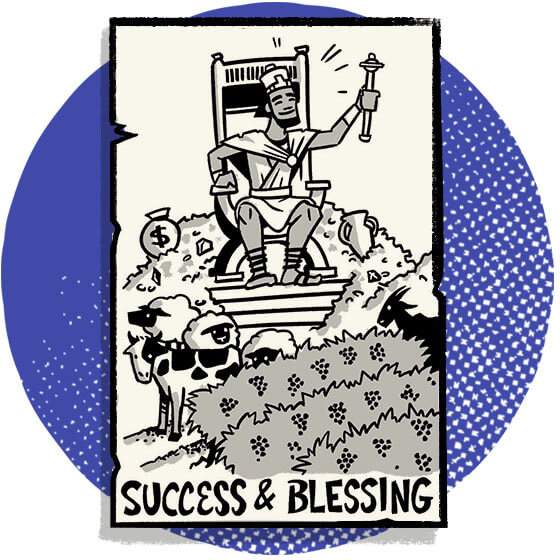
The world is full of His glory. It is a place of abundance and wealth. Under God’s rule and authority, we are meant to manage His creation and enjoy His blessings.
Union
Creation in Genesis is just the beginning of God’s ultimate plan for humanity. As it becomes clear as you walk through the story in the Bible, God’s design is our union with Him.
Just as God has always existed in three Persons in perfect union—Father, Son, and the Holy Spirit—as One, He desires us to be one with Him. In an intimate conversation with the Father, Jesus, in His last hours before His arrest and crucifixion, shares His prayer “that they may be one just as we are one—I in them and you in me—that they may be completely one.” (John 17:22b–23a)
This perfect union between God and man was first realized in the person of Jesus. Jesus is God Incarnate, the Word that became flesh, 100% divine and 100% human.
Even though Jesus is perfectly one with the Father, He remains the Second Person of the Holy Trinity. Similarly, we do not lose our individuality or identity in this union with God. Rather, we become all that we are designed to be. In a sense, we become truly human again.
In union with God, we are never lonely. We are fully known and embraced. We are one with God; so, we are fully alive because He is life. We are in the constant flow of love because He is love. We bask in the light of peace and joy because He is light.